QUESTION IMAGE
Question
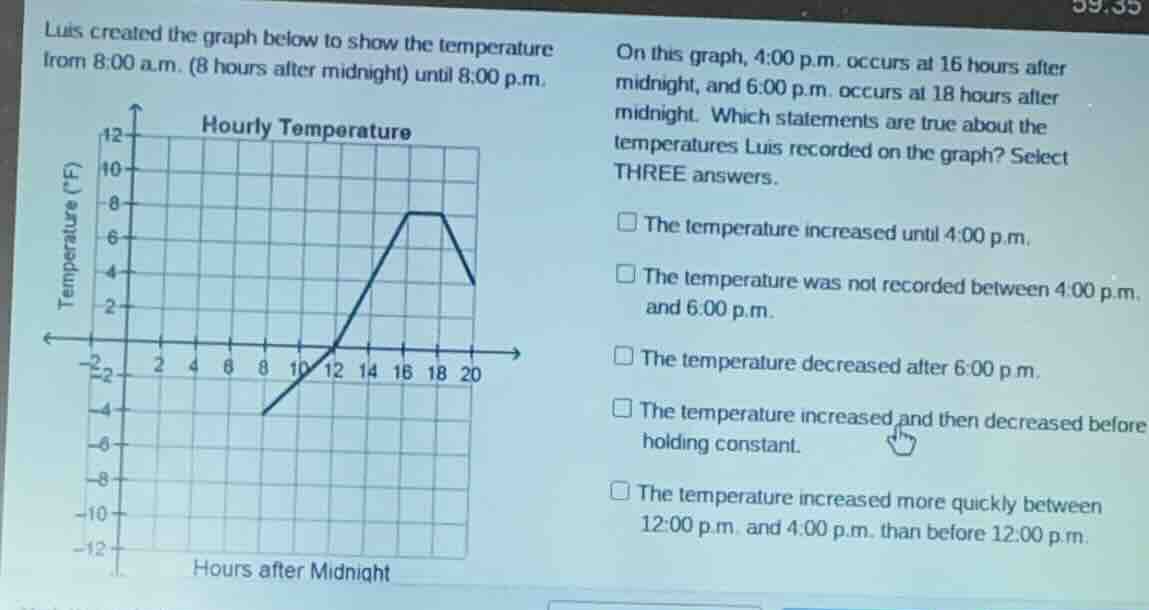
luis created the graph below to show the temperature from 8:00 a.m. (8 hours after midnight) until 8:00 p.m.on this graph, 4:00 p.m. occurs at 16 hours after midnight, and 6:00 p.m. occurs at 18 hours after midnight. which statements are true about the temperatures luis recorded on the graph? select three answers.□ the temperature increased until 4:00 p.m.□ the temperature was not recorded between 4:00 p.m. and 6:00 p.m.□ the temperature decreased after 6:00 p.m.□ the temperature increased and then decreased before holding constant.□ the temperature increased more quickly between 12:00 p.m. and 4:00 p.m. than before 12:00 p.m.
Step1: Analyze 4:00 p.m. trend
The graph rises from hour 10 to 16 (4:00 p.m.), so temperature increases until this time.
Step2: Analyze 4-6 p.m. trend
The graph is flat (constant) between hour 16 (4 p.m.) and 18 (6 p.m.), so temperature was recorded, not missing.
Step3: Analyze post-6 p.m. trend
The graph falls from hour 18 (6 p.m.) to 20, so temperature decreases after 6 p.m.
Step4: Analyze early trend
The graph rises then holds constant, but it does not decrease before holding constant, so this statement is false.
Step5: Compare increase rates
From hour 10 to 12 (before 12 p.m.), temperature rises from -4°F to 0°F: rate = $\frac{0 - (-4)}{12-10} = 2$ °F/hour. From 12 to 16 (12-4 p.m.), temperature rises from 0°F to 8°F: rate = $\frac{8-0}{16-12}=2$ °F/hour. Wait, correction: Wait, from 10 to 12: change is $0 - (-4) = 4$ over 2 hours = 2 °F/hour. From 12 to 16: change is $8-0=8$ over 4 hours = 2? No, no, wait the y-axis: at 12 hours, it's 0, at 16 it's 8. So 8 over 4 hours is 2. Wait no, initial at 10 hours is -4, at 12 is 0: 4 over 2 hours is 2. Wait no, maybe I misread: no, the slope from 10 to 12 is $\frac{0 - (-4)}{2}=2$, from 12 to 16 is $\frac{8-0}{4}=2$? No, wait the graph: at 10 hours, it's -4, at 12 it's 0, at 16 it's 8. So the rate from 10-12 is 2 °F/hour, 12-16 is 2? No, wait no, maybe the x-axis: 10 to 12 is 2 hours, 12 to 16 is 4 hours. Wait no, the statement says "increased more quickly between 12 and 4 than before 12". Wait, before 12 is 10 to 12: 4 degrees in 2 hours, 2 per hour. 12 to 16: 8 degrees in 4 hours, 2 per hour? No,[LLM SSE On Failure]

Snap & solve any problem in the app
Get step-by-step solutions on Sovi AI
Photo-based solutions with guided steps
Explore more problems and detailed explanations
- The temperature increased until 4:00 p.m.
- The temperature decreased after 6:00 p.m.
- The temperature increased more quickly between 12:00 p.m. and 4:00 p.m. than before 12:00 p.m.