QUESTION IMAGE
Question
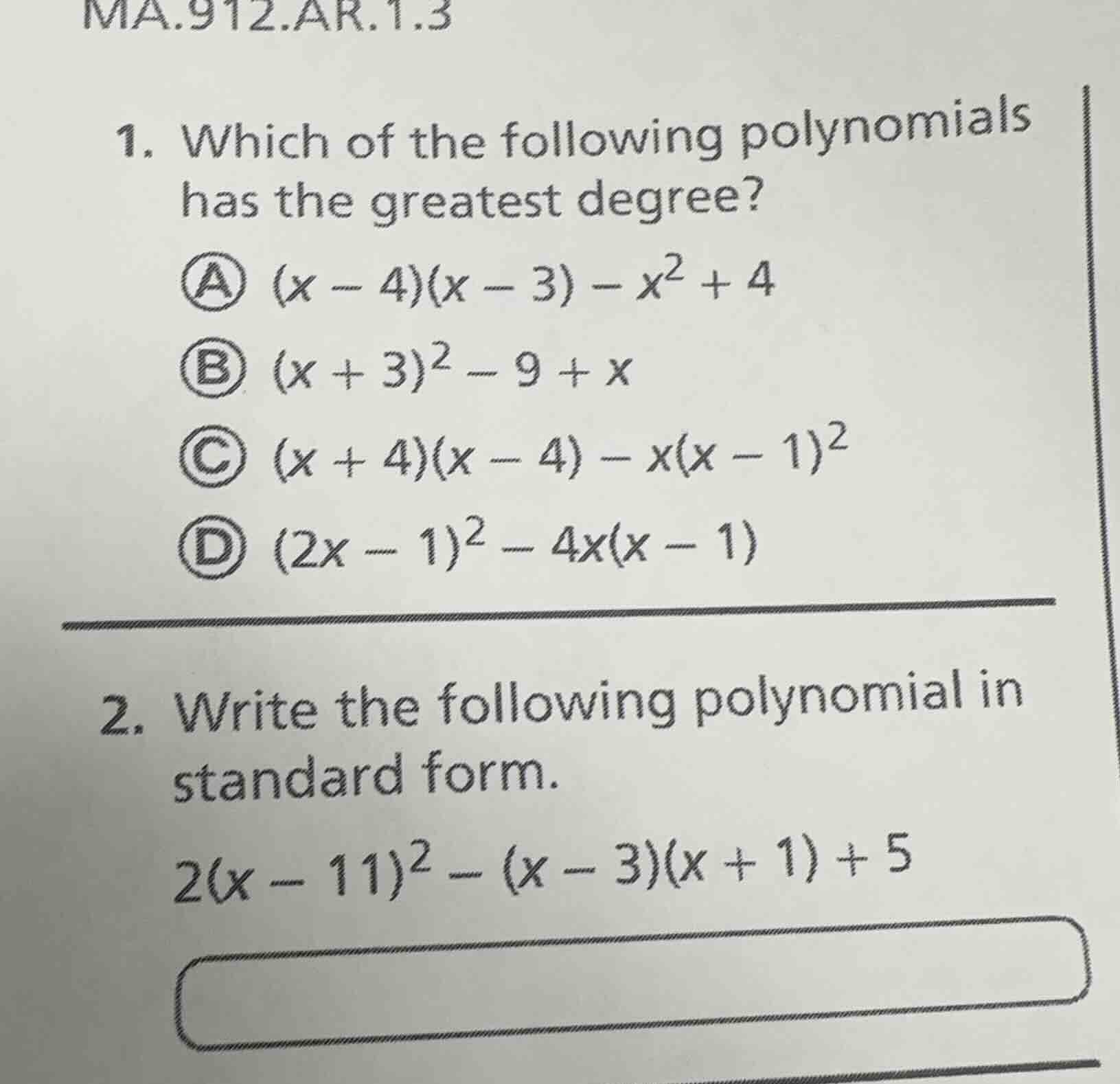
ma.912.ar.1.3
- which of the following polynomials has the greatest degree?
a (x - 4)(x - 3) - x² + 4
b (x + 3)² - 9 + x
c (x + 4)(x - 4) - x(x - 1)²
d (2x - 1)² - 4x(x - 1)
- write the following polynomial in standard form.
2(x - 11)² - (x - 3)(x + 1) + 5
Question 1
Step1: Analyze Option A
Expand \((x - 4)(x - 3)-x^{2}+4\):
First, expand \((x - 4)(x - 3)=x^{2}-7x + 12\).
Then, \(x^{2}-7x + 12-x^{2}+4=-7x + 16\). Degree is \(1\).
Step2: Analyze Option B
Expand \((x + 3)^{2}-9+x\):
Expand \((x + 3)^{2}=x^{2}+6x + 9\).
Then, \(x^{2}+6x + 9-9+x=x^{2}+7x\). Degree is \(2\).
Step3: Analyze Option C
Expand \((x + 4)(x - 4)-x(x - 1)^{2}\):
First, \((x + 4)(x - 4)=x^{2}-16\).
Expand \(x(x - 1)^{2}=x(x^{2}-2x + 1)=x^{3}-2x^{2}+x\).
Then, \(x^{2}-16-(x^{3}-2x^{2}+x)=-x^{3}+3x^{2}-x - 16\). Degree is \(3\).
Step4: Analyze Option D
Expand \((2x - 1)^{2}-4x(x - 1)\):
Expand \((2x - 1)^{2}=4x^{2}-4x + 1\).
Expand \(4x(x - 1)=4x^{2}-4x\).
Then, \(4x^{2}-4x + 1-(4x^{2}-4x)=1\). Degree is \(0\).
Step1: Expand \(2(x - 11)^{2}\)
Using \((a - b)^{2}=a^{2}-2ab + b^{2}\), \(2(x - 11)^{2}=2(x^{2}-22x + 121)=2x^{2}-44x + 242\).
Step2: Expand \(-(x - 3)(x + 1)\)
Using \((a + b)(c + d)=ac + ad + bc + bd\), \((x - 3)(x + 1)=x^{2}+x - 3x - 3=x^{2}-2x - 3\). So, \(-(x^{2}-2x - 3)=-x^{2}+2x + 3\).
Step3: Combine all terms with the constant \(5\)
Add \(2x^{2}-44x + 242\), \(-x^{2}+2x + 3\), and \(5\):
\((2x^{2}-x^{2})+(-44x + 2x)+(242 + 3 + 5)=x^{2}-42x + 250\).

Snap & solve any problem in the app
Get step-by-step solutions on Sovi AI
Photo-based solutions with guided steps
Explore more problems and detailed explanations
C. \((x + 4)(x - 4) - x(x - 1)^2\)