QUESTION IMAGE
Question
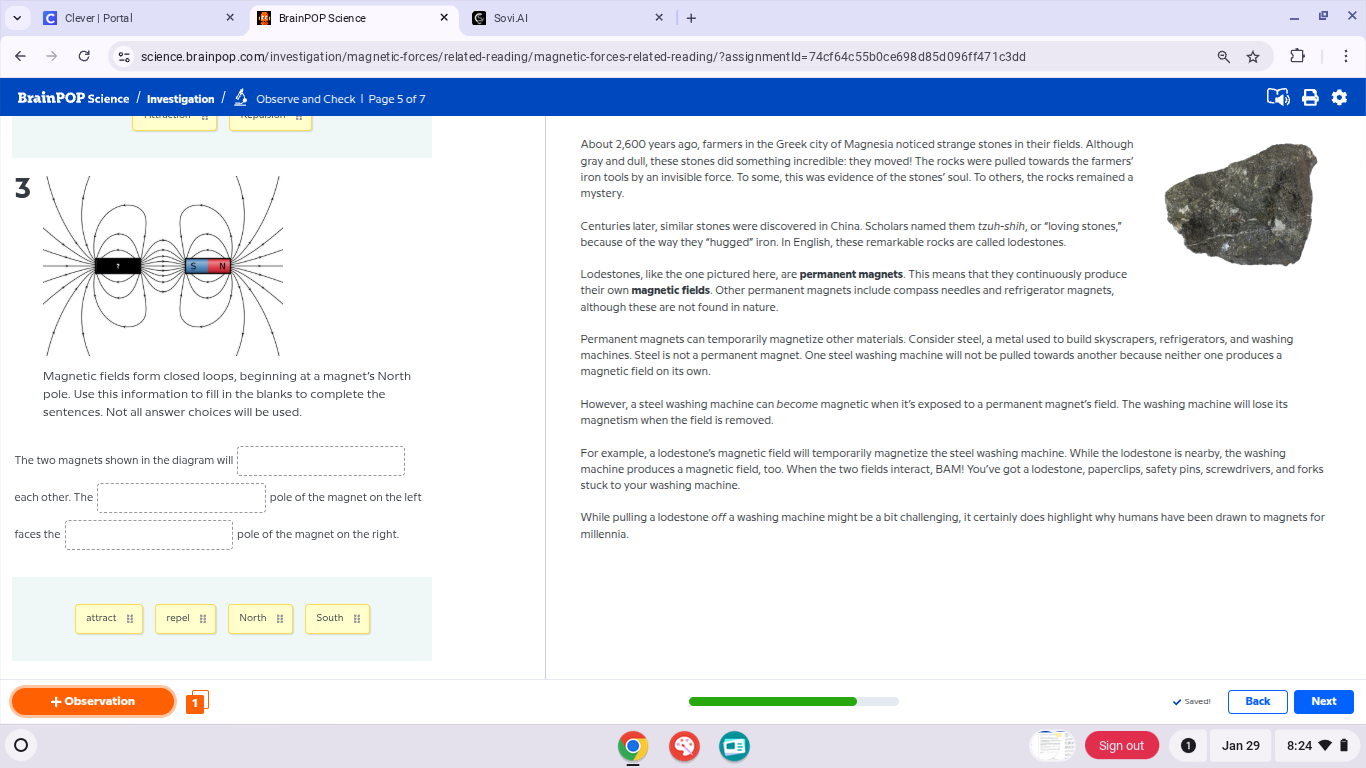
magnetic fields form closed loops, beginning at a magnet’s north pole. use this information to fill in the blanks to complete the sentences. not all answer choices will be used.
the two magnets shown in the diagram will
each other. the
pole of the magnet on the left
faces the
pole of the magnet on the right.
attract repel north south
about 2,600 years ago, farmers in the greek city of magnesia noticed strange stones in their fields. although gray and dull, these stones did something incredible: they moved! the rocks were pulled towards the farmers’ iron tools by an invisible force. to some, this was evidence of the stones’ soul. to others, the rocks remained a mystery.
centuries later, similar stones were discovered in china. scholars named them tzu-shih, or “loving stones,” because of the way they “hugged” iron. in english, these remarkable rocks are called lodestones.
lodestones, like the one pictured here, are permanent magnets. this means that they continuously produce their own magnetic fields. other permanent magnets include compass needles and refrigerator magnets, although these are not found in nature.
permanent magnets can temporarily magnetize other materials. consider steel, a metal used to build skyscrapers, refrigerators, and washing machines. steel is not a permanent magnet. one steel washing machine will not be pulled towards another because neither one produces a magnetic field on its own.
however, a steel washing machine can become magnetic when it’s exposed to a permanent magnet’s field. the washing machine will lose its magnetism when the field is removed.
for example, a lodestone’s magnetic field will temporarily magnetize the steel washing machine. while the lodestone is nearby, the washing machine produces a magnetic field, too. when the two fields interact, bam! you’ve got a lodestone, paperclips, safety pins, screwdrivers, and forks stuck to your washing machine.
while pulling a lodestone off a washing machine might be a bit challenging, it certainly does highlight why humans have been drawn to magnets for millennia.
To solve this, we analyze the magnetic field diagram and magnetic pole interactions:
Step 1: Determine the interaction between the two magnets
Magnetic field lines show the direction of the magnetic force. For two magnets, opposite poles (North - South or South - North) attract, and like poles (North - North or South - South) repel. In the diagram, the field lines between the two magnets are connecting, which indicates attraction (field lines go from North to South, so opposite poles are facing, leading to attraction). So the first blank: attract.
Step 2: Identify the left magnet’s pole facing the right magnet
The right magnet has a labeled “S” (South) and “N” (North) with the left - facing pole being “S” (South)? Wait, no—wait, the right magnet’s left - most pole is “S” (from the diagram: S - N on the right magnet). Wait, no, let's re - examine: the right magnet is labeled S (left) and N (right). The left magnet’s right - facing pole: in magnetic fields, field lines start at North and end at South. The field lines from the left magnet are going towards the right magnet’s left pole (which is S). So the left magnet’s right - facing pole must be North? Wait, no—wait, the right magnet’s left pole is S (South). So the left magnet’s pole facing the right magnet’s S pole must be North? Wait, no, opposite poles attract. So if the right magnet’s left pole is S (South), the left magnet’s right pole must be N (North)? Wait, no—wait, the right magnet is S (left) and N (right). The left magnet: let's see the field lines. The field lines of the left magnet are going towards its right pole, and the right magnet’s left pole (S) is receiving field lines. Wait, maybe I got it reversed. Wait, magnetic field lines go from North to South outside the magnet. So the left magnet’s right pole: if the field lines are going from the left magnet’s right pole towards the right magnet’s left pole (S), then the left magnet’s right pole is N (North), because field lines start at North. Wait, no—field lines start at North pole and end at South pole. So the left magnet’s right pole: the field lines are coming out? No, in the diagram, the field lines between the two magnets are connecting, so the left magnet’s right pole and the right magnet’s left pole are opposite. The right magnet’s left pole is S (from the diagram: S - N on the right). So the left magnet’s right pole must be N? Wait, no—opposite poles attract: North and South attract. So if the right magnet’s left pole is S (South), the left magnet’s right pole must be N (North)? Wait, no, South and North attract. So the left magnet’s right pole is N (North), and the right magnet’s left pole is S (South). Wait, but the options are North, South, attract, repel. Wait, the second blank: the pole of the left magnet facing the right magnet. The right magnet’s left pole is S (South), so the left magnet’s pole facing it is N (North)? Wait, no—wait, maybe the left magnet’s right pole is South? No, that can't be. Wait, let's re - read the hint: “Magnetic fields form closed loops, beginning at a magnet’s North pole.” So the left magnet’s field lines start at its North pole and end at its South pole. The field lines between the two magnets are going from the left magnet’s right pole to the right magnet’s left pole. So the left magnet’s right pole is North (since field lines start at North), and the right magnet’s left pole is South (since field lines end at South). So the left magnet’s pole (right - facing) is North? Wait, no—wait, the right magnet’s left pole is S (South). So the left magnet’s right pole is N…

Snap & solve any problem in the app
Get step-by-step solutions on Sovi AI
Photo-based solutions with guided steps
Explore more problems and detailed explanations
To solve this, we analyze the magnetic field diagram and magnetic pole interactions:
Step 1: Determine the interaction between the two magnets
Magnetic field lines show the direction of the magnetic force. For two magnets, opposite poles (North - South or South - North) attract, and like poles (North - North or South - South) repel. In the diagram, the field lines between the two magnets are connecting, which indicates attraction (field lines go from North to South, so opposite poles are facing, leading to attraction). So the first blank: attract.
Step 2: Identify the left magnet’s pole facing the right magnet
The right magnet has a labeled “S” (South) and “N” (North) with the left - facing pole being “S” (South)? Wait, no—wait, the right magnet’s left - most pole is “S” (from the diagram: S - N on the right magnet). Wait, no, let's re - examine: the right magnet is labeled S (left) and N (right). The left magnet’s right - facing pole: in magnetic fields, field lines start at North and end at South. The field lines from the left magnet are going towards the right magnet’s left pole (which is S). So the left magnet’s right - facing pole must be North? Wait, no—wait, the right magnet’s left pole is S (South). So the left magnet’s pole facing the right magnet’s S pole must be North? Wait, no, opposite poles attract. So if the right magnet’s left pole is S (South), the left magnet’s right pole must be N (North)? Wait, no—wait, the right magnet is S (left) and N (right). The left magnet: let's see the field lines. The field lines of the left magnet are going towards its right pole, and the right magnet’s left pole (S) is receiving field lines. Wait, maybe I got it reversed. Wait, magnetic field lines go from North to South outside the magnet. So the left magnet’s right pole: if the field lines are going from the left magnet’s right pole towards the right magnet’s left pole (S), then the left magnet’s right pole is N (North), because field lines start at North. Wait, no—field lines start at North pole and end at South pole. So the left magnet’s right pole: the field lines are coming out? No, in the diagram, the field lines between the two magnets are connecting, so the left magnet’s right pole and the right magnet’s left pole are opposite. The right magnet’s left pole is S (from the diagram: S - N on the right). So the left magnet’s right pole must be N? Wait, no—opposite poles attract: North and South attract. So if the right magnet’s left pole is S (South), the left magnet’s right pole must be N (North)? Wait, no, South and North attract. So the left magnet’s right pole is N (North), and the right magnet’s left pole is S (South). Wait, but the options are North, South, attract, repel. Wait, the second blank: the pole of the left magnet facing the right magnet. The right magnet’s left pole is S (South), so the left magnet’s pole facing it is N (North)? Wait, no—wait, maybe the left magnet’s right pole is South? No, that can't be. Wait, let's re - read the hint: “Magnetic fields form closed loops, beginning at a magnet’s North pole.” So the left magnet’s field lines start at its North pole and end at its South pole. The field lines between the two magnets are going from the left magnet’s right pole to the right magnet’s left pole. So the left magnet’s right pole is North (since field lines start at North), and the right magnet’s left pole is South (since field lines end at South). So the left magnet’s pole (right - facing) is North? Wait, no—wait, the right magnet’s left pole is S (South). So the left magnet’s right pole is N (North) (opposite pole, so they attract). Then the third blank: the right magnet’s left pole is S (South), so the left magnet’s right pole (North) faces the right magnet’s left pole (South). Wait, no—wait, the right magnet’s left pole is S (South), so the left magnet’s right pole is N (North), so the left magnet’s pole facing the right magnet is North, and the right magnet’s pole being faced is South. Wait, let's check the options. The options are attract, repel, North, South.
So:
- The two magnets will attract (opposite poles, field lines connecting).
- The pole of the left magnet facing the right: since the right magnet’s left pole is S (South), the left magnet’s pole facing it is N (North) (because North and South attract).
- The pole of the right magnet being faced: South (since the left magnet’s North pole is facing the right magnet’s South pole).
Final Answers (filling the blanks):
- The two magnets shown in the diagram will $\boldsymbol{\text{attract}}$ each other.
- The $\boldsymbol{\text{North}}$ pole of the magnet on the left faces the $\boldsymbol{\text{South}}$ pole of the magnet on the right.