QUESTION IMAGE
Question
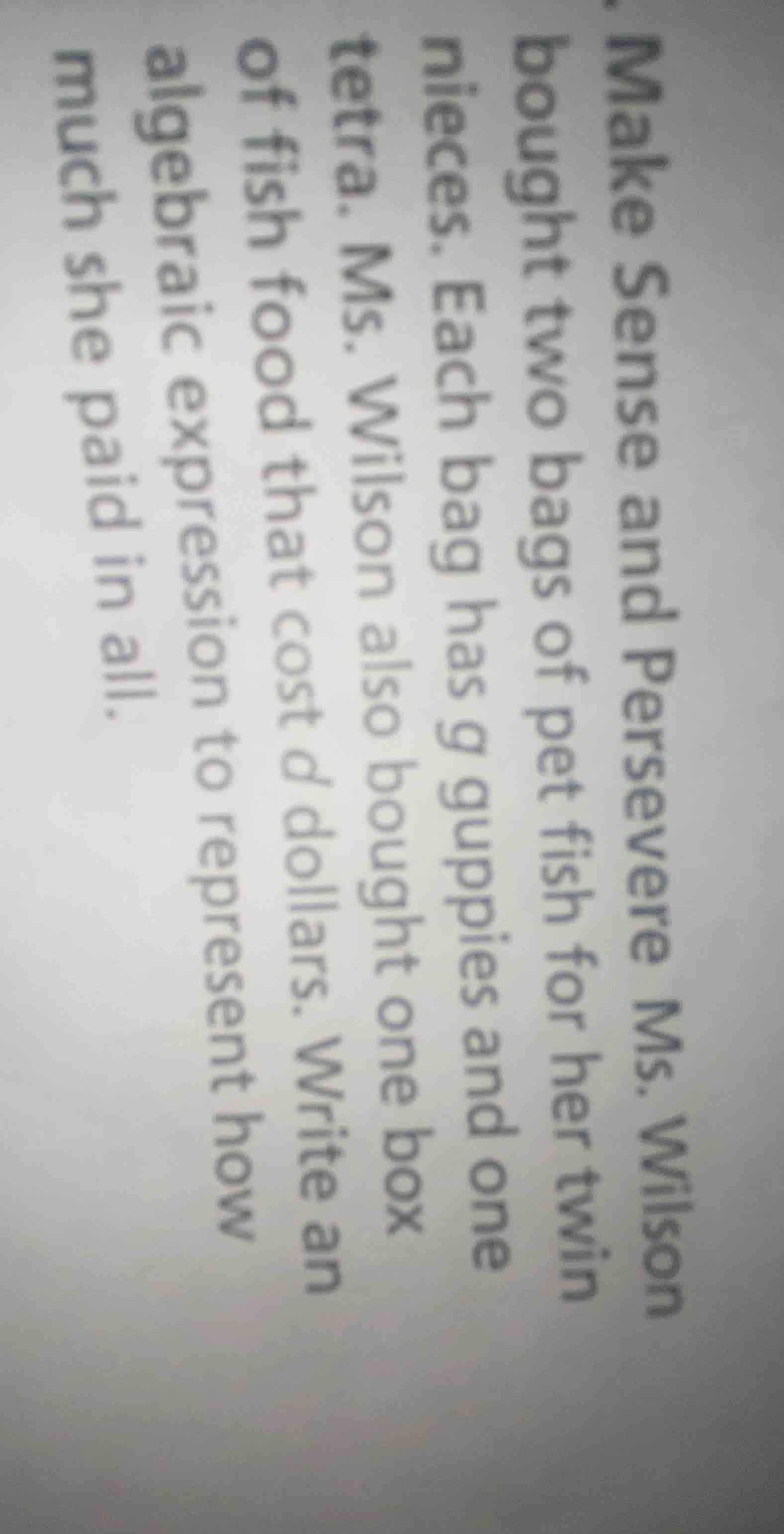
make sense and persevere ms. wilson bought two bags of pet fish for her twin nieces. each bag has g guppies and one tetra. ms. wilson also bought one box of fish food that cost d dollars. write an algebraic expression to represent how much she paid in all.
Step1: Analyze the cost of pet fish bags
Ms. Wilson bought 2 bags of pet fish. Let's assume each bag of pet fish costs \( x \) dollars (we need to know the cost per bag, but since it's not given, maybe we missed some info? Wait, maybe the problem has a typo or missing details. Wait, re-reading: "each bag has g guppies and one tetra" – no, the cost part: "one box of fish food that cost d dollars". Wait, maybe the pet fish bags: let's assume each bag of pet fish costs, say, let's check again. Wait, the problem says "Ms. Wilson bought two bags of pet fish for her twin nieces. Each bag has g guppies and one tetra. Ms. Wilson also bought one box of fish food that cost d dollars. Write an algebraic expression to represent how much she paid in all." Wait, we need the cost per bag of pet fish. Since it's not given, maybe it's a variable, say each bag costs \( b \) dollars? Then total cost would be cost of 2 bags + cost of fish food.
Wait, maybe the problem had a missing part, like each bag of pet fish costs, say, let's assume the cost per bag is, for example, if we assume each bag costs \( c \) dollars, then total cost is \( 2c + d \). But since the problem is about writing an algebraic expression, maybe the cost per bag is a variable, say \( b \), so total cost is \( 2b + d \). But maybe the problem intended that the number of fish doesn't affect the cost (since it's about payment, not quantity of fish), so we need to represent the total cost as the sum of the cost of 2 bags of pet fish and 1 box of fish food.
Step2: Define variables
Let \( b \) be the cost of one bag of pet fish (in dollars), and \( d \) be the cost of one box of fish food (in dollars).
Step3: Calculate total cost
The cost of 2 bags of pet fish is \( 2 \times b = 2b \) dollars. The cost of the fish food is \( d \) dollars. So the total amount she paid is the sum of these two costs: \( 2b + d \).
But wait, maybe the problem had a typo and the cost per bag is related to the number of fish? No, the question is about how much she paid, so it's about the cost of the items, not the number of fish (since the number of fish is about quantity, not cost, unless each fish has a cost, but the problem says "bags of pet fish", so the bag is a single item with a cost.
Assuming each bag of pet fish costs \( b \) dollars, then total cost is \( 2b + d \).

Snap & solve any problem in the app
Get step-by-step solutions on Sovi AI
Photo-based solutions with guided steps
Explore more problems and detailed explanations
If we let \( b \) be the cost of one bag of pet fish (in dollars) and \( d \) be the cost of one box of fish food (in dollars), the algebraic expression for the total amount Ms. Wilson paid is \( 2b + d \).
(Note: If there was a missing value for the cost per bag, maybe the problem intended the cost per bag to be, for example, if each bag costs, say, \( x \) dollars, but since it's not given, we use a variable. Alternatively, maybe the number of fish was a red herring, and we just need to sum the cost of 2 bags (with unknown cost per bag) and 1 box (cost \( d \)).)