QUESTION IMAGE
Question
making measurements
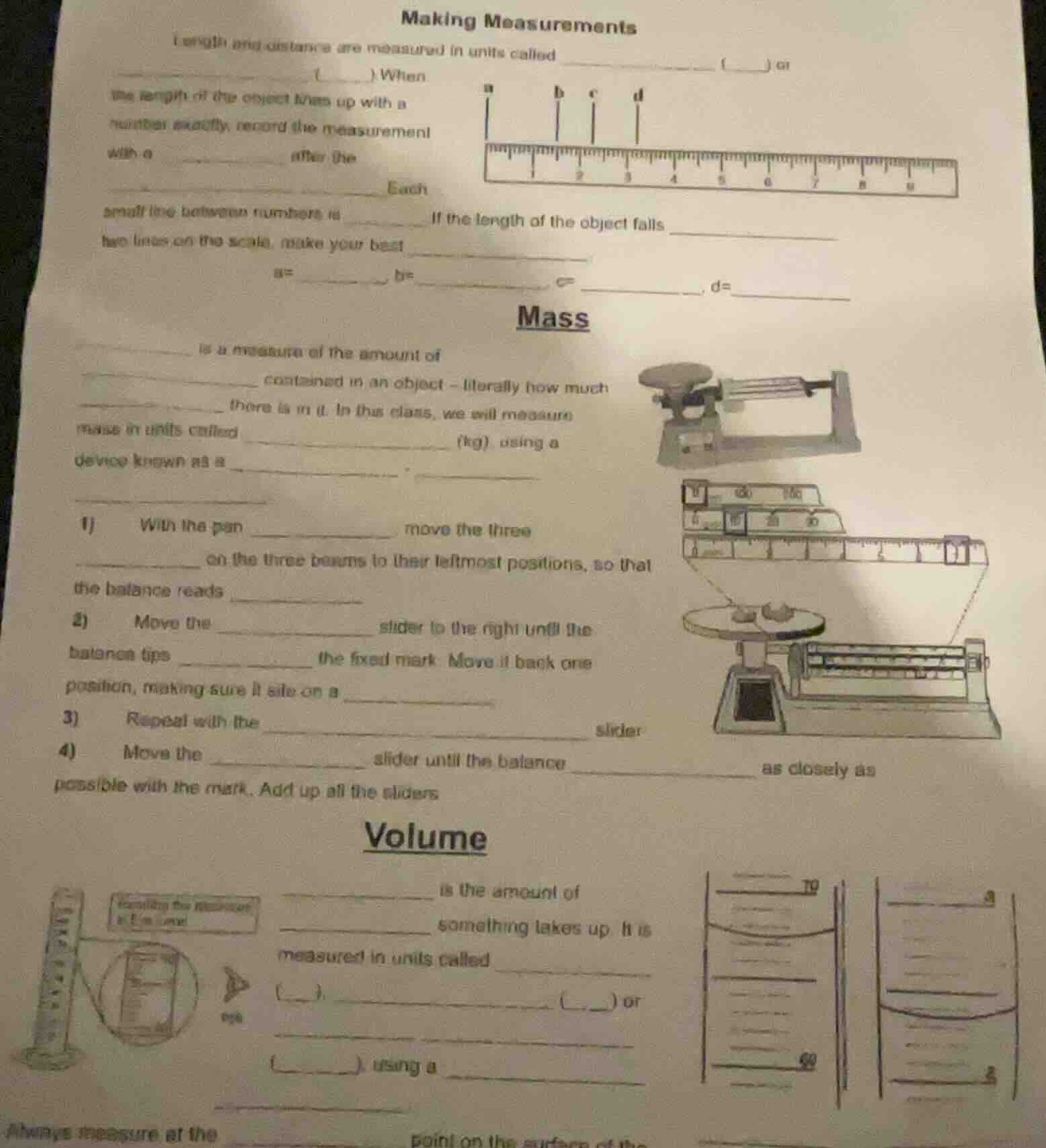
length and distance are measured in units called ____ () or __ (__). when
the length of the object lines up with a
number exactly, record the measurement
with a ____ after the ____. each
small line between numbers is ____. if the length of the object falls ____
two lines on the scale, make your best ______.
a= ____, b= __, c= __, d= ____
mass
______ is a measure of the amount of
______ contained in an object – literally how much
______ there is in it. in this class, we will measure
mass in units called ______ (kg) using a
device known as a ______.
- with the pan ______, move the three
______ on the three beams to their leftmost positions, so that
the balance reads ______.
- move the ______ slider to the right until the
balance tips ______ the fixed mark. move it back one
position, making sure it sits on a ______.
- repeat with the ______ slider.
- move the ____ slider until the balance ____ as closely as
possible with the mark. add up all the sliders.
volume
______ is the amount of
______ something takes up. it is
measured in units called ______
(__), __ (__) or
____ () using a ____.
always measure at the ____ point on the surface of the ____
Step1: Fill length measurement blanks
Length and distance are measured in units called meters (m) or centimeters (cm). When the length of the object lines up with a number exactly, record the measurement with a decimal point after the number. Each small line between numbers is 1 millimeter (0.1 cm). If the length of the object falls between two lines on the scale, make your best estimate.
- a: $0.0\ \text{cm}$
- b: $1.0\ \text{cm}$
- c: $2.0\ \text{cm}$
- d: $3.0\ \text{cm}$
Step2: Fill mass measurement blanks
Mass is a measure of the amount of matter contained in an object - literally how much "stuff" there is in it. In this class, we will measure mass in units called kilograms (kg) or grams (g), using a device known as a triple beam balance.
- With the pan empty, move the three sliders on the three beams to their leftmost positions, so that the balance reads 0.
- Move the largest (100g) slider to the right until the balance tips below the fixed mark. Move it back one position, making sure it sits on a notch.
- Repeat with the middle (10g) slider
- Move the smallest (1g) slider until the balance lines up as closely as possible with the mark. Add up all the sliders
Step3: Fill volume measurement blanks
Volume is the amount of space something takes up. It is measured in units called liters (L), milliliters (mL) or cubic centimeters ($\text{cm}^3$), using a graduated cylinder.
Always measure at the bottom (meniscus) point on the surface of the liquid.

Snap & solve any problem in the app
Get step-by-step solutions on Sovi AI
Photo-based solutions with guided steps
Explore more problems and detailed explanations
Making Measurements
Length and distance are measured in units called meters (m) or centimeters (cm). When the length of the object lines up with a number exactly, record the measurement with a decimal point after the number. Each small line between numbers is 1 millimeter (0.1 cm). If the length of the object falls between two lines on the scale, make your best estimate.
- a: $0.0\ \text{cm}$
- b: $1.0\ \text{cm}$
- c: $2.0\ \text{cm}$
- d: $3.0\ \text{cm}$
Mass
Mass is a measure of the amount of matter contained in an object - literally how much "stuff" there is in it. In this class, we will measure mass in units called kilograms (kg) (or grams), using a device known as a triple beam balance.
- With the pan empty, move the three sliders on the three beams to their leftmost positions, so that the balance reads 0.
- Move the largest (100g) slider to the right until the balance tips below the fixed mark. Move it back one position, making sure it sits on a notch.
- Repeat with the middle (10g) slider
- Move the smallest (1g) slider until the balance lines up as closely as possible with the mark. Add up all the sliders
Volume
Volume is the amount of space something takes up. It is measured in units called liters (L), milliliters (mL) or cubic centimeters ($\text{cm}^3$), using a graduated cylinder.
Always measure at the bottom (meniscus) point on the surface of the liquid.