QUESTION IMAGE
Question
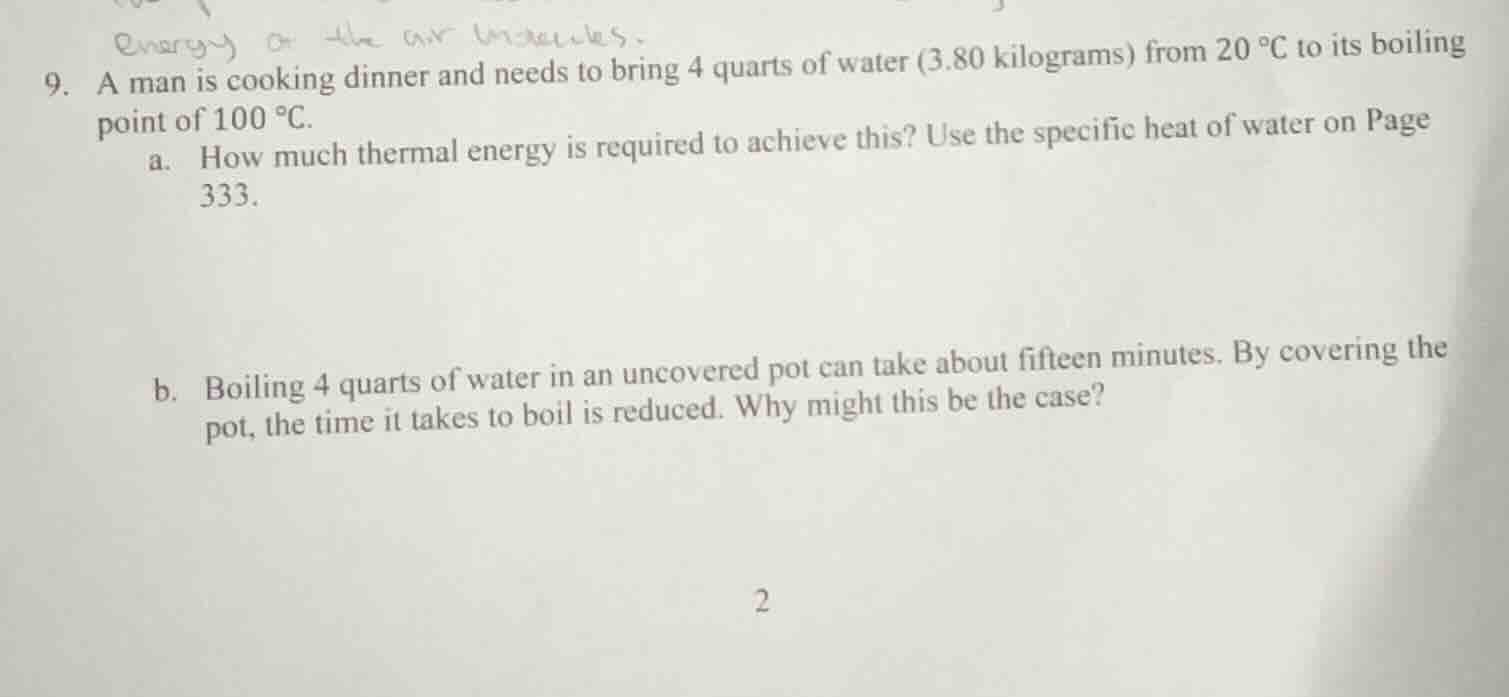
- a man is cooking dinner and needs to bring 4 quarts of water (3.80 kilograms) from 20 °c to its boiling point of 100 °c.
a. how much thermal energy is required to achieve this? use the specific heat of water on page 333.
b. boiling 4 quarts of water in an uncovered pot can take about fifteen minutes. by covering the pot, the time it takes to boil is reduced. why might this be the case?
Part a (Step-by-Step Format)
Step1: Recall heat energy formula
The formula for thermal energy required to change temperature is $Q = mc\Delta T$, where $m$ = mass, $c$ = specific heat of water, $\Delta T$ = temperature change.
Step2: Define known values
$m = 3.80\ \text{kg}$, $c = 4186\ \text{J/(kg·°C)}$ (standard specific heat of water), $\Delta T = 100^\circ\text{C} - 20^\circ\text{C} = 80^\circ\text{C}$
Step3: Substitute values into formula
$Q = 3.80\ \text{kg} \times 4186\ \text{J/(kg·°C)} \times 80^\circ\text{C}$
Step4: Calculate the result
First compute $4186 \times 80 = 334880$, then $3.80 \times 334880 = 1272544$
Covering the pot traps water vapor, which increases the air pressure above the water. Higher pressure raises the boiling point slightly, but more importantly, the lid prevents heat loss from evaporative cooling and radiant/ convective heat escape from the water's surface. This retains more thermal energy in the water, allowing it to reach boiling temperature faster.

Snap & solve any problem in the app
Get step-by-step solutions on Sovi AI
Photo-based solutions with guided steps
Explore more problems and detailed explanations
$1.27 \times 10^6\ \text{J}$ (or 1272544 J)
---