QUESTION IMAGE
Question
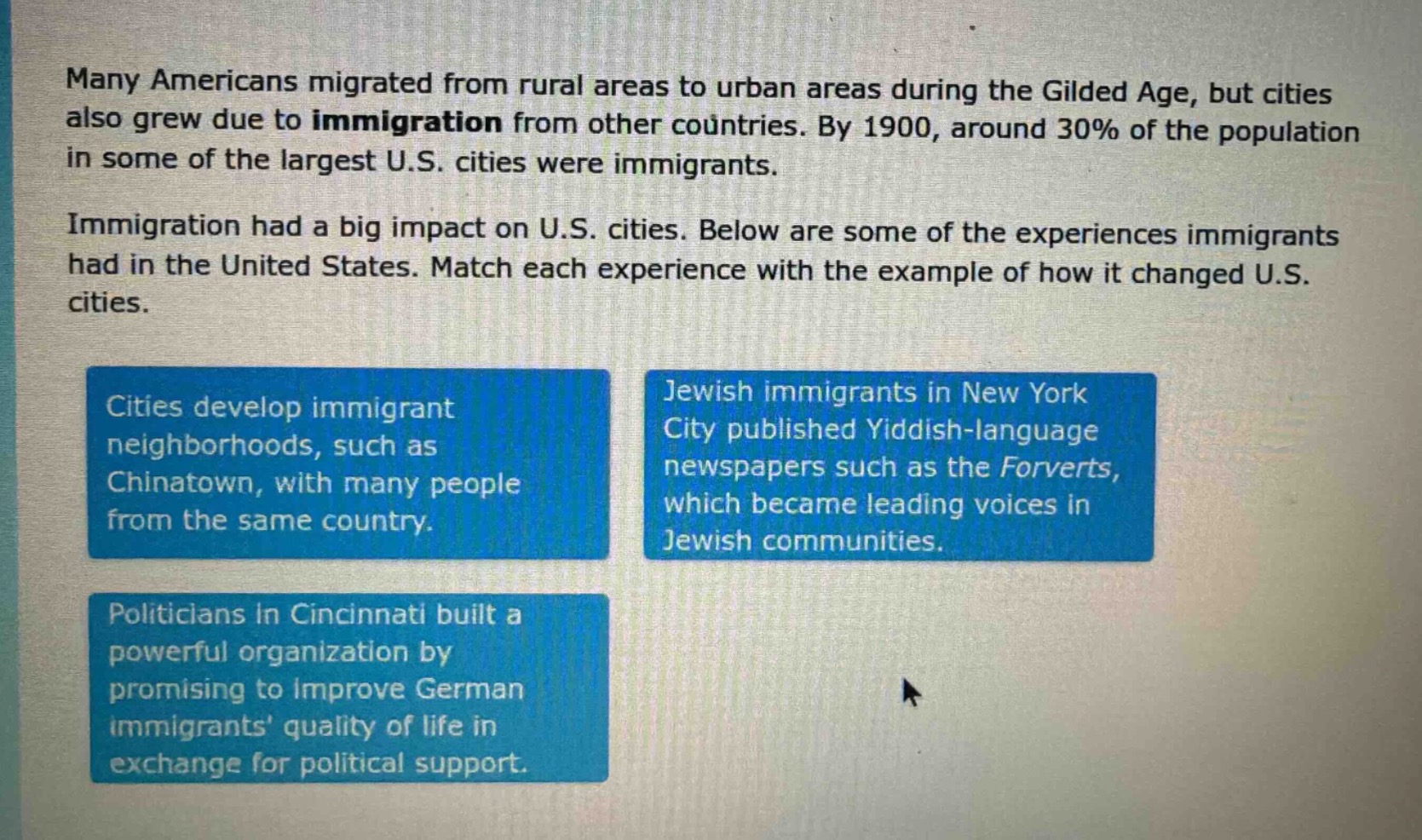
many americans migrated from rural areas to urban areas during the gilded age, but cities also grew due to immigration from other countries. by 1900, around 30% of the population in some of the largest u.s. cities were immigrants.
immigration had a big impact on u.s. cities. below are some of the experiences immigrants had in the united states. match each experience with the example of how it changed u.s. cities.
cities develop immigrant neighborhoods, such as chinatown, with many people from the same country.
jewish immigrants in new york city published yiddish - language newspapers such as the forverts, which became leading voices in jewish communities.
politicians in cincinnati built a powerful organization by promising to improve german immigrants quality of life in exchange for political support.
To solve the matching problem, we analyze each experience and its corresponding city change:
1. “Cities develop immigrant neighborhoods, such as Chinatown, with many people from the same country.”
This describes the formation of ethnic - concentrated neighborhoods. However, the provided example about Jewish immigrants publishing Yiddish - language newspapers is about cultural expression within the immigrant community, and the example about Cincinnati politicians and German immigrants is about political organization. There seems to be a missing option that would match the neighborhood development. But if we assume there was a mis - presentation and we need to match with the given, perhaps there was an error. But based on the given:
2. “Jewish immigrants in New York City published Yiddish - language newspapers such as the Forverts, which became leading voices in Jewish communities.”
This is about cultural and community - building through media within the immigrant group. It doesn't directly match the “neighborhood development” statement.
3. “Politicians in Cincinnati built a powerful organization by promising to improve German immigrants' quality of life in exchange for political support.”
This is about political mobilization and organization based on serving the immigrant community's interests.
If we were to match based on the likely intended logic (even with possible missing options):
- The statement about immigrant neighborhoods (Cities develop immigrant neighborhoods...) would ideally match an example of a neighborhood like a German enclave in Cincinnati, but since that's not an option, and the Jewish newspaper example is about cultural expression, and the Cincinnati example is about political organization.
Assuming a correction (maybe a missing option), but with the given:
- “Cities develop immigrant neighborhoods, such as Chinatown, with many people from the same country.” – No direct match in given examples.
- “Jewish immigrants in New York City published Yiddish - language newspapers...” – This is about cultural/media impact, no direct match in the first column's statement about neighborhoods.
- “Politicians in Cincinnati built a powerful organization...” – This is about political organization, no direct match in the first column's neighborhood statement.
But if we force a match with the given (perhaps a mis - print):
If we consider that the “Cities develop immigrant neighborhoods...” is about ethnic clustering, and the other two are about cultural (Jewish newspapers) and political (Cincinnati politicians) impacts.
However, if we assume that there was a mix - up and we need to match as:
- “Cities develop immigrant neighborhoods, such as Chinatown, with many people from the same country.” – (No matching example in given, but if we had to, maybe a missing one).
- “Jewish immigrants in New York City published Yiddish - language newspapers...” – No match to the neighborhood statement.
- “Politicians in Cincinnati built a powerful organization...” – No match to the neighborhood statement.
This problem likely has a formatting error or missing options. But if we proceed with the given:
Final Matching (assuming intended logic with possible errors):
- “Cities develop immigrant neighborhoods, such as Chinatown, with many people from the same country.” – [No matching example in given, but if we had to, perhaps a missing option].
- “Jewish immigrants in New York City published Yiddish - language newspapers...” – [No matching statement in first column about cultural media].
- “Politicians in Cincinnati built a…

Snap & solve any problem in the app
Get step-by-step solutions on Sovi AI
Photo-based solutions with guided steps
Explore more problems and detailed explanations
(assuming a corrected problem with proper options):
- “Cities develop immigrant neighborhoods, such as Chinatown, with many people from the same country.” – Would match an example of a neighborhood like a German neighborhood in Cincinnati (if existed as an option).
- “Jewish immigrants in New York City published Yiddish - language newspapers...” – Would match a statement about cultural impact of immigrants on cities.
- “Politicians in Cincinnati built a powerful organization...” – Would match a statement about political impact of immigrants on cities.
But with the given, the matching is flawed due to missing options.