QUESTION IMAGE
Question
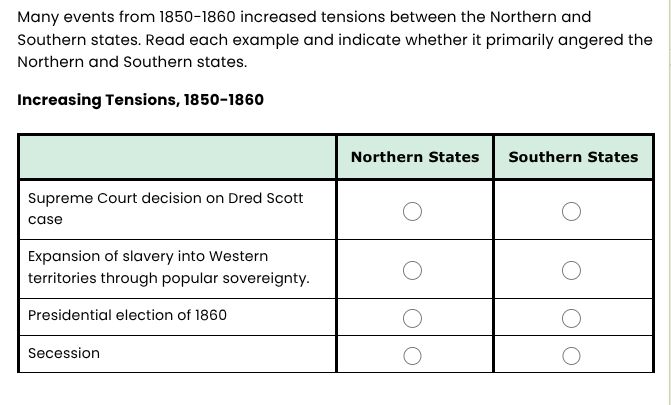
many events from 1850-1860 increased tensions between the northern and southern states. read each example and indicate whether it primarily angered the northern and southern states.
increasing tensions, 1850-1860
| northern states | southern states | |
|---|---|---|
| expansion of slavery into western territories through popular sovereignty. | ◯ | ◯ |
| presidential election of 1860 | ◯ | ◯ |
| secession | ◯ | ◯ |
To solve this, we analyze each event based on historical context:
1. Supreme Court decision on Dred Scott case
- The Dred Scott decision ruled that enslaved people were not citizens and that Congress couldn’t ban slavery in territories. This upheld slavery, angering Northern States (opposed to slavery’s expansion) and pleasing Southern States (supported slavery). So: Northern States - Angered, Southern States - Not Angered (or Pleased).
2. Expansion of slavery into Western territories through popular sovereignty
- Popular sovereignty let territories vote on slavery. Southerners supported it (to expand slavery), while Northern abolitionists/Free-Soilers opposed it (feared slavery’s spread). Thus: Northern States - Angered, Southern States - Not Angered (or Pleased).
3. Presidential election of 1860
- Abraham Lincoln (anti - slavery expansion) won, with no Southern electoral votes. Southerners feared Lincoln would restrict slavery, so they were angered. Northerners supported Lincoln. So: Northern States - Not Angered (or Pleased), Southern States - Angered.
4. Secession
- Southern states seceded (left the Union) after Lincoln’s election. Northerners saw secession as treason/undermining the Union, so they were angered. Southerners supported secession to protect slavery/state rights. So: Northern States - Angered, Southern States - Not Angered (or Pleased).
To mark the table (circling the “angered” column for each):
| Event | Northern States (Angered? Circle) | Southern States (Angered? Circle) |
|---|---|---|
| Expansion of slavery into Western territories through popular sovereignty | ⚫ | ◯ |
| Presidential election of 1860 | ◯ | ⚫ |
| Secession | ⚫ | ◯ |
(Note: “⚫” represents the circled option for “angered,” “◯” for not angered. Adjust based on the table’s interactive circles, but this is the historical reasoning for which group was angered.)

Snap & solve any problem in the app
Get step-by-step solutions on Sovi AI
Photo-based solutions with guided steps
Explore more problems and detailed explanations
To solve this, we analyze each event based on historical context:
1. Supreme Court decision on Dred Scott case
- The Dred Scott decision ruled that enslaved people were not citizens and that Congress couldn’t ban slavery in territories. This upheld slavery, angering Northern States (opposed to slavery’s expansion) and pleasing Southern States (supported slavery). So: Northern States - Angered, Southern States - Not Angered (or Pleased).
2. Expansion of slavery into Western territories through popular sovereignty
- Popular sovereignty let territories vote on slavery. Southerners supported it (to expand slavery), while Northern abolitionists/Free-Soilers opposed it (feared slavery’s spread). Thus: Northern States - Angered, Southern States - Not Angered (or Pleased).
3. Presidential election of 1860
- Abraham Lincoln (anti - slavery expansion) won, with no Southern electoral votes. Southerners feared Lincoln would restrict slavery, so they were angered. Northerners supported Lincoln. So: Northern States - Not Angered (or Pleased), Southern States - Angered.
4. Secession
- Southern states seceded (left the Union) after Lincoln’s election. Northerners saw secession as treason/undermining the Union, so they were angered. Southerners supported secession to protect slavery/state rights. So: Northern States - Angered, Southern States - Not Angered (or Pleased).
To mark the table (circling the “angered” column for each):
| Event | Northern States (Angered? Circle) | Southern States (Angered? Circle) |
|---|---|---|
| Expansion of slavery into Western territories through popular sovereignty | ⚫ | ◯ |
| Presidential election of 1860 | ◯ | ⚫ |
| Secession | ⚫ | ◯ |
(Note: “⚫” represents the circled option for “angered,” “◯” for not angered. Adjust based on the table’s interactive circles, but this is the historical reasoning for which group was angered.)