QUESTION IMAGE
Question
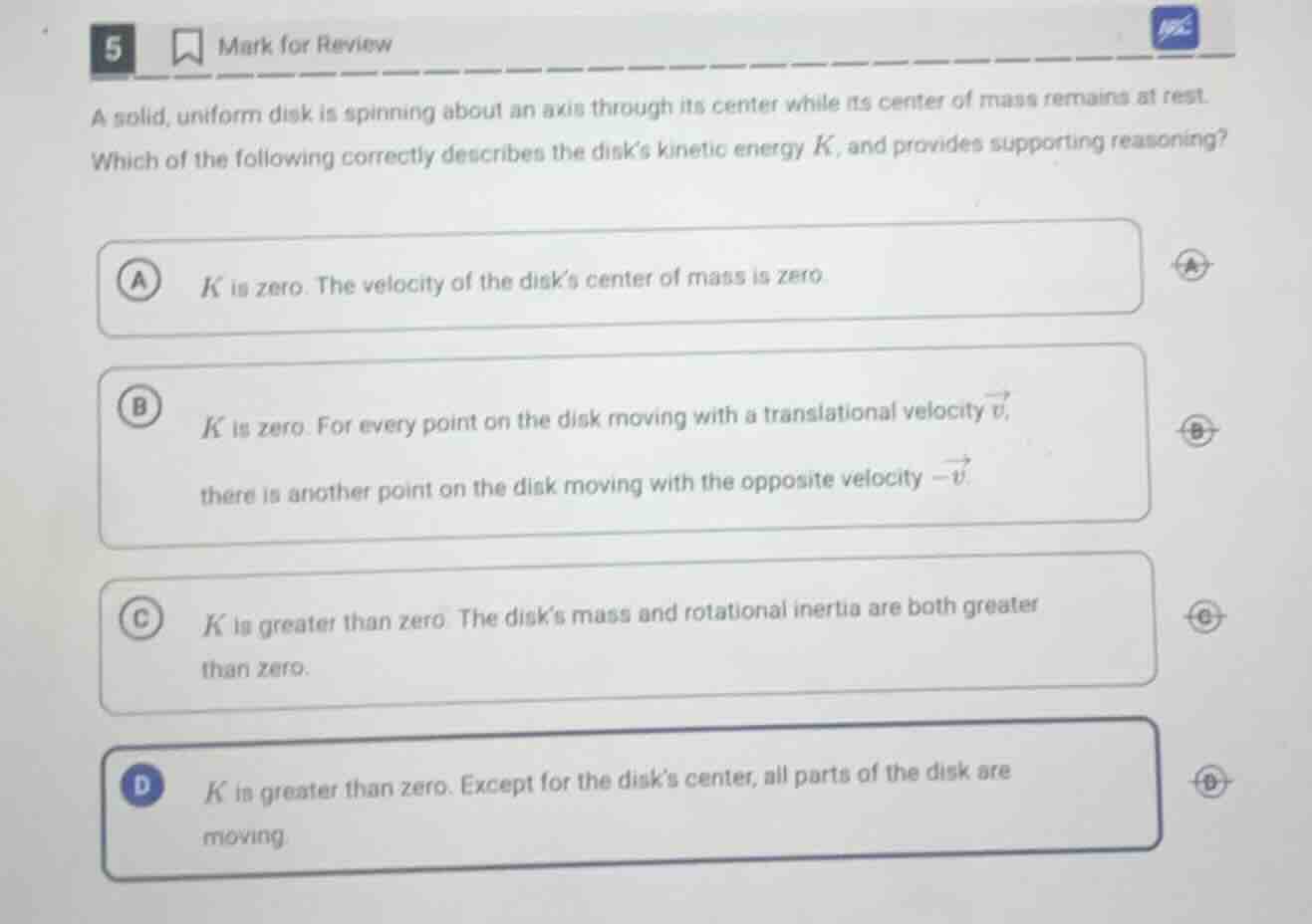
5 mark for review a solid, uniform disk is spinning about an axis through its center while its center of mass remains at rest. which of the following correctly describes the disk’s kinetic energy ( k ), and provides supporting reasoning? a ( k ) is zero. the velocity of the disk’s center of mass is zero. b ( k ) is zero. for every point on the disk moving with a translational velocity ( vec{v} ), there is another point on the disk moving with the opposite velocity ( -vec{v} ). c ( k ) is greater than zero. the disk’s mass and rotational inertia are both greater than zero. d ( k ) is greater than zero. except for the disk’s center, all parts of the disk are moving.
Kinetic energy for a rotating object (with no translational motion of the center of mass) comes from rotational kinetic energy. Rotational kinetic energy depends on the rotational inertia and angular velocity of the object. All points on the disk except the center are moving tangentially, so they have non-zero translational kinetic energy that sums to a positive total rotational kinetic energy. Option A is wrong because center of mass velocity being zero does not mean no kinetic energy (rotational energy exists). Option B is wrong because even though opposite velocities exist, kinetic energy is a scalar, so the energies add up rather than cancel. Option C's reasoning is incomplete; positive mass and rotational inertia alone do not guarantee kinetic energy (the disk needs to be rotating, which is given, but the reasoning is not as direct as D). Option D correctly states the kinetic energy is positive and gives the correct reasoning that all non-center parts are moving, contributing to kinetic energy.

Snap & solve any problem in the app
Get step-by-step solutions on Sovi AI
Photo-based solutions with guided steps
Explore more problems and detailed explanations
D. $K$ is greater than zero. Except for the disk's center, all parts of the disk are moving.