QUESTION IMAGE
Question
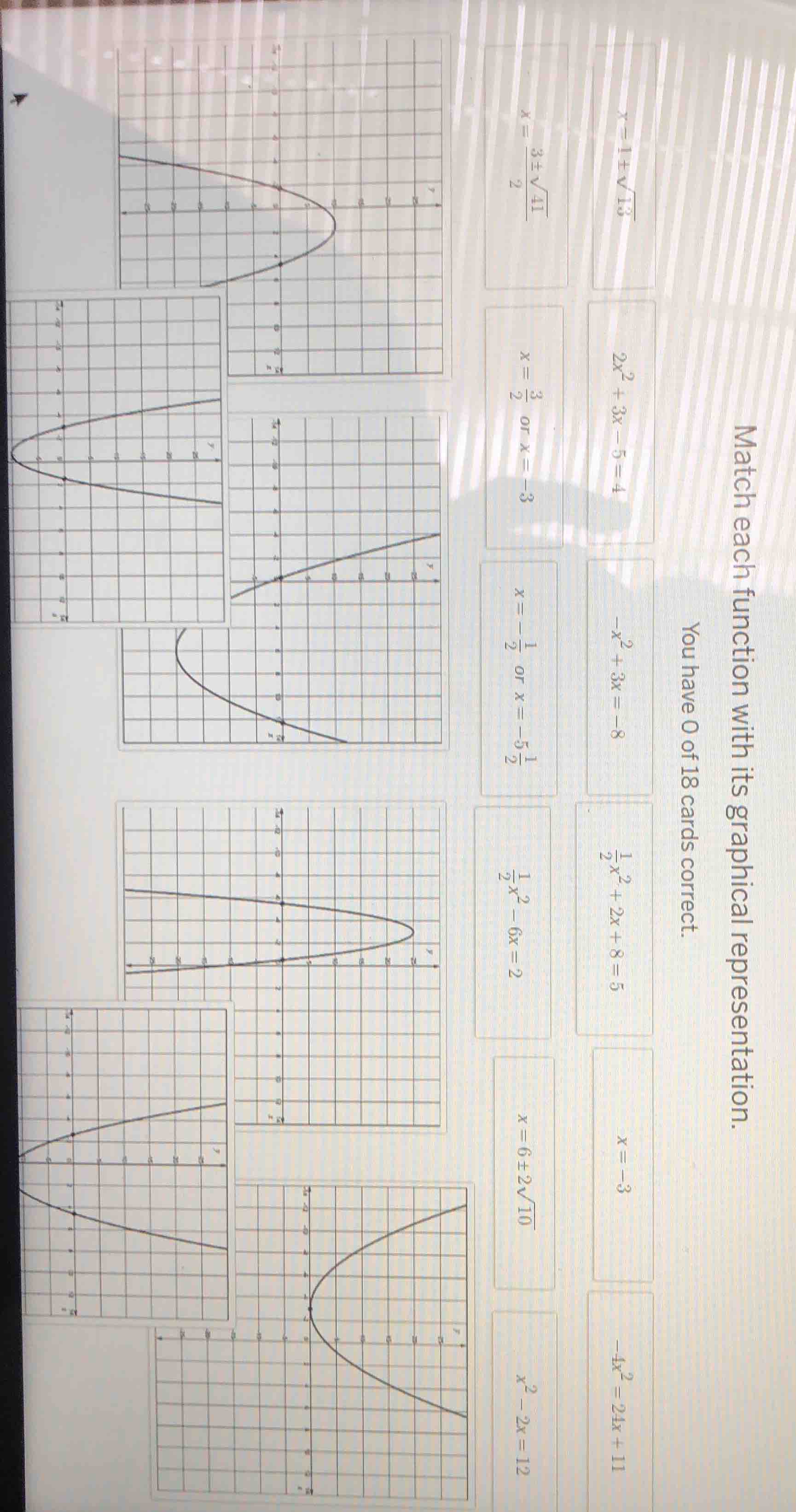
match each function with its graphical representation.
you have 0 of 18 cards correct.
$x=1+\sqrt{13}$
$2x^2 + 3x - 5 = 4$
$-x^2 + 3x = -8$
$\frac{1}{2}x^2 + 2x + 8 = 5$
$x = -3$
$-4x^2 = 24x + 11$
$x = \frac{3 \pm \sqrt{41}}{2}$
$x = \frac{3}{2}$ or $x = -3$
$x = -\frac{1}{2}$ or $x = -5\frac{1}{2}$
$\frac{1}{2}x^2 - 6x = 2$
$x = 6 \pm 2\sqrt{10}$
$x^2 - 2x = 12$
To solve this problem of matching each quadratic function (or equation) with its graphical representation, we analyze the key features of each quadratic (parabola) such as direction (opening up/down), vertex, roots (x - intercepts), and solve the equations to find roots for comparison. Here's a breakdown of a few examples:
1. Analyze \( -x^2 + 3x = -8 \) (rewrite as \( -x^2 + 3x + 8 = 0 \) or \( x^2 - 3x - 8 = 0 \))
- Direction: The coefficient of \( x^2 \) is \( -1 \) (negative), so the parabola opens downward.
- Roots: Use the quadratic formula \( x = \frac{-b \pm \sqrt{b^2 - 4ac}}{2a} \) for \( ax^2 + bx + c = 0 \). Here, \( a = 1 \), \( b = -3 \), \( c = -8 \):
\( x = \frac{3 \pm \sqrt{(-3)^2 - 4(1)(-8)}}{2(1)} = \frac{3 \pm \sqrt{9 + 32}}{2} = \frac{3 \pm \sqrt{41}}{2} \).
This matches the solution \( x = \frac{3 \pm \sqrt{41}}{2} \). Look for a downward - opening parabola with these roots.
2. Analyze \( 2x^2 + 3x - 5 = 4 \) (rewrite as \( 2x^2 + 3x - 9 = 0 \))
- Factor: \( 2x^2 + 3x - 9 = (2x - 3)(x + 3) = 0 \).
- Roots: \( 2x - 3 = 0 \implies x=\frac{3}{2} \); \( x + 3 = 0 \implies x = - 3 \).
This matches the solution \( x=\frac{3}{2} \) or \( x = - 3 \). Look for a parabola (opening up, since \( a = 2>0 \)) with x - intercepts at \( \frac{3}{2} \) and \( -3 \).
3. Analyze \( \frac{1}{2}x^2 + 2x + 8 = 5 \) (rewrite as \( \frac{1}{2}x^2 + 2x + 3 = 0 \) or multiply by 2: \( x^2 + 4x + 6 = 0 \))
- Discriminant: \( b^2 - 4ac=(4)^2 - 4(1)(6)=16 - 24=-8<0 \).
- Conclusion: No real roots (parabola does not cross the x - axis). The coefficient of \( x^2 \) is \( \frac{1}{2}>0 \), so it opens upward. Look for an upward - opening parabola with no x - intercepts.
4. Analyze \( \frac{1}{2}x^2 - 6x = 2 \) (rewrite as \( \frac{1}{2}x^2 - 6x - 2 = 0 \) or multiply by 2: \( x^2 - 12x - 4 = 0 \))
- Roots: Use the quadratic formula \( x=\frac{12\pm\sqrt{(-12)^2 - 4(1)(-4)}}{2(1)}=\frac{12\pm\sqrt{144 + 16}}{2}=\frac{12\pm\sqrt{160}}{2}=\frac{12\pm4\sqrt{10}}{2}=6\pm2\sqrt{10} \).
This matches the solution \( x=\frac{6\pm2\sqrt{10}}{2}=6\pm2\sqrt{10} \) (simplified). The parabola opens upward (\( a=\frac{1}{2}>0 \)).
5. Analyze \( x^2 - 2x = 12 \) (rewrite as \( x^2 - 2x - 12 = 0 \))
- Roots: Use the quadratic formula \( x=\frac{2\pm\sqrt{(-2)^2 - 4(1)(-12)}}{2(1)}=\frac{2\pm\sqrt{4 + 48}}{2}=\frac{2\pm\sqrt{52}}{2}=\frac{2\pm2\sqrt{13}}{2}=1\pm\sqrt{13} \).
This matches the solution \( x = 1\pm\sqrt{13} \). The parabola opens upward (\( a = 1>0 \)).
6. Analyze \( -4x^2 = 24x + 11 \) (rewrite as \( 4x^2+24x + 11 = 0 \))
- Factor: \( 4x^2+24x + 11=(2x + 1)(2x + 11)=0 \).
- Roots: \( 2x+1 = 0\implies x =-\frac{1}{2} \); \( 2x + 11 = 0\implies x=-\frac{11}{2}=-5\frac{1}{2} \).
This matches the solution \( x =-\frac{1}{2} \) or \( x=-5\frac{1}{2} \). The parabola opens downward (\( a=-4<0 \)).
To fully match all functions to their graphs, repeat this process:
- Identify the direction of the parabola (sign of \( a \) in \( y = ax^2+bx + c \)).
- Find the roots (x - intercepts) by solving the quadratic equation (factoring, quadratic formula, or completing the square).
- Match the parabola’s shape (direction) and x - intercepts to the given graphs.
For example, if we consider the equation \( x^2 - 2x = 12 \) (which simplifies to \( x = 1\pm\sqrt{13} \)) and its corresponding graph:
- The parabola opens upward (since \( a = 1>0 \)).
- The roots are \( 1+\sqrt{13}\approx1 + 3.605 = 4.605 \) and \( 1-\sqrt{13}\approx1 - 3.605=-2.605 \).
Find the upward - opening par…

Snap & solve any problem in the app
Get step-by-step solutions on Sovi AI
Photo-based solutions with guided steps
Explore more problems and detailed explanations
To solve this problem of matching each quadratic function (or equation) with its graphical representation, we analyze the key features of each quadratic (parabola) such as direction (opening up/down), vertex, roots (x - intercepts), and solve the equations to find roots for comparison. Here's a breakdown of a few examples:
1. Analyze \( -x^2 + 3x = -8 \) (rewrite as \( -x^2 + 3x + 8 = 0 \) or \( x^2 - 3x - 8 = 0 \))
- Direction: The coefficient of \( x^2 \) is \( -1 \) (negative), so the parabola opens downward.
- Roots: Use the quadratic formula \( x = \frac{-b \pm \sqrt{b^2 - 4ac}}{2a} \) for \( ax^2 + bx + c = 0 \). Here, \( a = 1 \), \( b = -3 \), \( c = -8 \):
\( x = \frac{3 \pm \sqrt{(-3)^2 - 4(1)(-8)}}{2(1)} = \frac{3 \pm \sqrt{9 + 32}}{2} = \frac{3 \pm \sqrt{41}}{2} \).
This matches the solution \( x = \frac{3 \pm \sqrt{41}}{2} \). Look for a downward - opening parabola with these roots.
2. Analyze \( 2x^2 + 3x - 5 = 4 \) (rewrite as \( 2x^2 + 3x - 9 = 0 \))
- Factor: \( 2x^2 + 3x - 9 = (2x - 3)(x + 3) = 0 \).
- Roots: \( 2x - 3 = 0 \implies x=\frac{3}{2} \); \( x + 3 = 0 \implies x = - 3 \).
This matches the solution \( x=\frac{3}{2} \) or \( x = - 3 \). Look for a parabola (opening up, since \( a = 2>0 \)) with x - intercepts at \( \frac{3}{2} \) and \( -3 \).
3. Analyze \( \frac{1}{2}x^2 + 2x + 8 = 5 \) (rewrite as \( \frac{1}{2}x^2 + 2x + 3 = 0 \) or multiply by 2: \( x^2 + 4x + 6 = 0 \))
- Discriminant: \( b^2 - 4ac=(4)^2 - 4(1)(6)=16 - 24=-8<0 \).
- Conclusion: No real roots (parabola does not cross the x - axis). The coefficient of \( x^2 \) is \( \frac{1}{2}>0 \), so it opens upward. Look for an upward - opening parabola with no x - intercepts.
4. Analyze \( \frac{1}{2}x^2 - 6x = 2 \) (rewrite as \( \frac{1}{2}x^2 - 6x - 2 = 0 \) or multiply by 2: \( x^2 - 12x - 4 = 0 \))
- Roots: Use the quadratic formula \( x=\frac{12\pm\sqrt{(-12)^2 - 4(1)(-4)}}{2(1)}=\frac{12\pm\sqrt{144 + 16}}{2}=\frac{12\pm\sqrt{160}}{2}=\frac{12\pm4\sqrt{10}}{2}=6\pm2\sqrt{10} \).
This matches the solution \( x=\frac{6\pm2\sqrt{10}}{2}=6\pm2\sqrt{10} \) (simplified). The parabola opens upward (\( a=\frac{1}{2}>0 \)).
5. Analyze \( x^2 - 2x = 12 \) (rewrite as \( x^2 - 2x - 12 = 0 \))
- Roots: Use the quadratic formula \( x=\frac{2\pm\sqrt{(-2)^2 - 4(1)(-12)}}{2(1)}=\frac{2\pm\sqrt{4 + 48}}{2}=\frac{2\pm\sqrt{52}}{2}=\frac{2\pm2\sqrt{13}}{2}=1\pm\sqrt{13} \).
This matches the solution \( x = 1\pm\sqrt{13} \). The parabola opens upward (\( a = 1>0 \)).
6. Analyze \( -4x^2 = 24x + 11 \) (rewrite as \( 4x^2+24x + 11 = 0 \))
- Factor: \( 4x^2+24x + 11=(2x + 1)(2x + 11)=0 \).
- Roots: \( 2x+1 = 0\implies x =-\frac{1}{2} \); \( 2x + 11 = 0\implies x=-\frac{11}{2}=-5\frac{1}{2} \).
This matches the solution \( x =-\frac{1}{2} \) or \( x=-5\frac{1}{2} \). The parabola opens downward (\( a=-4<0 \)).
To fully match all functions to their graphs, repeat this process:
- Identify the direction of the parabola (sign of \( a \) in \( y = ax^2+bx + c \)).
- Find the roots (x - intercepts) by solving the quadratic equation (factoring, quadratic formula, or completing the square).
- Match the parabola’s shape (direction) and x - intercepts to the given graphs.
For example, if we consider the equation \( x^2 - 2x = 12 \) (which simplifies to \( x = 1\pm\sqrt{13} \)) and its corresponding graph:
- The parabola opens upward (since \( a = 1>0 \)).
- The roots are \( 1+\sqrt{13}\approx1 + 3.605 = 4.605 \) and \( 1-\sqrt{13}\approx1 - 3.605=-2.605 \).
Find the upward - opening parabola with x - intercepts near \( 4.6 \) and \( -2.6 \).
By systematically analyzing the direction of opening, roots, and other features (like vertex, y - intercept) for each quadratic, you can match each function to its correct graphical representation.