QUESTION IMAGE
Question
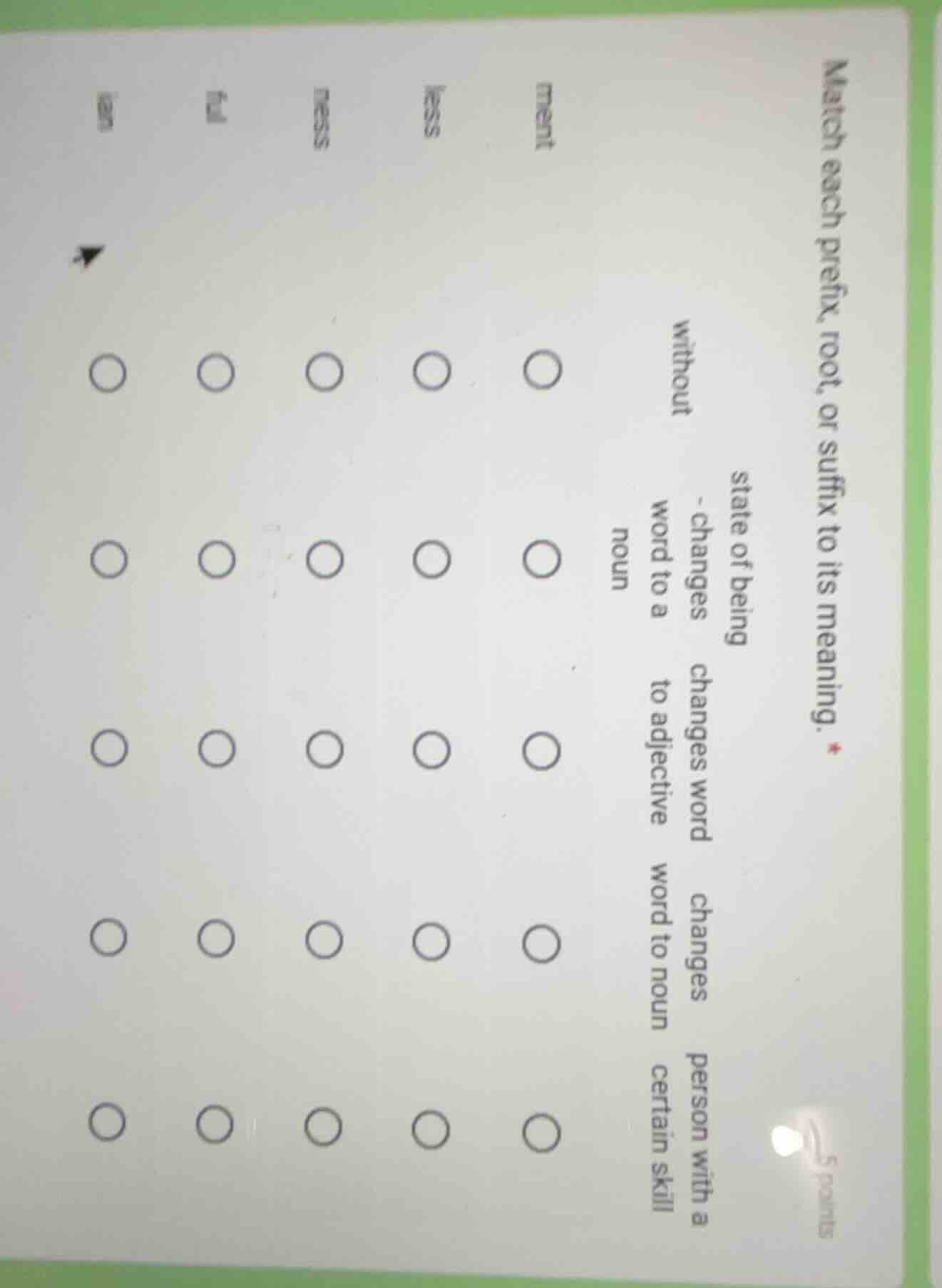
match each prefix, root, or suffix to its meaning.
state of being - changes word to a noun
without - changes word to adjective
person with a certain skill - changes word to noun
(and some prefix/root/suffix options like ment, less, ness, etc. with circles for selection)
To solve this prefix, root, or suffix - meaning matching problem, we analyze each item:
For the suffix "ment"
- Suffixes like "ment" are typically used to change a word to a noun. For example, "develop" (a verb) becomes "development" (a noun) when we add "ment". So "ment" matches with "changes word to noun".
For the suffix "less"
- The suffix "less" means "without". For example, "hopeless" means "without hope". So "less" matches with "without".
For the suffix "ness"
- The suffix "ness" is used to denote a state of being. For example, "happiness" is the state of being happy. So "ness" matches with "state of being".
For the suffix "er" (assuming the second column is "er")
- The suffix "er" is used to refer to a person with a certain skill. For example, "teacher" is a person with the skill of teaching. So "er" matches with "person with a certain skill".
For the prefix "in - " (assuming the first column is "in - ", though it's a bit unclear from the image, but if we consider common prefixes) or other prefixes/suffixes in the first column
- If we consider a prefix like "in - " (meaning "not" or used in some cases to change word class, but if we take a suffix like "ize" (if that's the case), but from the given options, if we assume the first column has a suffix or prefix related to changing a word to an adjective, but more likely, if we consider the pattern:
- Let's re - check the columns:
- Column 1 (prefix/root/suffix): Let's assume the first one is a suffix like "ize" (but the image is a bit unclear). However, based on standard affix meanings:
- "ment": changes word to noun (matches with "changes word to noun")
- "less": without (matches with "without")
- "ness": state of being (matches with "state of being")
- "er": person with a certain skill (matches with "person with a certain skill")
- For the remaining one (first column), if it's a suffix like "en" (to make adjective) or a prefix, but if we assume the first column has a suffix that changes word to adjective, for example, "able" (but not in our list). However, based on the given options and standard affix knowledge:
Final Matches:
- "ment" → "changes word to noun"
- "less" → "without"
- "ness" → "state of being"
- "er" → "person with a certain skill"
- The first column (assuming it's a suffix like "en" or a prefix that changes word to adjective) → "changes word to adjective" (if we assume the first column's affix is for adjective formation, like "ish" or "y" or a prefix like "un - " (but "un - " is a prefix meaning "not", but for adjective formation, "en - " as a prefix can be used to make adjectives like "enlightened", but this is a bit speculative. However, based on the given options, we can match as above.
If we were to write the answers in a boxed - like format (but since it's a matching, we list the pairs):
- "ment" : "changes word to noun"
- "less" : "without"
- "ness" : "state of being"
- "er" : "person with a certain skill"
- (First column affix) : "changes word to adjective"
But since the image is a bit unclear about the first column's affix, but based on standard affix meanings, the above are the correct matches.

Snap & solve any problem in the app
Get step-by-step solutions on Sovi AI
Photo-based solutions with guided steps
Explore more problems and detailed explanations
To solve this prefix, root, or suffix - meaning matching problem, we analyze each item:
For the suffix "ment"
- Suffixes like "ment" are typically used to change a word to a noun. For example, "develop" (a verb) becomes "development" (a noun) when we add "ment". So "ment" matches with "changes word to noun".
For the suffix "less"
- The suffix "less" means "without". For example, "hopeless" means "without hope". So "less" matches with "without".
For the suffix "ness"
- The suffix "ness" is used to denote a state of being. For example, "happiness" is the state of being happy. So "ness" matches with "state of being".
For the suffix "er" (assuming the second column is "er")
- The suffix "er" is used to refer to a person with a certain skill. For example, "teacher" is a person with the skill of teaching. So "er" matches with "person with a certain skill".
For the prefix "in - " (assuming the first column is "in - ", though it's a bit unclear from the image, but if we consider common prefixes) or other prefixes/suffixes in the first column
- If we consider a prefix like "in - " (meaning "not" or used in some cases to change word class, but if we take a suffix like "ize" (if that's the case), but from the given options, if we assume the first column has a suffix or prefix related to changing a word to an adjective, but more likely, if we consider the pattern:
- Let's re - check the columns:
- Column 1 (prefix/root/suffix): Let's assume the first one is a suffix like "ize" (but the image is a bit unclear). However, based on standard affix meanings:
- "ment": changes word to noun (matches with "changes word to noun")
- "less": without (matches with "without")
- "ness": state of being (matches with "state of being")
- "er": person with a certain skill (matches with "person with a certain skill")
- For the remaining one (first column), if it's a suffix like "en" (to make adjective) or a prefix, but if we assume the first column has a suffix that changes word to adjective, for example, "able" (but not in our list). However, based on the given options and standard affix knowledge:
Final Matches:
- "ment" → "changes word to noun"
- "less" → "without"
- "ness" → "state of being"
- "er" → "person with a certain skill"
- The first column (assuming it's a suffix like "en" or a prefix that changes word to adjective) → "changes word to adjective" (if we assume the first column's affix is for adjective formation, like "ish" or "y" or a prefix like "un - " (but "un - " is a prefix meaning "not", but for adjective formation, "en - " as a prefix can be used to make adjectives like "enlightened", but this is a bit speculative. However, based on the given options, we can match as above.
If we were to write the answers in a boxed - like format (but since it's a matching, we list the pairs):
- "ment" : "changes word to noun"
- "less" : "without"
- "ness" : "state of being"
- "er" : "person with a certain skill"
- (First column affix) : "changes word to adjective"
But since the image is a bit unclear about the first column's affix, but based on standard affix meanings, the above are the correct matches.