QUESTION IMAGE
Question
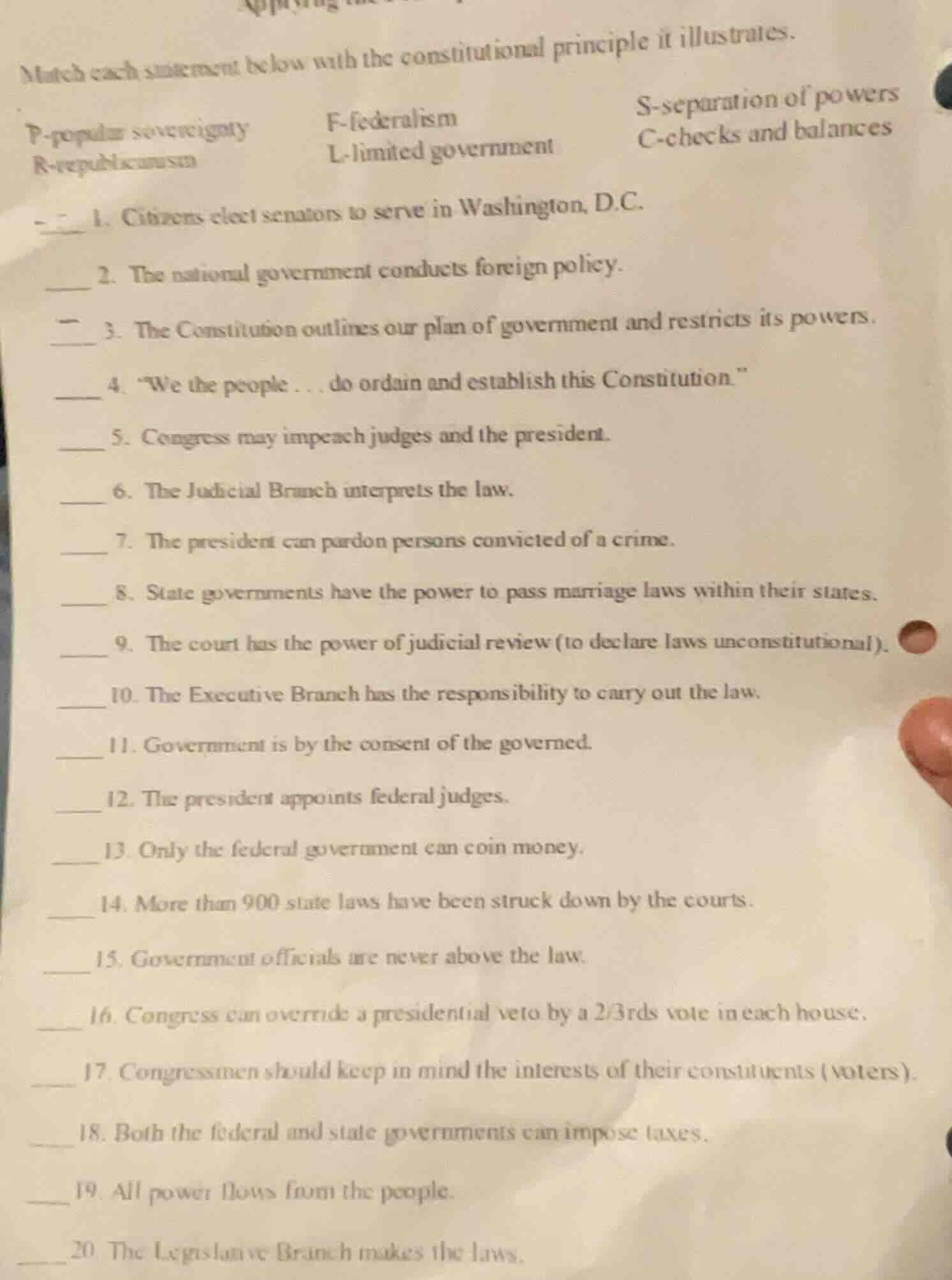
match each statement below with the constitutional principle it illustrates.
p - popular sovereignty f - federalism s - separation of powers
r - republicanism l - limited government c - checks and balances
- citizens elect senators to serve in washington, d.c.
- the national government conducts foreign policy.
- the constitution outlines our plan of government and restricts its powers.
- “we the people... do ordain and establish this constitution.”
- congress may impeach judges and the president.
- the judicial branch interprets the law.
- the president can pardon persons convicted of a crime.
- state governments have the power to pass marriage laws within their states.
- the court has the power of judicial review (to declare laws unconstitutional).
- the executive branch has the responsibility to carry out the law.
- government is by the consent of the governed.
- the president appoints federal judges.
- only the federal government can coin money.
- more than 900 state laws have been struck down by the courts.
- government officials are never above the law.
- congress can override a presidential veto by a 2/3rds vote in each house.
- congressmen should keep in mind the interests of their constituents (voters).
- both the federal and state governments can impose taxes.
- all power flows from the people.
- the legislative branch makes the laws.
Brief Explanations
Each statement is matched to the corresponding constitutional principle based on the core definition of each principle:
- Electing legislators aligns with republicanism (representative government).
- National government handling foreign policy is a federal power under federalism.
- The Constitution restricting government power defines limited government.
- "We the people" is the core of popular sovereignty.
- Congress impeaching officials is a check on other branches.
- Judicial Branch interpreting laws is its defined role in separation of powers.
- The president's pardon power is an executive role in separation of powers.
- States making marriage laws is a state power under federalism.
- Judicial review is a check on legislative/executive branches.
- Executive Branch enforcing laws is its role in separation of powers.
- Government by consent of the governed is popular sovereignty.
- The president appointing judges is an executive check on the judiciary.
- Federal-only coinage power is a federal authority under federalism.
- Courts striking down laws is judicial review, a check on government.
- Officials not being above the law is limited government.
- Congress overriding a veto is a check on the executive branch.
- Legislators representing constituents is republicanism.
- Shared tax power between levels is federalism.
- Power originating from the people is popular sovereignty.
- Legislative Branch making laws is its role in separation of powers.

Snap & solve any problem in the app
Get step-by-step solutions on Sovi AI
Photo-based solutions with guided steps
Explore more problems and detailed explanations
- R-republicanism
- F-federalism
- L-limited government
- P-popular sovereignty
- C-checks and balances
- S-separation of powers
- S-separation of powers
- F-federalism
- C-checks and balances
- S-separation of powers
- P-popular sovereignty
- C-checks and balances
- F-federalism
- C-checks and balances
- L-limited government
- C-checks and balances
- R-republicanism
- F-federalism
- P-popular sovereignty
- S-separation of powers