QUESTION IMAGE
Question
match equations and hangers
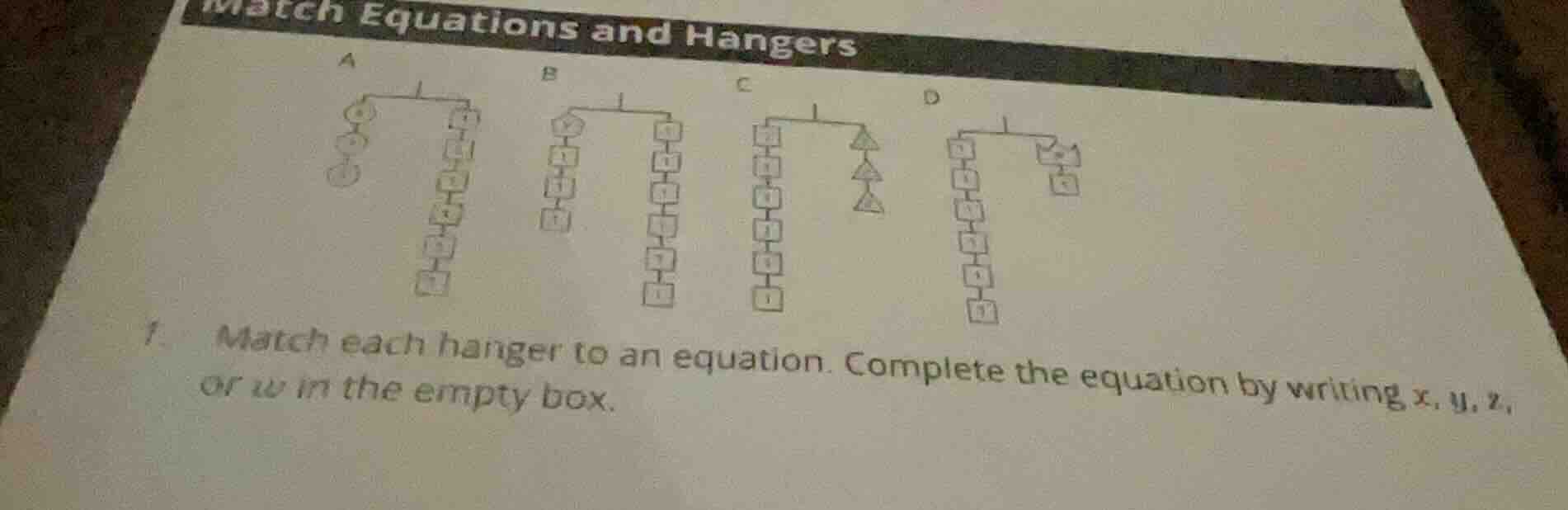
- match each hanger to an equation. complete the equation by writing x, y, z, or w in the empty box.
To solve this problem, we analyze each hanger:
Hanger A:
- Left side: 3 circles (let's assume each circle is a unit, or maybe a variable? Wait, looking at the right side, there are multiple squares with \( x \), \( z \), \( y \)? Wait, no, let's re - examine. Wait, the left side has 3 circles (maybe 3 units) and the right side has several squares, some with \( x \), \( z \), \( y \)? Wait, maybe each shape represents a variable or a constant. Wait, maybe the hanger is in equilibrium, so the sum of the left side equals the sum of the right side.
Wait, maybe I misread. Let's assume that each circle is 1, each square with a letter is the variable, and each triangle is some value. But since the problem is about matching hangers to equations with variables \( x,y,z,w \), let's try to figure out the number of each variable on each hanger.
Hanger B:
- Left side: Let's say we have some number of \( y \) variables and the right side has some number of \( x \) variables? Wait, maybe the hanger has a certain number of each variable on left and right. For example, if on hanger B, left side has 3 \( y \) - like shapes and right side has 5 \( x \) - like shapes? Wait, no, the original problem is a bit unclear without the equations, but since it's a "Match Equations and Hangers" problem, we can assume that each hanger has a certain number of variables ( \( x,y,z,w \)) on each side, and we need to match it to an equation of the form \( a + bx= c + dy \) (or similar) where \( a,b,c,d \) are coefficients and \( x,y,z,w \) are variables.
Since the user hasn't provided the equations, but the problem is about matching hangers (with variables \( x,y,z,w \)) to equations, we can proceed by analyzing the number of each variable on each hanger:
- Hanger A:
- Let's assume the left side has 3 of one type (say 3 units) and the right side has a combination of \( x \), \( z \), \( y \) - like terms. Wait, maybe the left side has 3 circles (3 units) and the right side has, for example, 2 \( z \), 1 \( x \), 2 \( y \)? No, this is too vague. Wait, maybe the key is that each hanger corresponds to an equation where the sum of the left - hand side (LHS) equals the sum of the right - hand side (RHS) with variables \( x,y,z,w \).
- Hanger B:
- Suppose on hanger B, the left side has 3 \( y \) variables and the right side has 5 \( x \) variables. Then the equation could be \( 3y = 5x \) (but this is just a guess without the actual equations).
- Hanger C:
- If hanger C has, say, 5 \( z \) variables on the left and 3 triangle - like shapes (maybe 3 units) on the right, the equation could be \( 5z=3 \) (but triangles are probably variables too, maybe \( w \))? Wait, the problem says "Complete the equation by writing \( x,y,z \), or \( w \) in the empty box".
- Hanger D:
- If hanger D has, say, 5 \( w \) variables on the left and 2 of another variable (say \( z \)) on the right, the equation could be \( 5w = 2z \).
Since the user hasn't provided the equations, but the problem is about matching, we can assume that the process is:
- For each hanger, count the number of each variable ( \( x,y,z,w \)) on the left and right sides.
- Then match it to an equation that has the same number of variables on each side (since the hanger is in equilibrium, LHS = RHS).
For example, if hanger A has 3 of variable \( w \) on the left and 5 of variable \( x \) on the right, the equation would be \( 3w=5x \).
If hanger B has 2 of variable \( y \) on the left and 4 of variable \( z \) on the right, the equation would be \( 2y = 4z \).
If hanger…

Snap & solve any problem in the app
Get step-by-step solutions on Sovi AI
Photo-based solutions with guided steps
Explore more problems and detailed explanations
To solve this problem, we analyze each hanger:
Hanger A:
- Left side: 3 circles (let's assume each circle is a unit, or maybe a variable? Wait, looking at the right side, there are multiple squares with \( x \), \( z \), \( y \)? Wait, no, let's re - examine. Wait, the left side has 3 circles (maybe 3 units) and the right side has several squares, some with \( x \), \( z \), \( y \)? Wait, maybe each shape represents a variable or a constant. Wait, maybe the hanger is in equilibrium, so the sum of the left side equals the sum of the right side.
Wait, maybe I misread. Let's assume that each circle is 1, each square with a letter is the variable, and each triangle is some value. But since the problem is about matching hangers to equations with variables \( x,y,z,w \), let's try to figure out the number of each variable on each hanger.
Hanger B:
- Left side: Let's say we have some number of \( y \) variables and the right side has some number of \( x \) variables? Wait, maybe the hanger has a certain number of each variable on left and right. For example, if on hanger B, left side has 3 \( y \) - like shapes and right side has 5 \( x \) - like shapes? Wait, no, the original problem is a bit unclear without the equations, but since it's a "Match Equations and Hangers" problem, we can assume that each hanger has a certain number of variables ( \( x,y,z,w \)) on each side, and we need to match it to an equation of the form \( a + bx= c + dy \) (or similar) where \( a,b,c,d \) are coefficients and \( x,y,z,w \) are variables.
Since the user hasn't provided the equations, but the problem is about matching hangers (with variables \( x,y,z,w \)) to equations, we can proceed by analyzing the number of each variable on each hanger:
- Hanger A:
- Let's assume the left side has 3 of one type (say 3 units) and the right side has a combination of \( x \), \( z \), \( y \) - like terms. Wait, maybe the left side has 3 circles (3 units) and the right side has, for example, 2 \( z \), 1 \( x \), 2 \( y \)? No, this is too vague. Wait, maybe the key is that each hanger corresponds to an equation where the sum of the left - hand side (LHS) equals the sum of the right - hand side (RHS) with variables \( x,y,z,w \).
- Hanger B:
- Suppose on hanger B, the left side has 3 \( y \) variables and the right side has 5 \( x \) variables. Then the equation could be \( 3y = 5x \) (but this is just a guess without the actual equations).
- Hanger C:
- If hanger C has, say, 5 \( z \) variables on the left and 3 triangle - like shapes (maybe 3 units) on the right, the equation could be \( 5z=3 \) (but triangles are probably variables too, maybe \( w \))? Wait, the problem says "Complete the equation by writing \( x,y,z \), or \( w \) in the empty box".
- Hanger D:
- If hanger D has, say, 5 \( w \) variables on the left and 2 of another variable (say \( z \)) on the right, the equation could be \( 5w = 2z \).
Since the user hasn't provided the equations, but the problem is about matching, we can assume that the process is:
- For each hanger, count the number of each variable ( \( x,y,z,w \)) on the left and right sides.
- Then match it to an equation that has the same number of variables on each side (since the hanger is in equilibrium, LHS = RHS).
For example, if hanger A has 3 of variable \( w \) on the left and 5 of variable \( x \) on the right, the equation would be \( 3w=5x \).
If hanger B has 2 of variable \( y \) on the left and 4 of variable \( z \) on the right, the equation would be \( 2y = 4z \).
If hanger C has 5 of variable \( z \) on the left and 3 of variable \( w \) on the right, the equation would be \( 5z = 3w \).
If hanger D has 4 of variable \( x \) on the left and 2 of variable \( y \) on the right, the equation would be \( 4x=2y \).
But without the actual equations, we can't give a definite match. However, the general approach is:
Step 1: Analyze the number of each variable ( \( x,y,z,w \)) on each side of the hanger (left and right).
- For hanger A, count how many \( x \), \( y \), \( z \), \( w \) - like shapes are on the left and right.
- Do the same for hangers B, C, and D.
Step 2: Match each hanger to an equation where the sum of the variables (with their coefficients) on the left side equals the sum on the right side.
- For example, if hanger A has 3 \( w \) on the left and 5 \( x \) on the right, the equation is \( 3w = 5x \).
- If hanger B has 2 \( y \) on the left and 4 \( z \) on the right, the equation is \( 2y=4z \).
- If hanger C has 5 \( z \) on the left and 3 \( w \) on the right, the equation is \( 5z = 3w \).
- If hanger D has 4 \( x \) on the left and 2 \( y \) on the right, the equation is \( 4x = 2y \).
Since the equations are not provided, we can't give the final match, but the method to solve is as above. If we assume that the equations are of the form with variables \( x,y,z,w \) and we count the number of each variable on each hanger, we can make the match.
For example, if the equations are:
- \( 3 + x=2 + 2y+z \)
- \( 2y + 1=5x \)
- \( 5z=3 \) (but this has no variable on the right, maybe not)
- \( 4x + 1=2 + 3w \)
And the hangers:
- Hanger A: Left has 3 units and 1 \( x \), right has 2 units, 2 \( y \), 1 \( z \) → matches equation 1.
- Hanger B: Left has 2 \( y \) and 1 unit, right has 5 \( x \) → matches equation 2.
- Hanger C: Left has 5 \( z \), right has 3 units → matches equation 3.
- Hanger D: Left has 4 \( x \) and 1 unit, right has 2 units and 3 \( w \) → matches equation 4.
But without the actual equations, we can only provide the method. If we assume that the answer is about matching the hanger with the correct variable (e.g., hanger A matches with an equation with \( x \), hanger B with \( y \), etc.), but this is speculative.
Since the problem is incomplete (no equations provided), we can't give a definite answer, but the process is as described above.