QUESTION IMAGE
Question
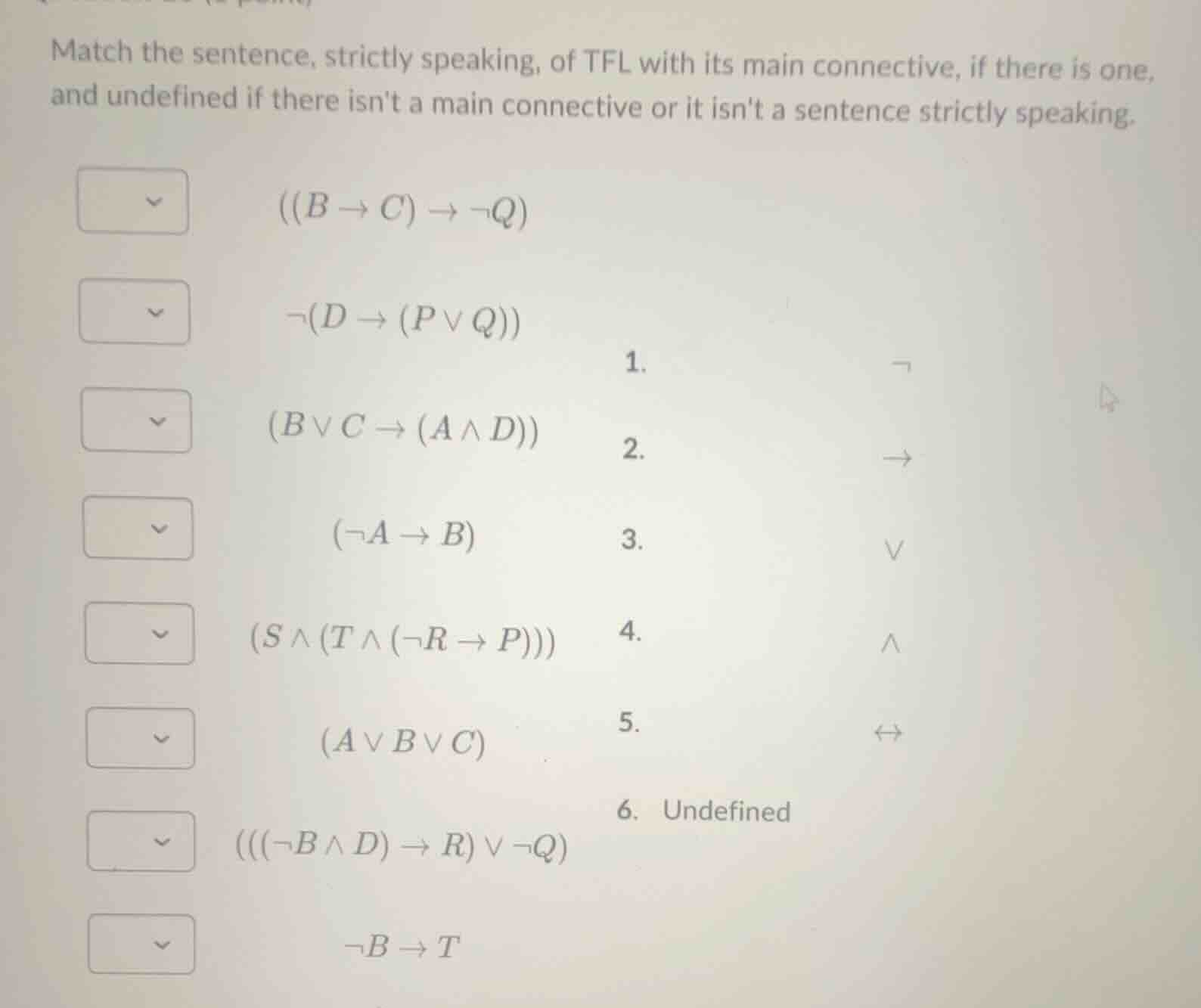
match the sentence, strictly speaking, of tfl with its main connective, if there is one, and undefined if there isnt a main connective or it isnt a sentence strictly speaking.$((b \
ightarrow c) \
ightarrow \
eg q)
(b \vee c \
ightarrow (a \wedge d))$2. $\
ightarrow
(s \wedge (t \wedge (\
eg r \
ightarrow p)))$4. $\wedge
\
eg b \
ightarrow t$
- For $((B \to C) \to
eg Q)$: The outermost structure is a conditional connecting $(B \to C)$ and $
eg Q$, so main connective is $\to$.
- For $
eg(D \to (P \vee Q))$: The entire formula is negated, so main connective is $
eg$.
- For $(B \vee C \to (A \wedge D))$: This is a conditional with $(B \vee C)$ as antecedent, so main connective is $\to$.
- For $(
eg A \to B)$: This is a standard conditional, main connective is $\to$.
- For $(S \wedge (T \wedge (
eg R \to P)))$: The outermost connective is conjunction, main connective is $\wedge$.
- For $(A \vee B \vee C)$: In TFL, disjunction is associative, so main connective is $\vee$.
- For $(((
eg B \wedge D) \to R) \vee
eg Q)$: The outermost structure is disjunction, main connective is $\vee$.
- For $
eg B \to T$: This is a conditional with $
eg B$ as antecedent, main connective is $\to$.

Snap & solve any problem in the app
Get step-by-step solutions on Sovi AI
Photo-based solutions with guided steps
Explore more problems and detailed explanations
$((B \to C) \to
eg Q)$ → 2. $\to$
$
eg(D \to (P \vee Q))$ → 1. $
eg$
$(B \vee C \to (A \wedge D))$ → 2. $\to$
$(
eg A \to B)$ → 2. $\to$
$(S \wedge (T \wedge (
eg R \to P)))$ → 4. $\wedge$
$(A \vee B \vee C)$ → 3. $\vee$
$(((
eg B \wedge D) \to R) \vee
eg Q)$ → 3. $\vee$
$
eg B \to T$ → 2. $\to$