QUESTION IMAGE
Question
6 matching 1.5 points
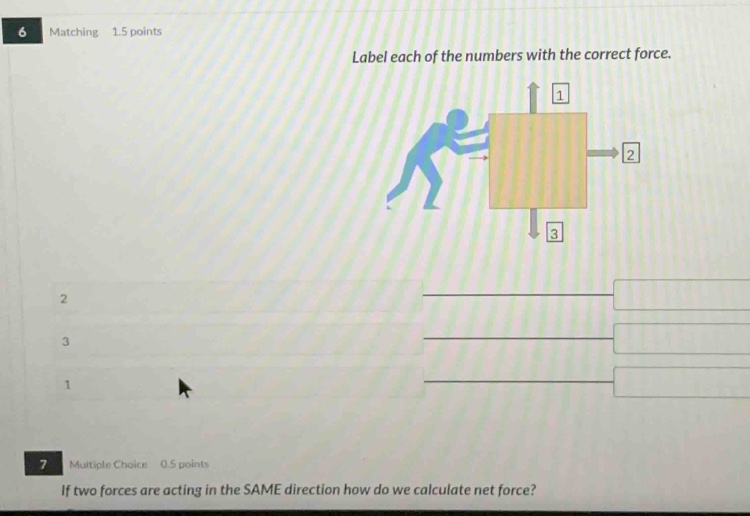
label each of the numbers with the correct force.
2
3
1
7 multiple choice 0.5 points
if two forces are acting in the same direction how do we calculate net force?
Question 6 (Matching)
To solve the matching for labeling the forces, we analyze the diagram:
- Force 1 (upward arrow): This is the normal force (or upward force, like the force from a surface pushing up, or could be the upward component of a force; in a typical scenario with a box, if it's in equilibrium vertically, force 1 and 3 would be gravity and normal force. Wait, force 1 is upward, force 3 is downward. So force 1 is the normal force (pushing up), force 3 is gravity (weight, pulling down), and force 2 (rightward) and the person's push (left? Wait no, the person is pushing right? Wait the diagram: person is pushing the box to the right? Wait the arrow from the person is right? Wait the box has arrow 2 to the right, and the person is pushing right? Wait no, maybe the person is pushing right, and force 2 is the friction or another force? Wait no, let's clarify:
In a typical force diagram for a box on a surface with a person pushing:
- Vertical forces: upward force (normal force, \( F_N \)) and downward force (gravity, \( F_g \) or weight). So force 1 (up) is normal force, force 3 (down) is gravity (weight).
- Horizontal forces: the person's push (let's say to the right) and another force (like friction, or maybe the reaction? Wait the box has arrow 2 to the right. Wait maybe the person is pushing right, so force from the person is, and force 2 is the friction or the applied force? Wait maybe the labels are:
1: Normal Force (upward)
3: Gravitational Force (downward, weight)
2: Applied Force (rightward, from the person) or maybe the reaction? Wait no, let's assume standard:
- 1: Normal Force (up)
- 3: Gravitational Force (down)
- 2: Applied Force (right, from the person)
So matching:
- 1 → Normal Force (or Upward Force)
- 3 → Gravitational Force (or Weight, Downward Force)
- 2 → Applied Force (Rightward, from the person)
Question 7 (Multiple Choice)
When two forces act in the same direction, the net force is the sum of the two forces.
For example, if force \( F_1 = 5 \, \text{N} \) to the right and force \( F_2 = 3 \, \text{N} \) to the right, the net force \( F_{\text{net}} = F_1 + F_2 = 5 + 3 = 8 \, \text{N} \) to the right.
So the formula is \( F_{\text{net}} = F_1 + F_2 \) (when directions are the same).
Final Answers
Question 6 (Matching)
Assuming standard force labels:
- 1: Normal Force (Upward)
- 3: Gravitational Force (Downward)
- 2: Applied Force (Rightward)
(Note: The exact labels depend on the context, but the key is vertical forces (1 up, 3 down) are normal and gravity; horizontal (2 right) is applied force or friction, but in the diagram, the person is pushing, so 2 is the applied force from the person or the reaction. But the main vertical forces: 1 (up) = normal, 3 (down) = gravity; horizontal: 2 (right) = applied force.)
Question 7
To calculate the net force when two forces act in the same direction, we add the magnitudes of the two forces.
So the answer is: Net force = Force 1 + Force 2 (sum of the two forces)
Final Answers
Question 6 (Matching)
1 → Normal Force (Upward)
3 → Gravitational Force (Downward)
2 → Applied Force (Rightward)
(Adjust based on exact diagram context, but this is the standard interpretation.)
Question 7
The net force is calculated by summing the two forces (adding their magnitudes). So the correct option (if options are like "Add the two forces", "Subtract the two forces", etc.) would be the one that says to add them.

Snap & solve any problem in the app
Get step-by-step solutions on Sovi AI
Photo-based solutions with guided steps
Explore more problems and detailed explanations
Question 6 (Matching)
To solve the matching for labeling the forces, we analyze the diagram:
- Force 1 (upward arrow): This is the normal force (or upward force, like the force from a surface pushing up, or could be the upward component of a force; in a typical scenario with a box, if it's in equilibrium vertically, force 1 and 3 would be gravity and normal force. Wait, force 1 is upward, force 3 is downward. So force 1 is the normal force (pushing up), force 3 is gravity (weight, pulling down), and force 2 (rightward) and the person's push (left? Wait no, the person is pushing right? Wait the diagram: person is pushing the box to the right? Wait the arrow from the person is right? Wait the box has arrow 2 to the right, and the person is pushing right? Wait no, maybe the person is pushing right, and force 2 is the friction or another force? Wait no, let's clarify:
In a typical force diagram for a box on a surface with a person pushing:
- Vertical forces: upward force (normal force, \( F_N \)) and downward force (gravity, \( F_g \) or weight). So force 1 (up) is normal force, force 3 (down) is gravity (weight).
- Horizontal forces: the person's push (let's say to the right) and another force (like friction, or maybe the reaction? Wait the box has arrow 2 to the right. Wait maybe the person is pushing right, so force from the person is, and force 2 is the friction or the applied force? Wait maybe the labels are:
1: Normal Force (upward)
3: Gravitational Force (downward, weight)
2: Applied Force (rightward, from the person) or maybe the reaction? Wait no, let's assume standard:
- 1: Normal Force (up)
- 3: Gravitational Force (down)
- 2: Applied Force (right, from the person)
So matching:
- 1 → Normal Force (or Upward Force)
- 3 → Gravitational Force (or Weight, Downward Force)
- 2 → Applied Force (Rightward, from the person)
Question 7 (Multiple Choice)
When two forces act in the same direction, the net force is the sum of the two forces.
For example, if force \( F_1 = 5 \, \text{N} \) to the right and force \( F_2 = 3 \, \text{N} \) to the right, the net force \( F_{\text{net}} = F_1 + F_2 = 5 + 3 = 8 \, \text{N} \) to the right.
So the formula is \( F_{\text{net}} = F_1 + F_2 \) (when directions are the same).
Final Answers
Question 6 (Matching)
Assuming standard force labels:
- 1: Normal Force (Upward)
- 3: Gravitational Force (Downward)
- 2: Applied Force (Rightward)
(Note: The exact labels depend on the context, but the key is vertical forces (1 up, 3 down) are normal and gravity; horizontal (2 right) is applied force or friction, but in the diagram, the person is pushing, so 2 is the applied force from the person or the reaction. But the main vertical forces: 1 (up) = normal, 3 (down) = gravity; horizontal: 2 (right) = applied force.)
Question 7
To calculate the net force when two forces act in the same direction, we add the magnitudes of the two forces.
So the answer is: Net force = Force 1 + Force 2 (sum of the two forces)
Final Answers
Question 6 (Matching)
1 → Normal Force (Upward)
3 → Gravitational Force (Downward)
2 → Applied Force (Rightward)
(Adjust based on exact diagram context, but this is the standard interpretation.)
Question 7
The net force is calculated by summing the two forces (adding their magnitudes). So the correct option (if options are like "Add the two forces", "Subtract the two forces", etc.) would be the one that says to add them.