QUESTION IMAGE
Question
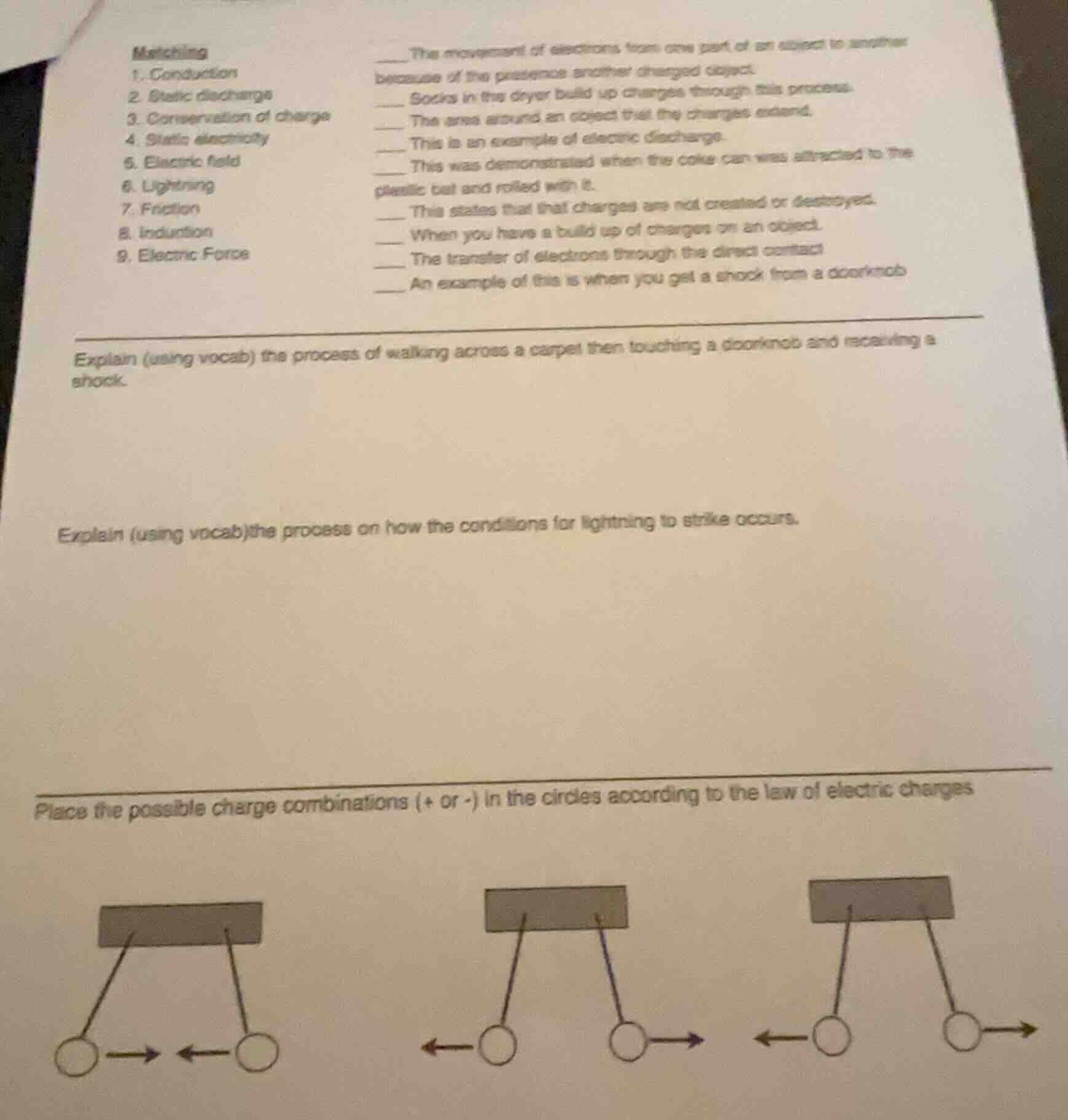
matching1. conduction2. static discharge3. conservation of charge4. static electricity5. electric field6. lightning7. friction8. induction9. electric force__the movement of electrons from one part of an object to another because of the presence another charged object. socks in the dryer build up charges through this process. the area around an object that the charges extend. this is an example of electric discharge. this was demonstrated when the coke can was attracted to the plastic bat and rolled with it. this states that that charges are not created or destroyed. when you have a build up of charges on an object. the transfer of electrons through the direct contact__ an example of this is when you get a shock from a doorknobexplain (using vocab) the process of walking across a carpet then touching a doorknob and receiving a shock.explain (using vocab)the process on how the conditions for lightning to strike occurs.place the possible charge combinations (+ or -) in the circles according to the law of electric charges
Matching Section
Each term is matched to its definition/description based on static electricity concepts:
- Conduction matches electron transfer via direct contact.
- Static discharge matches the doorknob shock and lightning as examples.
- Conservation of charge states charges are not created/destroyed.
- Static electricity is the buildup of charge on an object.
- Electric field is the area around a charged object.
- Lightning is an example of electric discharge.
- Friction is how socks in a dryer build charge.
- Induction is electron movement from a nearby charged object.
- Electric Force is the attraction between the coke can and plastic bat.
1: Walking on Carpet + Doorknob Shock
The process uses friction, static electricity, and static discharge:
- Friction: Walking across a carpet transfers electrons between your shoes and the carpet, giving your body a net static charge (static electricity).
- Static Electricity: Your body holds this excess charge, creating a potential difference with the neutral doorknob.
- Static Discharge: When you touch the conductive doorknob, the excess electrons rapidly transfer from your body to the doorknob, creating the visible/feeling shock.

Snap & solve any problem in the app
Get step-by-step solutions on Sovi AI
Photo-based solutions with guided steps
Explore more problems and detailed explanations
- Conduction → The transfer of electrons through the direct contact
- Static discharge → An example of this is when you get a shock from a doorknob
- Conservation of charge → This states that that charges are not created or destroyed.
- Static electricity → When you have a build up of charges on an object.
- Electric field → The area around an object that the charges extend.
- Lightning → This is an example of electric discharge.
- Friction → Socks in the dryer build up charges through this process.
- Induction → The movement of electrons from one part of an object to another because of the presence another charged object.
- Electric Force → This was demonstrated when the coke can was attracted to the plastic bat and rolled with it.
---