QUESTION IMAGE
Question
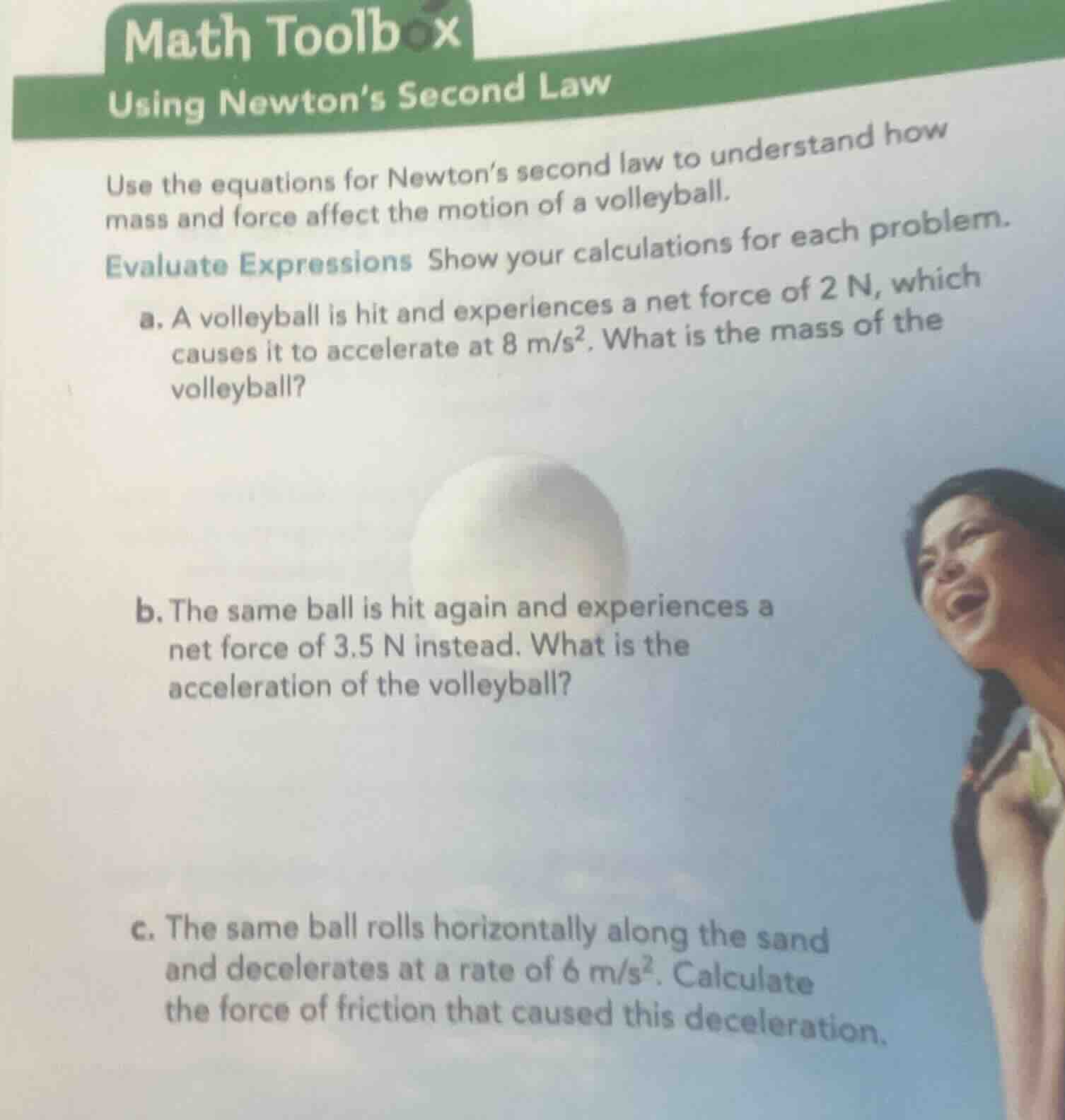
math toolbox
using newton’s second law
use the equations for newton’s second law to understand how
mass and force affect the motion of a volleyball.
evaluate expressions show your calculations for each problem.
a. a volleyball is hit and experiences a net force of 2 n, which
causes it to accelerate at 8 m/s². what is the mass of the
volleyball?
b. the same ball is hit again and experiences a
net force of 3.5 n instead. what is the
acceleration of the volleyball?
c. the same ball rolls horizontally along the sand
and decelerates at a rate of 6 m/s². calculate
the force of friction that caused this deceleration.
Part (a)
Step1: Recall Newton's Second Law
Newton's second law is given by \( F = ma \), where \( F \) is the force, \( m \) is the mass, and \( a \) is the acceleration. We need to solve for \( m \), so we rearrange the formula to \( m=\frac{F}{a} \).
Step2: Substitute the given values
We know that \( F = 2\space N \) and \( a = 8\space m/s^{2} \). Substituting these values into the formula \( m=\frac{F}{a} \), we get \( m=\frac{2}{8} \).
Step3: Simplify the expression
Simplifying \( \frac{2}{8} \) gives \( m = 0.25\space kg \).
Step1: Recall Newton's Second Law
We use the formula \( F = ma \), and we need to solve for \( a \). First, we know the mass \( m \) from part (a) is \( 0.25\space kg \), and the new force \( F = 3.5\space N \). Rearranging the formula for \( a \), we get \( a=\frac{F}{m} \).
Step2: Substitute the values
Substituting \( F = 3.5\space N \) and \( m = 0.25\space kg \) into the formula \( a=\frac{F}{m} \), we have \( a=\frac{3.5}{0.25} \).
Step3: Calculate the acceleration
Calculating \( \frac{3.5}{0.25} \) gives \( a = 14\space m/s^{2} \).
Step1: Recall Newton's Second Law
We use the formula \( F = ma \). The mass \( m \) is \( 0.25\space kg \) (from part a), and the deceleration \( a = 6\space m/s^{2} \) (deceleration is just acceleration in the opposite direction, so we use the magnitude for force calculation).
Step2: Substitute the values
Substituting \( m = 0.25\space kg \) and \( a = 6\space m/s^{2} \) into the formula \( F = ma \), we get \( F=(0.25)\times(6) \).
Step3: Calculate the force
Calculating \( 0.25\times6 \) gives \( F = 1.5\space N \). Since friction is the force causing deceleration, the force of friction is \( 1.5\space N \).

Snap & solve any problem in the app
Get step-by-step solutions on Sovi AI
Photo-based solutions with guided steps
Explore more problems and detailed explanations
The mass of the volleyball is \( 0.25\space kg \).