QUESTION IMAGE
Question
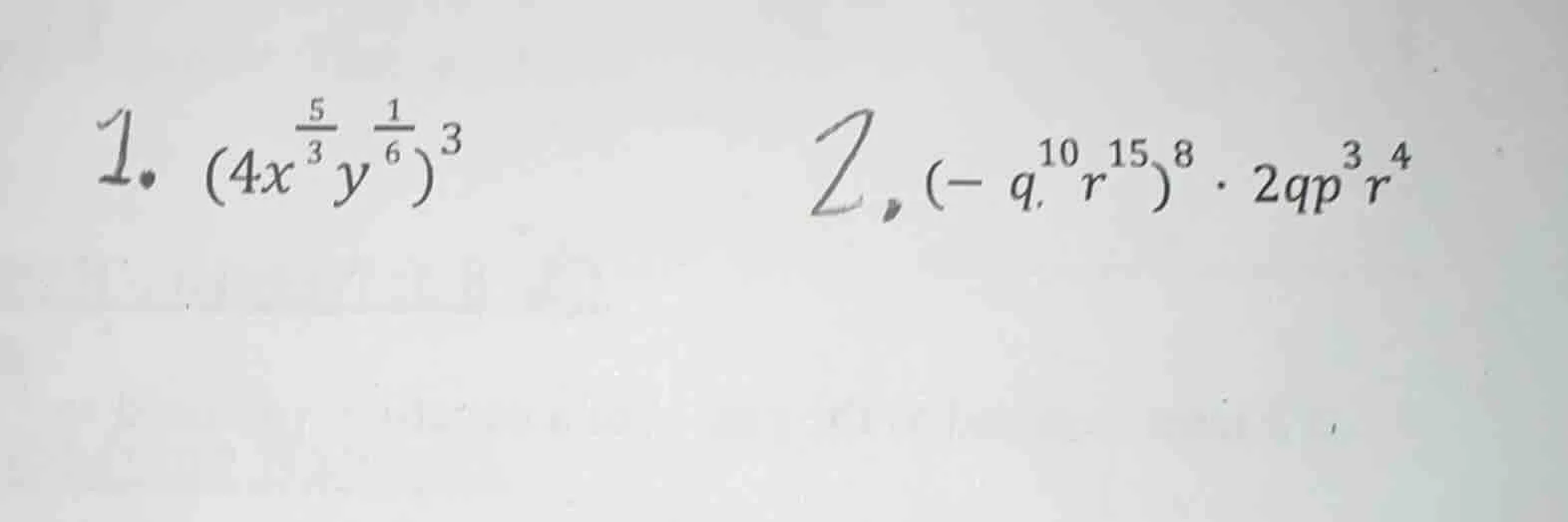
- $(4x^{\frac{5}{3}}y^{\frac{1}{6}})^3$ 2. $(-q^{10}r^{15})^8cdot 2qp^3r^4$
Problem 1: \(\boldsymbol{(4x^{\frac{5}{3}}y^{\frac{1}{6}})^3}\)
Step1: Apply power of a product rule
The power of a product rule states that \((ab)^n = a^n b^n\). So we can apply this to each factor inside the parentheses:
\((4x^{\frac{5}{3}}y^{\frac{1}{6}})^3 = 4^3 \cdot (x^{\frac{5}{3}})^3 \cdot (y^{\frac{1}{6}})^3\)
Step2: Simplify each term
- For \(4^3\), we calculate \(4\times4\times4 = 64\).
- For \((x^{\frac{5}{3}})^3\), we use the power of a power rule \((a^m)^n=a^{mn}\). So \((x^{\frac{5}{3}})^3=x^{\frac{5}{3}\times3}=x^5\).
- For \((y^{\frac{1}{6}})^3\), using the power of a power rule: \((y^{\frac{1}{6}})^3 = y^{\frac{1}{6}\times3}=y^{\frac{1}{2}}\) (or \(y^{0.5}\), but fractional exponents are often preferred in this form).
Step3: Combine the simplified terms
Putting it all together, we get \(64x^5y^{\frac{1}{2}}\) (or \(64x^5\sqrt{y}\) if we want to write the fractional exponent as a radical, but the exponential form is also correct).
Step1: Simplify \((-q^{10}r^{15})^8\)
Using the power of a product rule \((ab)^n=a^n b^n\) and the power of a power rule \((a^m)^n = a^{mn}\), and also noting that \((-a)^n=a^n\) when \(n\) is even (since \(8\) is even):
\((-q^{10}r^{15})^8=(-1)^8\cdot(q^{10})^8\cdot(r^{15})^8\)
\((-1)^8 = 1\), \((q^{10})^8=q^{10\times8}=q^{80}\), \((r^{15})^8=r^{15\times8}=r^{120}\)
So \((-q^{10}r^{15})^8 = q^{80}r^{120}\)
Step2: Multiply by \(2qp^{3}r^{4}\)
Now we multiply \(q^{80}r^{120}\) by \(2qp^{3}r^{4}\). Using the product rule for exponents \(a^m\cdot a^n=a^{m + n}\) for like bases:
- For the \(q\) terms: \(q^{80}\cdot q = q^{80 + 1}=q^{81}\)
- For the \(r\) terms: \(r^{120}\cdot r^{4}=r^{120+4}=r^{124}\)
- The \(p\) term remains \(p^{3}\) (since there's no other \(p\) term to multiply with)
- The coefficient is \(2\) (from \(2qp^{3}r^{4}\))
Putting it all together: \(2\times q^{81}\times p^{3}\times r^{124}=2q^{81}p^{3}r^{124}\)

Snap & solve any problem in the app
Get step-by-step solutions on Sovi AI
Photo-based solutions with guided steps
Explore more problems and detailed explanations
\(64x^{5}y^{\frac{1}{2}}\) (or \(64x^{5}\sqrt{y}\))