QUESTION IMAGE
Question
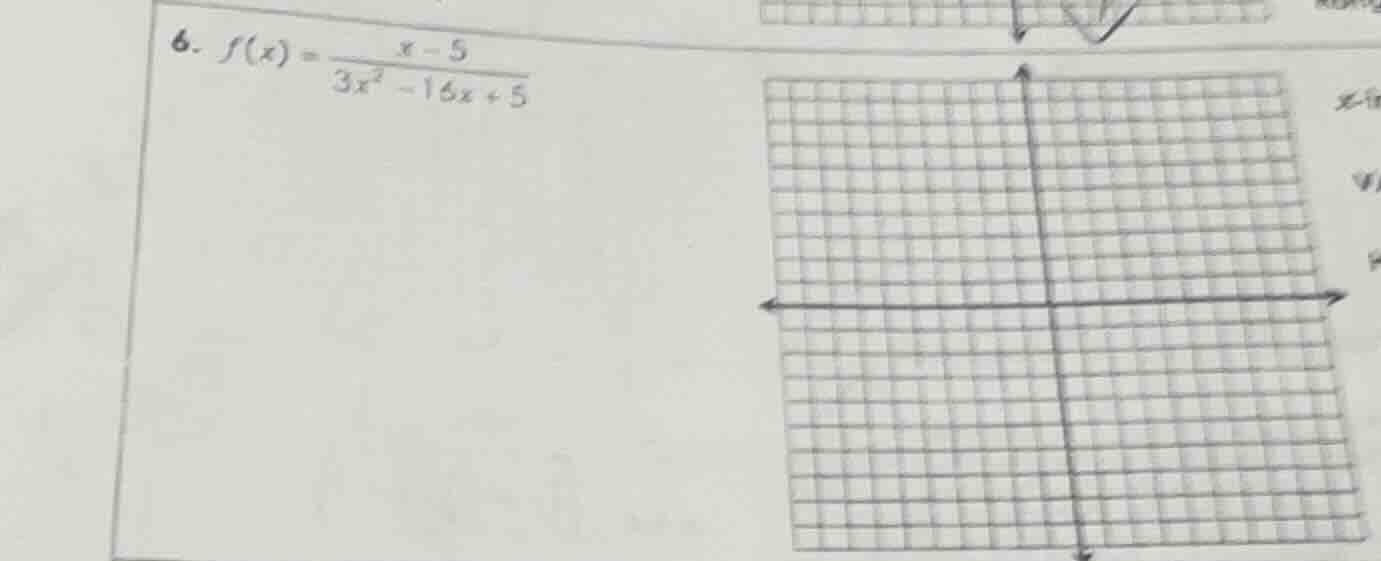
- $f(x) = \frac{x - 5}{3x^2 - 16x + 5}$
Assuming the problem is to find the domain of the function \( f(x)=\frac{x - 5}{3x^{2}-16x + 5} \) (a common type of problem with this function), here's the step - by - step solution:
Step 1: Factor the denominator
We need to factor the quadratic expression in the denominator \( 3x^{2}-16x + 5 \).
We use the formula for factoring \( ax^{2}+bx + c=a(x - x_1)(x - x_2) \), where \( x_{1,2}=\frac{-b\pm\sqrt{b^{2}-4ac}}{2a} \). For \( 3x^{2}-16x + 5 \), \( a = 3 \), \( b=-16 \), \( c = 5 \).
First, calculate the discriminant \( \Delta=b^{2}-4ac=(-16)^{2}-4\times3\times5=256 - 60 = 196 \).
Then \( x=\frac{16\pm\sqrt{196}}{6}=\frac{16\pm14}{6} \).
\( x_1=\frac{16 + 14}{6}=\frac{30}{6}=5 \), \( x_2=\frac{16-14}{6}=\frac{2}{6}=\frac{1}{3} \).
So \( 3x^{2}-16x + 5=3(x - 5)(x-\frac{1}{3})=(3x - 1)(x - 5) \) (by multiplying out \( 3(x - 5)(x-\frac{1}{3})=3(x^{2}-\frac{1}{3}x-5x + \frac{5}{3})=3x^{2}-x-15x + 5=3x^{2}-16x + 5 \))
Step 2: Find values that make denominator zero
The function is undefined when the denominator is zero. So we set \( 3x^{2}-16x + 5 = 0 \), which we factored as \( (3x - 1)(x - 5)=0 \).
Setting each factor equal to zero:
- \( 3x-1 = 0\Rightarrow x=\frac{1}{3} \)
- \( x - 5=0\Rightarrow x = 5 \)
Step 3: Determine the domain
The domain of a rational function is all real numbers except the values that make the denominator zero. But we also need to check if there are any common factors in the numerator and denominator that can be canceled. The numerator is \( x - 5 \) and the denominator has a factor of \( x - 5 \). However, we still need to exclude \( x = 5 \) from the domain because when \( x = 5 \), the original function has a \( \frac{0}{0} \) form (it is a removable discontinuity, but still not in the domain of the original function). And we also exclude \( x=\frac{1}{3} \) because it makes the denominator zero.
So the domain of \( f(x) \) is all real numbers except \( x=\frac{1}{3} \) and \( x = 5 \), or in interval notation \( (-\infty,\frac{1}{3})\cup(\frac{1}{3},5)\cup(5,\infty) \)
If the problem was different (e.g., finding the vertical asymptote), the vertical asymptote occurs at \( x=\frac{1}{3} \) (since \( x = 5 \) is a removable discontinuity, we cancel the \( (x - 5) \) factors and then the denominator of the simplified function \( f(x)=\frac{1}{3x - 1} \) (for \( x
eq5 \)) is zero when \( 3x-1=0\Rightarrow x=\frac{1}{3} \))

Snap & solve any problem in the app
Get step-by-step solutions on Sovi AI
Photo-based solutions with guided steps
Explore more problems and detailed explanations
If the question was about the domain: The domain is all real numbers except \( x=\frac{1}{3} \) and \( x = 5 \) (or in interval notation \( (-\infty,\frac{1}{3})\cup(\frac{1}{3},5)\cup(5,\infty) \))
If the question was about vertical asymptote: The vertical asymptote is \( x=\frac{1}{3} \)