QUESTION IMAGE
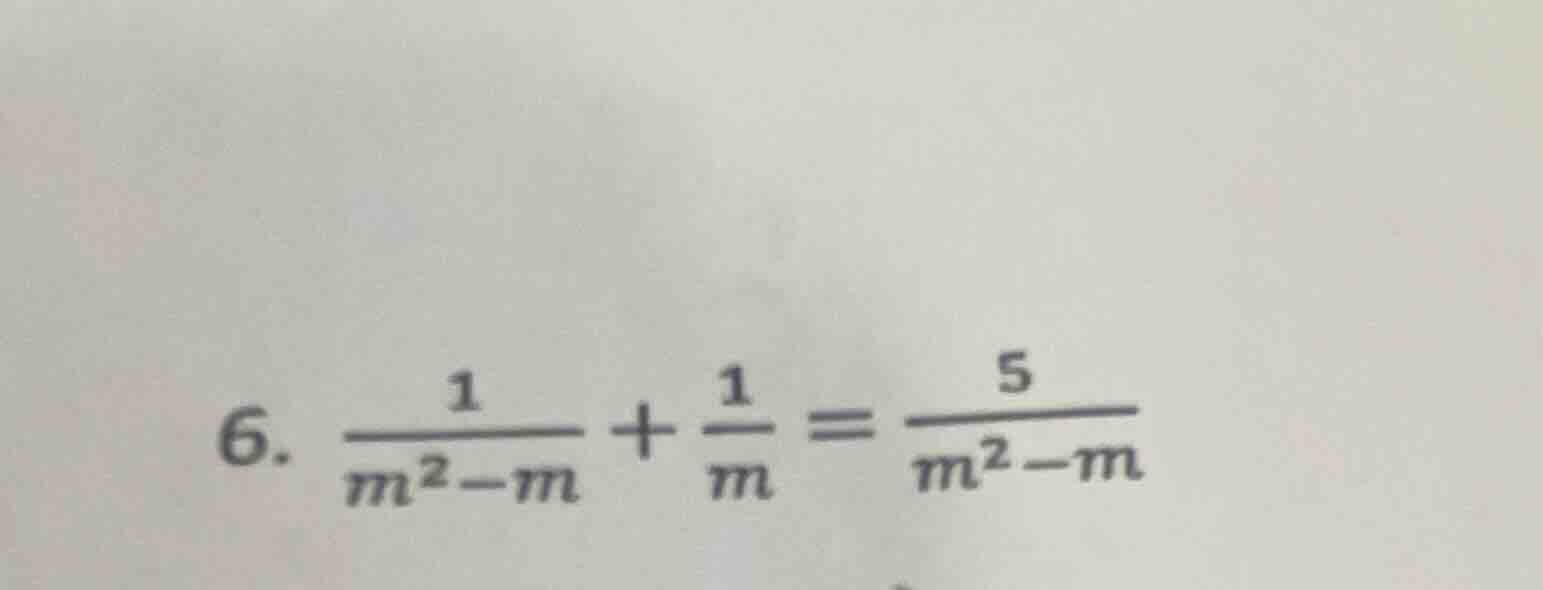
Question
- \\(\frac{1}{m^2 - m} + \frac{1}{m} = \frac{5}{m^2 - m}\\)
Step1: Factor the denominator
First, factor the denominators. We know that \(m^{2}-m = m(m - 1)\). So the equation becomes \(\frac{1}{m(m - 1)}+\frac{1}{m}=\frac{5}{m(m - 1)}\).
Step2: Find a common denominator
The common denominator for the left - hand side is \(m(m - 1)\). Rewrite \(\frac{1}{m}\) with the common denominator: \(\frac{1}{m}=\frac{m - 1}{m(m - 1)}\).
Now the equation is \(\frac{1}{m(m - 1)}+\frac{m - 1}{m(m - 1)}=\frac{5}{m(m - 1)}\).
Step3: Combine the fractions on the left - hand side
Combine the two fractions on the left: \(\frac{1+(m - 1)}{m(m - 1)}=\frac{5}{m(m - 1)}\).
Simplify the numerator of the left - hand side: \(1+(m - 1)=m\). So we have \(\frac{m}{m(m - 1)}=\frac{5}{m(m - 1)}\).
Step4: Exclude the non - valid values
Note that \(m
eq0\) and \(m
eq1\) because these values would make the original denominators zero.
Step5: Solve for m
Since the denominators \(m(m - 1)\) are the same (and non - zero), we can set the numerators equal: \(m = 5\). But wait, when we substitute \(m = 5\) back into the original equation:
Left - hand side: \(\frac{1}{25 - 5}+\frac{1}{5}=\frac{1}{20}+\frac{1}{5}=\frac{1 + 4}{20}=\frac{5}{20}=\frac{1}{4}\)
Right - hand side: \(\frac{5}{25 - 5}=\frac{5}{20}=\frac{1}{4}\)
Wait, but let's check our step 3 again. Wait, when we combined the fractions:
\(\frac{1+(m - 1)}{m(m - 1)}=\frac{m}{m(m - 1)}\), then we can cancel out \(m\) (since \(m
eq0\)) to get \(\frac{1}{m - 1}=\frac{5}{m(m - 1)}\) (Wait, no, earlier step had a mistake). Let's redo step 3:
Starting over from the equation \(\frac{1}{m(m - 1)}+\frac{1}{m}=\frac{5}{m(m - 1)}\)
Multiply both sides of the equation by \(m(m - 1)\) (since \(m
eq0\) and \(m
eq1\)) to get rid of the denominators:
\(1+(m - 1)=5\)
Simplify the left - hand side: \(1+m - 1=m\)
So \(m = 5\)
Wait, but when we did the first simplification, we had \(\frac{m}{m(m - 1)}=\frac{5}{m(m - 1)}\), cancel \(m\) ( \(m
eq0\)) gives \(\frac{1}{m - 1}=\frac{5}{m(m - 1)}\), then multiply both sides by \(m(m - 1)\) ( \(m
eq0,m
eq1\)): \(m = 5\)
Now check \(m = 5\) in original equation:
Left: \(\frac{1}{25 - 5}+\frac{1}{5}=\frac{1}{20}+\frac{1}{5}=\frac{1 + 4}{20}=\frac{5}{20}=\frac{1}{4}\)
Right: \(\frac{5}{25 - 5}=\frac{5}{20}=\frac{1}{4}\)
But wait, when we first combined the fractions, we had \(\frac{1+(m - 1)}{m(m - 1)}=\frac{m}{m(m - 1)}\), then \(\frac{m}{m(m - 1)}=\frac{5}{m(m - 1)}\), so \(m = 5\) (after canceling \(m(m - 1)\) for \(m
eq0,m
eq1\))
Wait, but let's check the case when we made a mistake. Wait, no, the solution \(m = 5\) is valid? Wait, no, wait:
Wait, original equation: \(\frac{1}{m^{2}-m}+\frac{1}{m}=\frac{5}{m^{2}-m}\)
\(m^{2}-m=m(m - 1)\), so domain is \(m
eq0,m
eq1\)
Multiply both sides by \(m(m - 1)\):
\(1+(m - 1)=5\)
\(1+m - 1=5\)
\(m = 5\)
Which is in the domain. So the solution is \(m = 5\)? Wait, but let's check again.
Wait, when we have \(\frac{1}{m(m - 1)}+\frac{1}{m}=\frac{5}{m(m - 1)}\)
\(\frac{1}{m(m - 1)}+\frac{m - 1}{m(m - 1)}=\frac{5}{m(m - 1)}\)
\(\frac{1+m - 1}{m(m - 1)}=\frac{5}{m(m - 1)}\)
\(\frac{m}{m(m - 1)}=\frac{5}{m(m - 1)}\)
Cancel \(m\) ( \(m
eq0\)): \(\frac{1}{m - 1}=\frac{5}{m(m - 1)}\)
Multiply both sides by \(m(m - 1)\) ( \(m
eq0,m
eq1\)): \(m=5\)
Yes, \(m = 5\) is valid.
Wait, but earlier when I thought there was a mistake, I was wrong. So the solution is \(m = 5\)

Snap & solve any problem in the app
Get step-by-step solutions on Sovi AI
Photo-based solutions with guided steps
Explore more problems and detailed explanations
\(m = 5\)