QUESTION IMAGE
Question
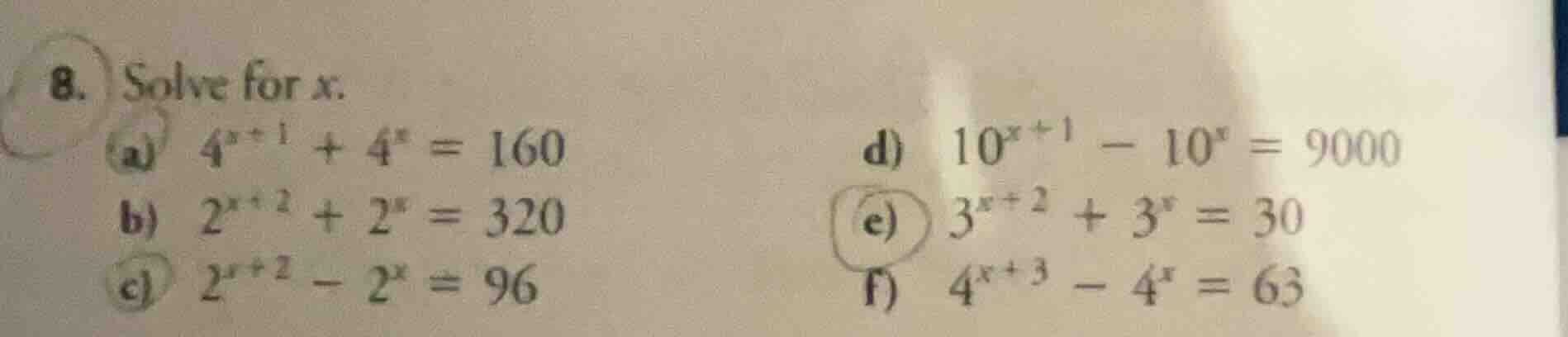
- solve for x.
a) $4^{x + 1} + 4^{x} = 160$
d) $10^{x + 1} - 10^{x} = 9000$
b) $2^{x + 2} + 2^{x} = 320$
e) $3^{x + 2} + 3^{x} = 30$
c) $2^{x + 2} - 2^{x} = 96$
f) $4^{x + 3} - 4^{x} = 63$
Part (a)
Step1: Factor out \(4^x\)
Using the exponent rule \(a^{m+n}=a^m\times a^n\), we can rewrite \(4^{x + 1}\) as \(4\times4^x\). So the equation \(4^{x+1}+4^x = 160\) becomes:
\(4\times4^x+4^x=160\)
Factor out \(4^x\):
\(4^x(4 + 1)=160\)
\(4^x\times5 = 160\)
Step2: Solve for \(4^x\)
Divide both sides by 5:
\(4^x=\frac{160}{5}=32\)
Step3: Express 32 as a power of 4
We know that \(4^2 = 16\) and \(4^3=64\), but \(32 = 2^5\) and \(4^x=(2^2)^x = 2^{2x}\). So we can rewrite the equation as:
\(2^{2x}=2^5\)
Since the bases are the same, we can set the exponents equal:
\(2x = 5\)
\(x=\frac{5}{2}=2.5\)
Step1: Factor out \(2^x\)
Rewrite \(2^{x + 2}\) as \(4\times2^x\) (using \(a^{m + n}=a^m\times a^n\)). The equation \(2^{x+2}+2^x = 320\) becomes:
\(4\times2^x+2^x=320\)
Factor out \(2^x\):
\(2^x(4 + 1)=320\)
\(2^x\times5 = 320\)
Step2: Solve for \(2^x\)
Divide both sides by 5:
\(2^x=\frac{320}{5}=64\)
Step3: Express 64 as a power of 2
We know that \(2^6 = 64\). So:
\(2^x=2^6\)
Setting the exponents equal (since the bases are the same), we get \(x = 6\)
Step1: Factor out \(2^x\)
Rewrite \(2^{x + 2}\) as \(4\times2^x\). The equation \(2^{x+2}-2^x = 96\) becomes:
\(4\times2^x-2^x=96\)
Factor out \(2^x\):
\(2^x(4 - 1)=96\)
\(2^x\times3 = 96\)
Step2: Solve for \(2^x\)
Divide both sides by 3:
\(2^x=\frac{96}{3}=32\)
Step3: Express 32 as a power of 2
We know that \(2^5 = 32\). So:
\(2^x=2^5\)
Setting the exponents equal, we get \(x = 5\)

Snap & solve any problem in the app
Get step-by-step solutions on Sovi AI
Photo-based solutions with guided steps
Explore more problems and detailed explanations
\(x = \frac{5}{2}\) (or \(2.5\))