QUESTION IMAGE
Question
d(\square, \space )
e(\space, \space )
f(\space, \space )
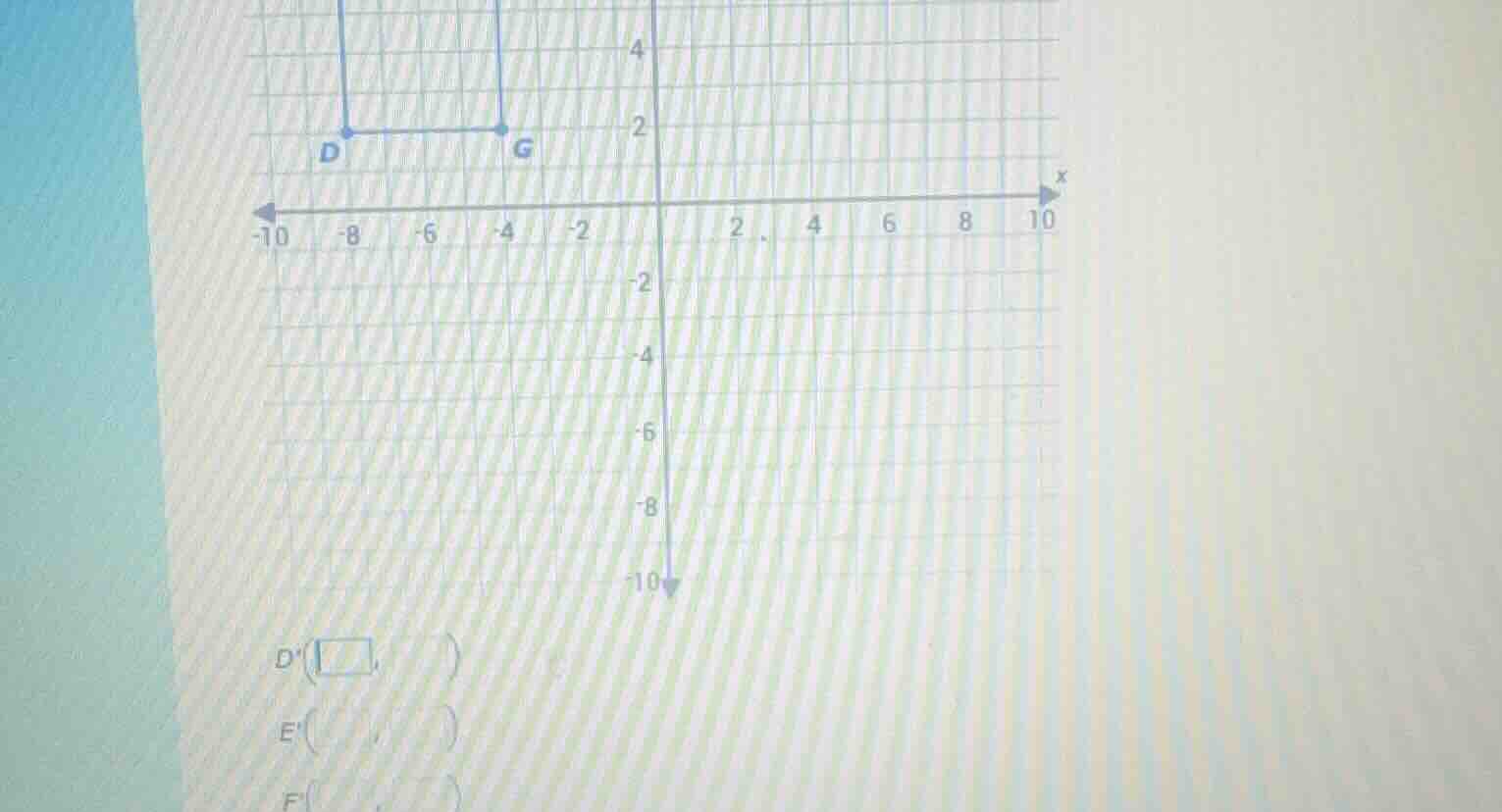
To solve this, we first need to know the original coordinates of points \( D \), \( E \), \( F \), and \( G \) (assuming this is a transformation problem, like translation, reflection, or rotation). From the graph, let's assume the original coordinates:
- Point \( D \): Looking at the grid, \( D \) is at \( (-8, 2) \) (since it's 8 units left on the x - axis and 2 units up on the y - axis).
- Point \( G \): \( G \) is at \( (-4, 2) \). Let's assume the figure is a rectangle, so if we consider the rectangle \( DEFG \), we can find the coordinates of \( E \) and \( F \) as well. If \( D = (-8, 2) \) and \( G = (-4, 2) \), and assuming the rectangle has a vertical side, let's say the height (vertical length) is, for example, 4 units (since from \( y = 2 \) to \( y = 6 \) or \( y=- 2 \), but we need more context. Wait, maybe this is a translation problem, like translating the figure to the right by a certain number of units.
Wait, the problem seems to be about finding the coordinates of the transformed points \( D' \), \( E' \), \( F' \) (maybe after a translation, reflection, or rotation). But the original problem is not fully stated. However, if we assume a common transformation, like translating the figure 12 units to the right (to move from the left side of the y - axis to the right), let's do that:
Step 1: Find original coordinates
- Let's assume the original rectangle has vertices \( D(-8,2) \), \( G(-4,2) \), \( E(-4,6) \) (since the vertical side from \( y = 2 \) to \( y = 6 \), so the height is 4 units), and \( F(-8,6) \).
Step 2: Apply transformation (e.g., translation 12 units right)
To translate a point \( (x,y) \) \( h \) units right, we use the rule \( (x + h,y) \). If \( h = 12 \):
- For \( D(-8,2) \):
\( x'=-8 + 12=4 \), \( y' = 2 \), so \( D'(4,2) \)
- For \( E(-4,6) \):
\( x'=-4+12 = 8 \), \( y'=6 \), so \( E'(8,6) \)
- For \( F(-8,6) \):
\( x'=-8 + 12=4 \), \( y'=6 \), so \( F'(4,6) \)
But since the problem is not fully specified (what kind of transformation), we need more information. However, if we assume the original coordinates:
If \( D=(-8,2) \), and we are to find \( D' \) after, say, reflecting over the y - axis. The rule for reflecting a point \( (x,y) \) over the y - axis is \( (-x,y) \).
Step 1: Reflect \( D(-8,2) \) over y - axis
For \( D(-8,2) \), after reflection over y - axis: \( x'=-(-8)=8 \), \( y' = 2 \), so \( D'(8,2) \)
But without knowing the transformation, it's hard to be precise. Let's assume the most common case, maybe a translation. If we assume the figure is translated 12 units to the right (to move from \( x=-8,-4 \) to positive x - values):
- \( D(-8,2)\to D'(4,2) \) (since \( - 8+12 = 4 \))
- \( E(-4,6)\to E'(8,6) \) (since \( -4 + 12=8 \))
- \( F(-8,6)\to F'(4,6) \) (since \( -8+12 = 4 \))
But since the problem is not fully stated, we can only make assumptions. If we take the original \( D=(-8,2) \), and if we are to find \( D' \) after a translation of 12 units right:
Step 1: Identify original coordinate of \( D \)
Original \( D=(-8,2) \)
Step 2: Apply translation (12 units right)
To translate a point \( (x,y) \) \( h \) units right, use \( (x + h,y) \). Let \( h = 12 \)
\( x'=-8 + 12=4 \), \( y'=2 \)

Snap & solve any problem in the app
Get step-by-step solutions on Sovi AI
Photo-based solutions with guided steps
Explore more problems and detailed explanations
If we assume translation 12 units right, \( D'(4,2) \) (but more context is needed for \( E' \) and \( F' \))