QUESTION IMAGE
Question
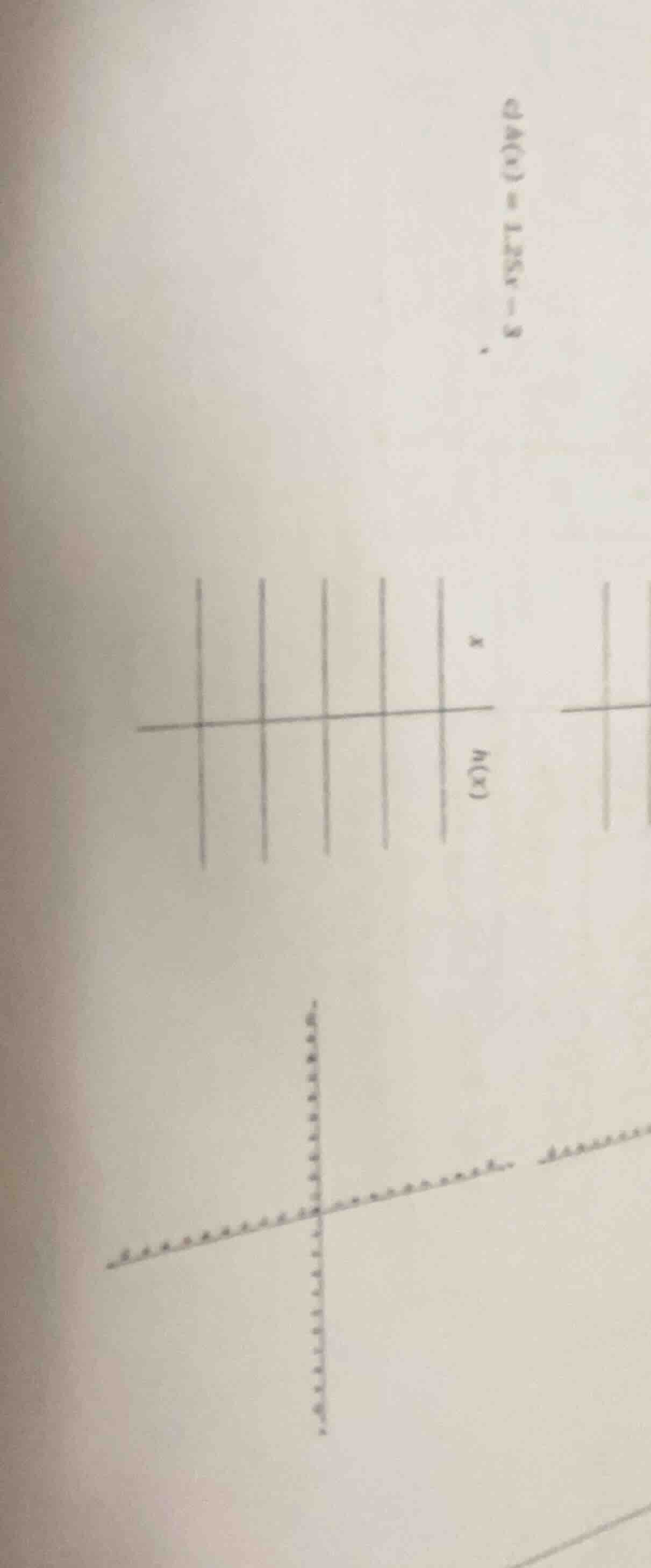
h(x) = 1.25x - 3
To analyze the function \( h(x) = 1.25x - 3 \), we can follow these steps:
Step 1: Identify the type of function
The function \( h(x) = 1.25x - 3 \) is a linear function in the form \( y = mx + b \), where \( m \) is the slope and \( b \) is the y-intercept.
Step 2: Determine the slope and y-intercept
- The slope (\( m \)) is \( 1.25 \) (or \( \frac{5}{4} \)), which means for every 1 unit increase in \( x \), \( h(x) \) increases by 1.25 units.
- The y-intercept (\( b \)) is \( -3 \), so the line crosses the y-axis at \( (0, -3) \).
Step 3: Find the x-intercept (optional)
To find the x-intercept, set \( h(x) = 0 \) and solve for \( x \):
\[
\]
So the x-intercept is \( (2.4, 0) \).
Step 4: Graph the function (optional)
- Plot the y-intercept \( (0, -3) \) and the x-intercept \( (2.4, 0) \).
- Draw a straight line through these two points. The line should have a positive slope (going up from left to right) since the slope is positive (1.25).
Step 5: Analyze the behavior
- As \( x \) approaches \( +\infty \), \( h(x) \) approaches \( +\infty \) (because the slope is positive).
- As \( x \) approaches \( -\infty \), \( h(x) \) approaches \( -\infty \).
Step 6: Evaluate the function at specific values (optional)
For example, if we want to find \( h(4) \):
\[
h(4) = 1.25(4) - 3 = 5 - 3 = 2
\]
So when \( x = 4 \), \( h(x) = 2 \).
Final Answer
The function \( h(x) = 1.25x - 3 \) is a linear function with a slope of \( 1.25 \) and a y-intercept of \( -3 \). It crosses the x-axis at \( (2.4, 0) \) and the y-axis at \( (0, -3) \). The graph is a straight line with a positive slope, increasing from left to right.

Snap & solve any problem in the app
Get step-by-step solutions on Sovi AI
Photo-based solutions with guided steps
Explore more problems and detailed explanations
To analyze the function \( h(x) = 1.25x - 3 \), we can follow these steps:
Step 1: Identify the type of function
The function \( h(x) = 1.25x - 3 \) is a linear function in the form \( y = mx + b \), where \( m \) is the slope and \( b \) is the y-intercept.
Step 2: Determine the slope and y-intercept
- The slope (\( m \)) is \( 1.25 \) (or \( \frac{5}{4} \)), which means for every 1 unit increase in \( x \), \( h(x) \) increases by 1.25 units.
- The y-intercept (\( b \)) is \( -3 \), so the line crosses the y-axis at \( (0, -3) \).
Step 3: Find the x-intercept (optional)
To find the x-intercept, set \( h(x) = 0 \) and solve for \( x \):
\[
\]
So the x-intercept is \( (2.4, 0) \).
Step 4: Graph the function (optional)
- Plot the y-intercept \( (0, -3) \) and the x-intercept \( (2.4, 0) \).
- Draw a straight line through these two points. The line should have a positive slope (going up from left to right) since the slope is positive (1.25).
Step 5: Analyze the behavior
- As \( x \) approaches \( +\infty \), \( h(x) \) approaches \( +\infty \) (because the slope is positive).
- As \( x \) approaches \( -\infty \), \( h(x) \) approaches \( -\infty \).
Step 6: Evaluate the function at specific values (optional)
For example, if we want to find \( h(4) \):
\[
h(4) = 1.25(4) - 3 = 5 - 3 = 2
\]
So when \( x = 4 \), \( h(x) = 2 \).
Final Answer
The function \( h(x) = 1.25x - 3 \) is a linear function with a slope of \( 1.25 \) and a y-intercept of \( -3 \). It crosses the x-axis at \( (2.4, 0) \) and the y-axis at \( (0, -3) \). The graph is a straight line with a positive slope, increasing from left to right.