QUESTION IMAGE
Question
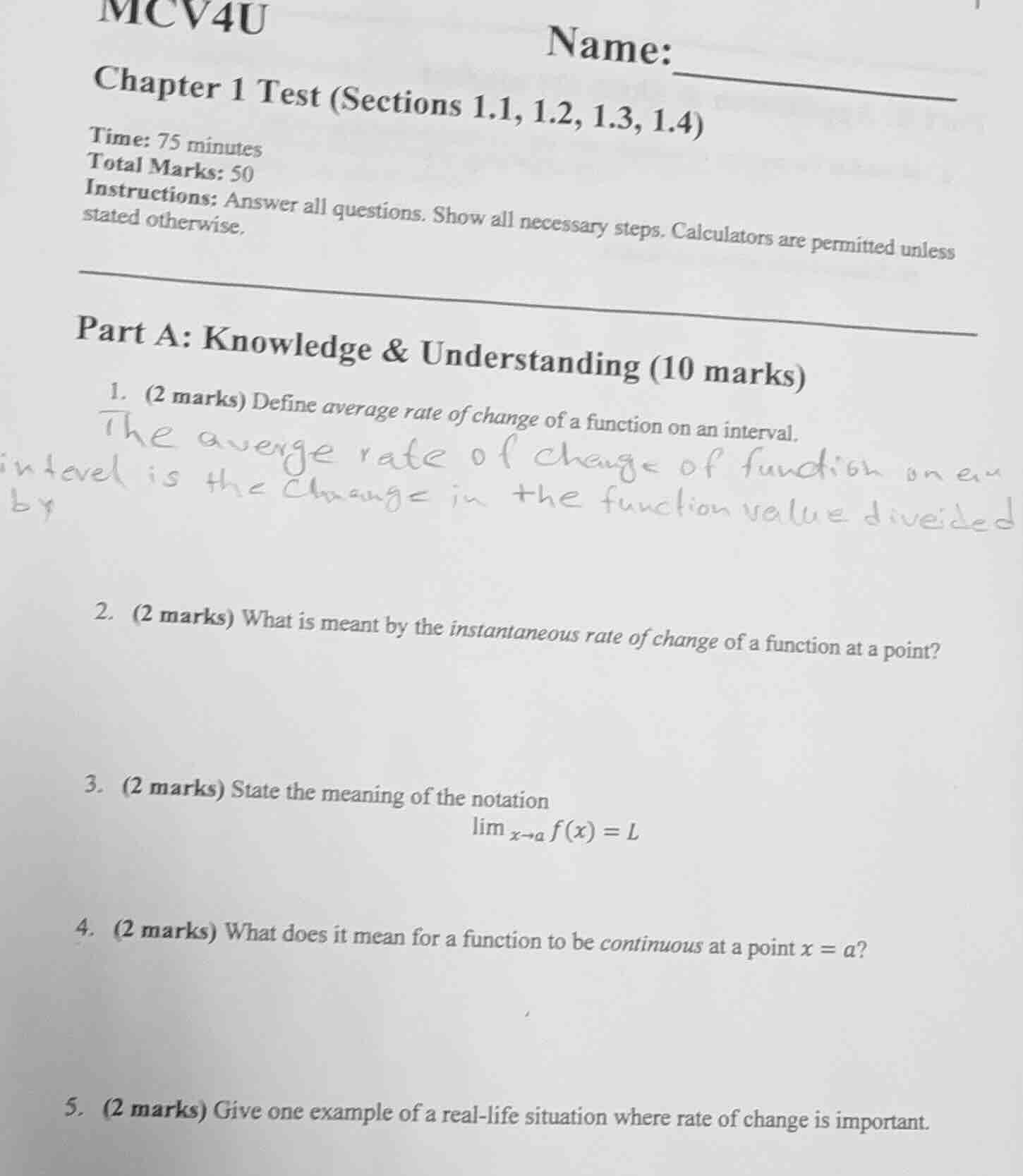
mcv4uname:chapter 1 test (sections 1.1, 1.2, 1.3, 1.4)time: 75 minutestotal marks: 50instructions: answer all questions. show all necessary steps. calculators are permitted unless stated otherwise.part a: knowledge & understanding (10 marks)1. (2 marks) define average rate of change of a function on an interval.the average rate of change of function on anintovel is the change in the function value diveidedby2. (2 marks) what is meant by the instantaneous rate of change of a function at a point?3. (2 marks) state the meaning of the notation$lim_{x \to a} f(x) = l$4. (2 marks) what does it mean for a function to be continuous at a point $x = a$?5. (2 marks) give one example of a real-life situation where rate of change is important.
- Defined average rate of change as the ratio of function value change to input change over an interval, with the formal formula included.
- Explained instantaneous rate of change as the limit of average rate of change as the interval shrinks to a single point, equivalent to the function's derivative at that point.
- Interpreted the limit notation as the function approaching a specific value as its input nears a given point, regardless of the function's value at that point.
- Listed the three required conditions for a function to be continuous at a point: the function is defined at the point, the limit exists at the point, and the limit equals the function's value at the point.
- Provided a real-life example where rate of change is critical, explaining its practical use.

Snap & solve any problem in the app
Get step-by-step solutions on Sovi AI
Photo-based solutions with guided steps
Explore more problems and detailed explanations
- For a function $f(x)$ on interval $[x_1, x_2]$, the average rate of change is the ratio of the change in the function's output to the change in its input:
$\text{Average Rate of Change} = \frac{f(x_2) - f(x_1)}{x_2 - x_1}$
- The instantaneous rate of change of a function at $x=a$ is the limit of the average rate of change as the interval around $a$ shrinks to zero. It is equal to the value of the derivative $f'(a)$, representing the slope of the tangent line to the function at $x=a$.
- The notation $\lim_{x \to a} f(x) = L$ means that as the input value $x$ gets arbitrarily close to $a$ (from both sides, without necessarily equaling $a$), the output values of the function $f(x)$ get arbitrarily close to the value $L$.
- A function $f(x)$ is continuous at $x=a$ if three conditions are met:
- $f(a)$ is defined (the function has a value at $x=a$)
- $\lim_{x \to a} f(x)$ exists (the left-hand and right-hand limits at $a$ are equal)
- $\lim_{x \to a} f(x) = f(a)$ (the limit equals the function's value at $a$)
- One real-life example is calculating the speed of a moving vehicle: speed is the instantaneous rate of change of the vehicle's position with respect to time, which is critical for navigation, safety, and fuel efficiency calculations.