QUESTION IMAGE
Question
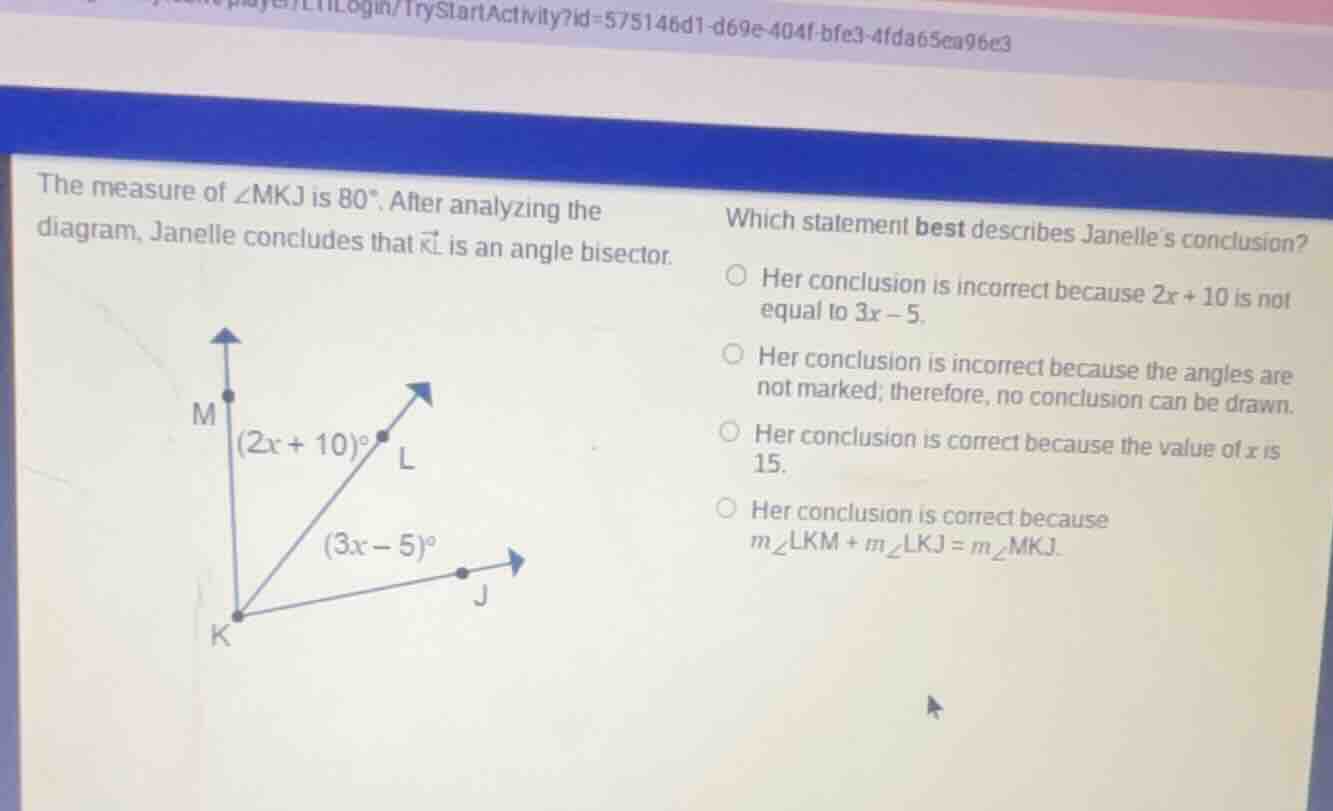
the measure of $\angle mkj$ is $80^\circ$. after analyzing the diagram, janelle concludes that $\overleftrightarrow{kl}$ is an angle bisector. which statement best describes janelle’s conclusion? \bigcirc her conclusion is incorrect because $2x + 10$ is not equal to $3x - 5$. \bigcirc her conclusion is incorrect because the angles are not marked; therefore, no conclusion can be drawn. \bigcirc her conclusion is correct because the value of $x$ is 15. \bigcirc her conclusion is correct because $m\angle lkm + m\angle lkj = m\angle mkj$.
To determine if \(\overrightarrow{KL}\) is an angle bisector, the two angles \(\angle LKM\) (\(2x + 10\)) and \(\angle LKJ\) (\(3x - 5\)) should be equal (since an angle bisector divides the angle into two equal parts) and their sum should be \(\angle MKJ = 80^\circ\).
First, set \(2x + 10 = 3x - 5\) to solve for \(x\):
- Subtract \(2x\) from both sides: \(10 = x - 5\)
- Add 5 to both sides: \(x = 15\)
Now, substitute \(x = 15\) into the angle expressions:
- \(\angle LKM = 2(15)+ 10 = 40^\circ\)
- \(\angle LKJ = 3(15)- 5 = 40^\circ\)
Check if their sum is \(80^\circ\): \(40^\circ+ 40^\circ = 80^\circ\), which matches \(\angle MKJ\). So, \(\overrightarrow{KL}\) divides \(\angle MKJ\) into two equal angles, meaning it is an angle bisector. The third option states her conclusion is correct because \(x = 15\), which is valid as shown.

Snap & solve any problem in the app
Get step-by-step solutions on Sovi AI
Photo-based solutions with guided steps
Explore more problems and detailed explanations
Her conclusion is correct because the value of \(x\) is 15.