QUESTION IMAGE
Question
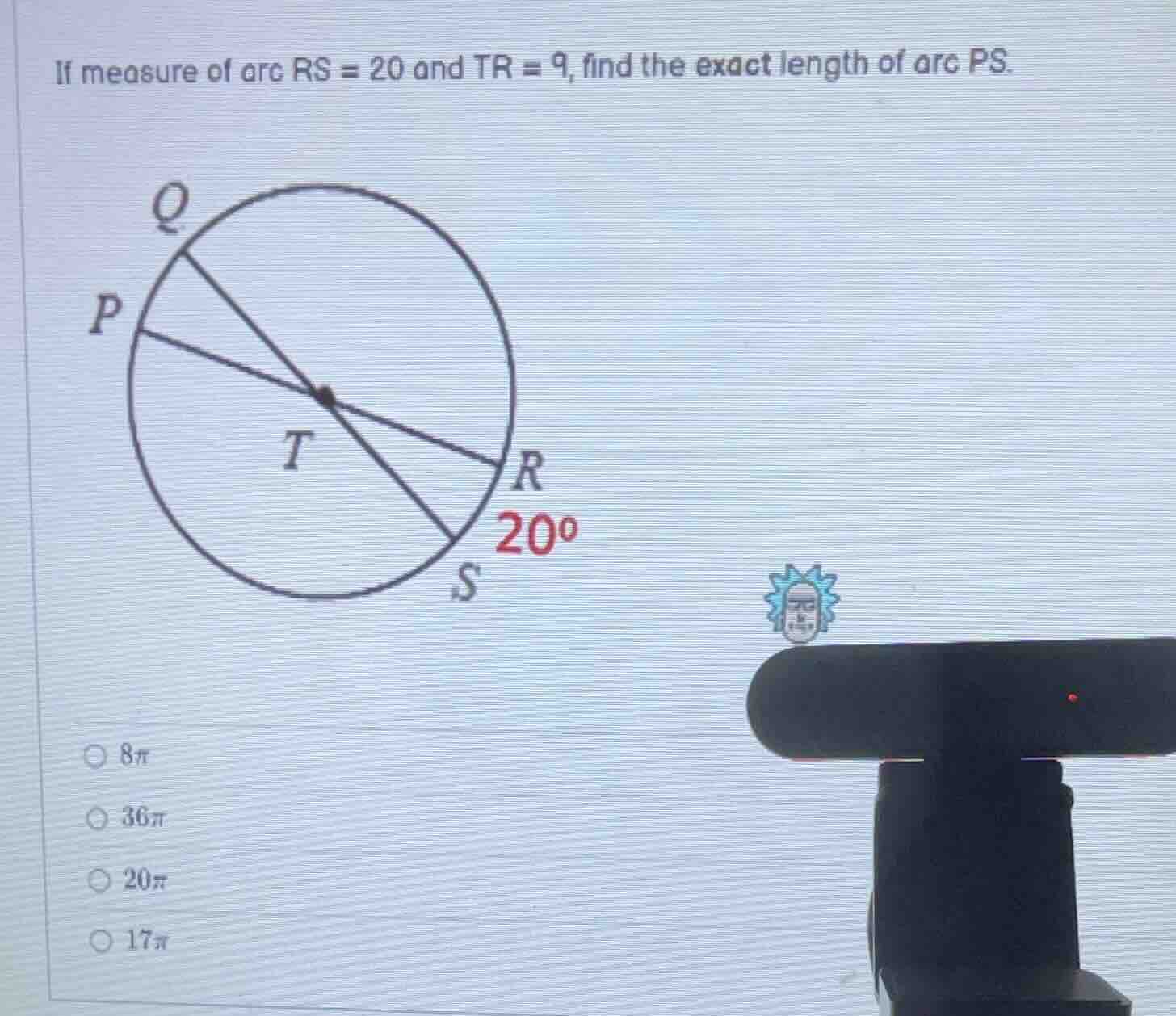
if measure of arc rs = 20 and tr = 9, find the exact length of arc ps.
options:
8π
36π
20π
17π
Step1: Identify the radius and the central angle for arc PS.
The radius \( TR = 9 \), so the radius of the circle \( r = 9 \). The central angle for arc \( RS \) is \( 20^\circ \), and since \( PS \) is a major arc? Wait, no, let's check the straight line. Wait, \( PR \) and \( QS \) are diameters? Wait, \( T \) is the center, so \( PR \) and \( QS \) are diameters, so \( \angle PTR = 180^\circ \), but arc \( RS \) is \( 20^\circ \), so the central angle for arc \( PS \): Wait, the total around a point is \( 360^\circ \), but since \( PR \) is a diameter, the semicircle is \( 180^\circ \). Wait, arc \( RS \) is \( 20^\circ \), so the central angle for arc \( PS \) would be \( 180^\circ - 20^\circ = 160^\circ \)? Wait, no, maybe I misread. Wait, the measure of arc \( RS \) is \( 20^\circ \) (in degrees), and we need to find the length of arc \( PS \). Wait, the formula for arc length is \( s = r\theta \) (when \( \theta \) is in radians) or \( s=\frac{\theta}{360^\circ}\times 2\pi r \) (when \( \theta \) is in degrees). Wait, first, let's confirm the central angle for arc \( PS \). Since \( PR \) is a diameter, the arc \( PR \) is a semicircle, \( 180^\circ \). Arc \( RS \) is \( 20^\circ \), so arc \( PS = arc\ PR - arc\ RS \)? Wait, no, \( P \) to \( S \): let's see the diagram. \( T \) is the center, \( P \), \( T \), \( R \) are colinear (diameter), \( Q \), \( T \), \( S \) are colinear (diameter). So arc \( RS \) is between \( R \) and \( S \), central angle \( 20^\circ \), so arc \( PS \): from \( P \) to \( S \), passing through the other side? Wait, no, the length of arc \( PS \): let's use the formula for arc length. Wait, maybe the central angle for arc \( PS \) is \( 180^\circ - 20^\circ = 160^\circ \)? No, wait, maybe I made a mistake. Wait, the problem says "measure of arc RS = 20" – maybe that's 20 degrees? Wait, the options are in terms of \( \pi \), so let's check the formula. Wait, the radius is 9, so the circumference is \( 2\pi r = 18\pi \). Wait, no, the options are 8π, 36π, 20π, 17π. Wait, maybe the measure of arc RS is 20 degrees, and we need to find the length of arc PS. Wait, maybe the central angle for arc PS is 160 degrees? No, that doesn't match the options. Wait, maybe the measure of arc RS is 20 (in some units, but the options are in π, so maybe the central angle is 20 radians? No, that can't be. Wait, maybe the "measure of arc RS = 20" is 20 degrees, and TR = 9 is the radius. Wait, let's re-express the arc length formula. Arc length \( s = \frac{\theta}{360^\circ} \times 2\pi r \). If \( r = 9 \), and let's see the options. Wait, 36π would be if the central angle is 360/2 = 180? No, 36π is \( 2\pi \times 18 \), but radius is 9, so circumference is 18π. Wait, that's a key point! The circumference of the circle is \( C = 2\pi r = 2\pi \times 9 = 18\pi \). Wait, but the options include 36π, which is double, so maybe I misread the radius. Wait, TR is 9, so the radius is 9, diameter is 18. Wait, maybe the measure of arc RS is 20 degrees, but the central angle for arc PS is 180 - 20 = 160? No, 160 degrees arc length would be \( \frac{160}{360} \times 18\pi = 8\pi \). Ah! That matches option A. Let's check:
Circumference \( C = 2\pi r = 18\pi \). The central angle for arc \( PS \): since \( PR \) is a diameter (180 degrees), and arc \( RS \) is 20 degrees, then arc \( PS = 180 - 20 = 160 \) degrees. Then arc length \( s = \frac{160}{360} \times 18\pi = \frac{160 \times 18\pi}{360} = \frac{160\pi}{20} = 8\pi \).
Step2: Calculate the arc length using the formula.
Using the arc length formula \( s = \frac{…

Snap & solve any problem in the app
Get step-by-step solutions on Sovi AI
Photo-based solutions with guided steps
Explore more problems and detailed explanations
\( 8\pi \) (Option A: \( 8\pi \))