QUESTION IMAGE
Question
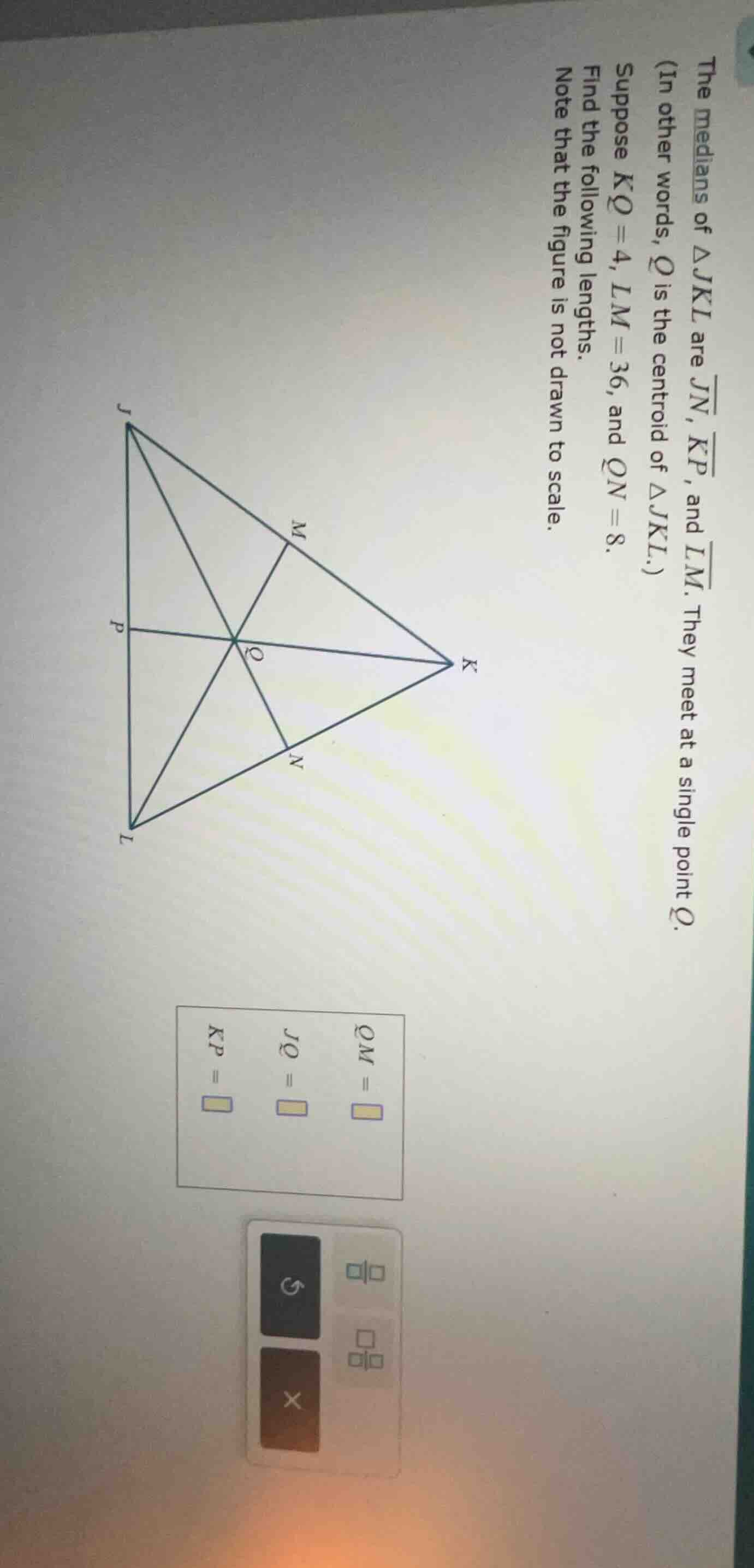
the medians of $\triangle jkl$ are $\overline{jn}$, $\overline{kp}$, and $\overline{lm}$. they meet at a single point $q$. (in other words, $q$ is the centroid of $\triangle jkl$.) suppose $kq = 4$, $lm = 36$, and $qn = 8$. find the following lengths. note that the figure is not drawn to scale. $qm = \square$ $jq = \square$ $kp = \square$
Step1: Recall centroid properties
The centroid of a triangle divides each median into a ratio of \(2:1\), with the longer segment being closer to the vertex.
Step2: Find \(QM\)
Given \(LM = 36\), and \(Q\) is the centroid, so \(LM\) is a median, and \(LQ:QM=2:1\). Let \(QM = x\), then \(LQ = 2x\), and \(LM=LQ + QM=2x+x = 3x\). So \(3x = 36\), solving for \(x\), we get \(x=\frac{36}{3}=12\). Wait, no, wait. Wait, \(LM\) is a median, so \(M\) is the midpoint? Wait, no, the median \(LM\): wait, the medians are \(JN\), \(KP\), \(LM\). Wait, \(Q\) is the centroid. For median \(JN\): \(QN = 8\), so \(JQ:QN = 2:1\), so \(JQ = 2\times8 = 16\). For median \(KP\): \(KQ = 4\), so \(KP=KQ + QP\), and \(KQ:QP = 2:1\), so \(QP=\frac{4}{2}=2\), so \(KP = 4 + 2=6\)? Wait, no, wait. Wait, the centroid divides the median into \(2:1\), so the length from vertex to centroid is \(\frac{2}{3}\) of the median, and centroid to midpoint is \(\frac{1}{3}\) of the median.
Wait, let's re - clarify:
- For median \(JN\): \(Q\) is centroid, so \(JQ:QN = 2:1\). Given \(QN = 8\), then \(JQ=2\times8 = 16\).
- For median \(KP\): \(KQ:QP = 2:1\). Given \(KQ = 4\), then \(QP=\frac{KQ}{2}=\frac{4}{2}=2\), so \(KP=KQ + QP=4 + 2 = 6\).
- For median \(LM\): \(LQ:QM = 2:1\), and \(LM = LQ+QM\). Let \(QM=x\), then \(LQ = 2x\), so \(LM=3x\). Given \(LM = 36\), then \(x=\frac{LM}{3}=\frac{36}{3}=12\). Wait, but the problem asks for \(QM\), \(JQ\), \(KP\).
Wait, let's correct:
- For \(JQ\): Since \(Q\) is centroid, \(JQ:QN = 2:1\), \(QN = 8\), so \(JQ = 2\times8=16\).
- For \(KP\): \(KQ:QP = 2:1\), \(KQ = 4\), so \(QP=\frac{KQ}{2}=2\), so \(KP=KQ + QP=4 + 2 = 6\).
- For \(QM\): \(LM\) is a median, so \(LQ:QM = 2:1\), \(LM = 36\), so \(QM=\frac{1}{3}\times LM=\frac{36}{3}=12\). Wait, but the initial thought was wrong. Let's start over.
Centroid theorem: The centroid of a triangle divides each median into two segments, with the segment from the vertex to the centroid being twice as long as the segment from the centroid to the midpoint of the side. So, if \(d\) is the length of the median, then the length from vertex to centroid is \(\frac{2}{3}d\), and from centroid to midpoint is \(\frac{1}{3}d\).
- For median \(JN\): \(QN\) is the segment from centroid to midpoint (\(N\) is midpoint of \(KL\)?), so \(QN=\frac{1}{3}JN\), so \(JN = 3\times QN=3\times8 = 24\). Then \(JQ=\frac{2}{3}JN=\frac{2}{3}\times24 = 16\).
- For median \(KP\): \(KQ\) is the segment from vertex \(K\) to centroid \(Q\), so \(KQ=\frac{2}{3}KP\), so \(KP=\frac{3}{2}KQ=\frac{3}{2}\times4 = 6\).
- For median \(LM\): \(QM\) is the segment from centroid \(Q\) to midpoint \(M\) ( \(M\) is midpoint of \(JK\)?), so \(QM=\frac{1}{3}LM\), so \(QM=\frac{36}{3}=12\).

Snap & solve any problem in the app
Get step-by-step solutions on Sovi AI
Photo-based solutions with guided steps
Explore more problems and detailed explanations
\(QM = 12\), \(JQ = 16\), \(KP = 6\)