QUESTION IMAGE
Question
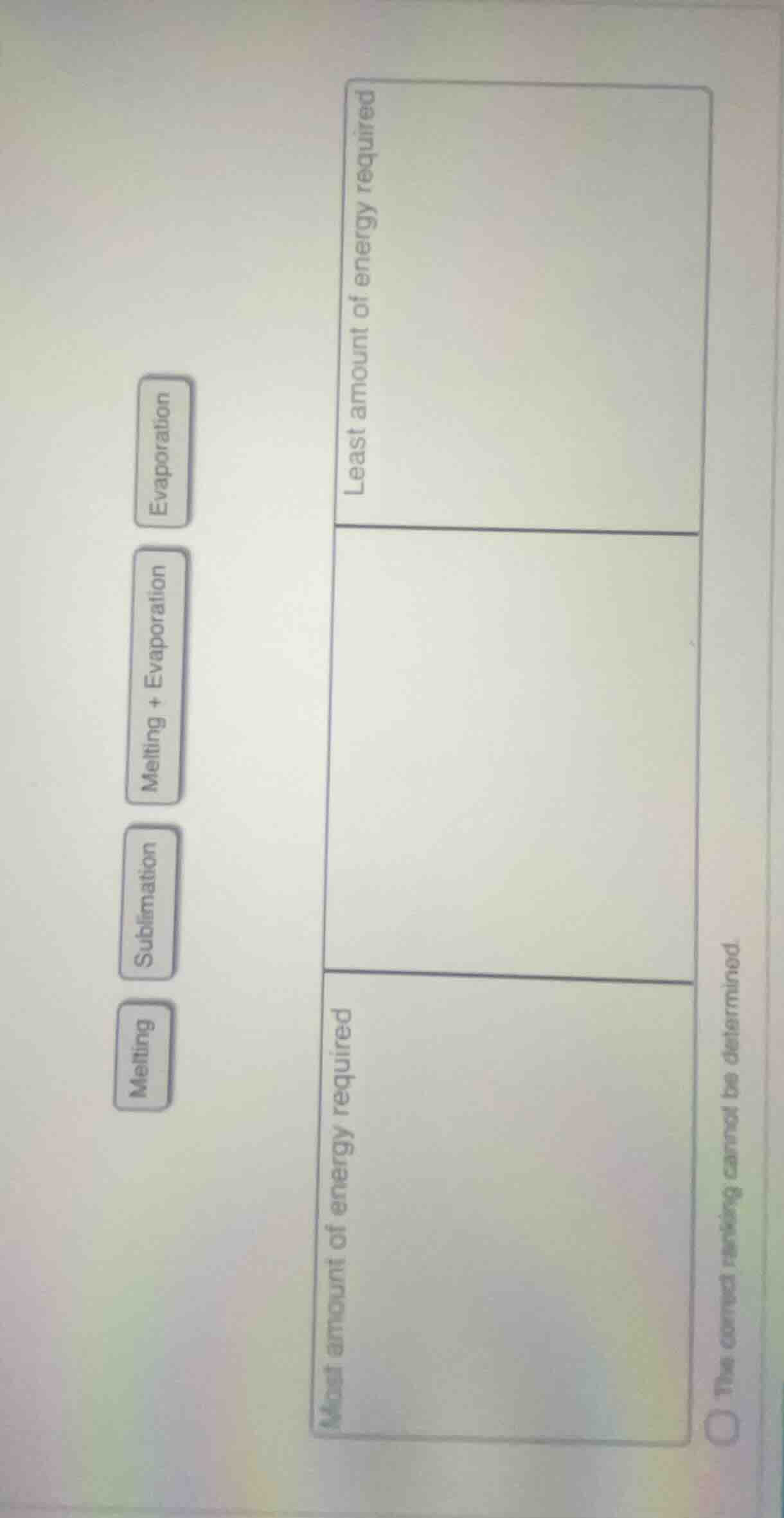
melting
sublimation
melting + evaporation
evaporation
most amount of energy required
least amount of energy required
the correct ranking cannot be determined.
Response
To solve this, we analyze the energy required for each phase change:
Step 1: Understand Phase Change Energies
- Melting: Solid → Liquid (needs energy, but less than vaporization/sublimation).
- Evaporation: Liquid → Gas (needs more energy than melting, as it breaks intermolecular forces more).
- Melting + Evaporation: Sum of melting and evaporation energies (more than either alone).
- Sublimation: Solid → Gas (skips liquid phase; requires energy for both solid→liquid and liquid→gas, so more than melting or evaporation alone).
Step 2: Categorize by Energy
- Most energy required: Sublimation (solid→gas, combines melting + evaporation energy) and Melting + Evaporation (sum of two processes). Among these, Sublimation and Melting + Evaporation have high energy, but Sublimation is a single process with equivalent energy to melting + evaporation. However, if we consider the options:
- Sublimation and Melting + Evaporation require the most energy.
- Melting requires the least energy (only solid→liquid).
Final Categorization (Typical for Phase Change Energy):
- Most amount of energy required: Sublimation, Melting + Evaporation
- Least amount of energy required: Melting
(Note: If the table requires placing each process:
- Most energy: Sublimation, Melting + Evaporation
- Least energy: Melting
- Evaporation is between melting and the combined/ sublimation.)

Snap & solve any problem in the app
Get step-by-step solutions on Sovi AI
Photo-based solutions with guided steps
Explore more problems and detailed explanations
- Most amount of energy required: Sublimation, Melting + Evaporation
- Least amount of energy required: Melting
(Adjust based on the exact table structure, but this is the energy hierarchy for these phase changes.)