QUESTION IMAGE
Question
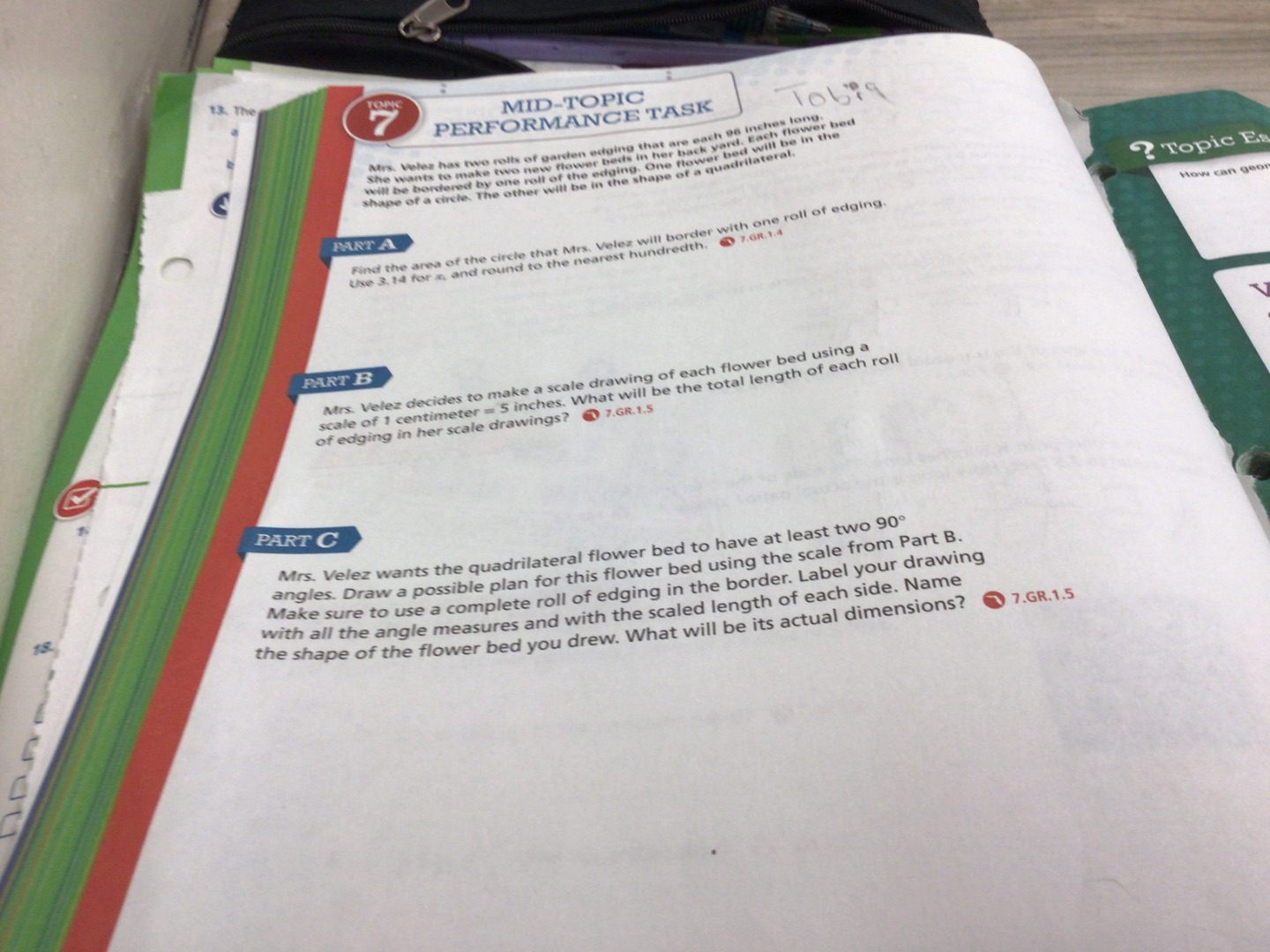
mid - topic performance task
mrs. velez has two rolls of garden edging that are each 96 inches long. she wants to make two new flower beds in her back yard. each flower bed will be bordered by one roll of the edging. one flower bed will be in the shape of a circle. the other will be in the shape of a quadrilateral.
part a
find the area of the circle that mrs. velez will border with one roll of edging. use 3.14 for π, and round to the nearest hundredth. 7.gr.1.4
part b
mrs. velez decides to make a scale drawing of each flower bed using a scale of 1 centimeter = 5 inches. what will be the total length of each roll of edging in her scale drawings? 7.gr.1.5
part c
mrs. velez wants the quadrilateral flower bed to have at least two 90° angles. draw a possible plan for this flower bed using the scale from part b. make sure to use a complete roll of edging in the border. label your drawing with all the angle measures and with the scaled length of each side. name the shape of the flower bed you drew. what will be its actual dimensions? 7.gr.1.5
Part A
Step 1: Find the radius of the circle
The circumference of the circle \( C \) is equal to the length of the edging, which is 96 inches. The formula for the circumference of a circle is \( C = 2\pi r \). We know \( C = 96 \) and \( \pi = 3.14 \), so we solve for \( r \):
\( r=\frac{C}{2\pi}=\frac{96}{2\times3.14}=\frac{96}{6.28}\approx15.29 \) inches.
Step 2: Calculate the area of the circle
The formula for the area of a circle is \( A=\pi r^{2} \). Substitute \( r\approx15.29 \) and \( \pi = 3.14 \):
\( A = 3.14\times(15.29)^{2}=3.14\times233.7841\approx734.08 \) square inches.
Step 1: Understand the scale
The scale is 1 centimeter = 5 inches. The length of each roll of edging is 96 inches.
Step 2: Convert inches to centimeters
To find the length in the scale drawing, we divide the actual length by the scale factor. So, the length \( l=\frac{96}{5} = 19.2 \) centimeters. Since there are two flower beds, but we are asked for the total length of each roll in the scale drawing (so for one roll, it's 19.2 cm, and if we consider both? Wait, no, the question is "the total length of each roll of edging in her scale drawings". Wait, each roll is 96 inches, so for each roll, the scaled length is \( \frac{96}{5}=19.2 \) centimeters.
A possible quadrilateral with at least two \( 90^{\circ} \) angles is a rectangle (or a square, or a right - angled trapezoid). Let's choose a rectangle. Using the scale from Part B (1 cm = 5 inches), if we draw a rectangle with length 10 cm and width 5 cm (scaled lengths).
- Scaled length of length: 10 cm, actual length \( = 10\times5 = 50 \) inches.
- Scaled length of width: 5 cm, actual width \( = 5\times5 = 25 \) inches.
- Angles: All angles in a rectangle are \( 90^{\circ} \), so it satisfies the "at least two \( 90^{\circ} \) angles" condition.
- The shape is a rectangle. The actual dimensions: length 50 inches, width 25 inches. The perimeter of the scaled rectangle is \( 2\times(10 + 5)=30 \) cm, and the actual perimeter should be equal to the length of the edging (96 inches). Let's check: \( 2\times(50 + 25)=150 \) inches? Wait, no, we made a mistake. Wait, the length of the edging is 96 inches, so the perimeter of the quadrilateral should be 96 inches. Let's correctly calculate the scaled lengths. The perimeter of the quadrilateral (actual) is 96 inches. For a rectangle, perimeter \( P = 2(l + w)=96 \), so \( l + w = 48 \) inches. Using the scale 1 cm = 5 inches, let's choose \( l = 30 \) inches (6 cm) and \( w = 18 \) inches (3.6 cm).
- Scaled length of length: \( \frac{30}{5}=6 \) cm.
- Scaled length of width: \( \frac{18}{5}=3.6 \) cm.
- Angles: All angles are \( 90^{\circ} \).
- The shape is a rectangle. The actual dimensions are length 30 inches and width 18 inches.
To draw it:
- Draw a horizontal line segment of 6 cm (scaled length, actual 30 inches).
- At one end, draw a vertical line segment of 3.6 cm (scaled length, actual 18 inches) at a \( 90^{\circ} \) angle.
- Draw a horizontal line segment parallel to the first one, of length 6 cm, from the end of the vertical segment.
- Connect the remaining endpoints with a vertical line segment of 3.6 cm.
Label the drawing with the scaled lengths (6 cm and 3.6 cm) and the actual dimensions (30 inches and 18 inches). Name the shape as a rectangle.

Snap & solve any problem in the app
Get step-by-step solutions on Sovi AI
Photo-based solutions with guided steps
Explore more problems and detailed explanations
The area of the circle is approximately \( 734.08 \) square inches.