QUESTION IMAGE
Question
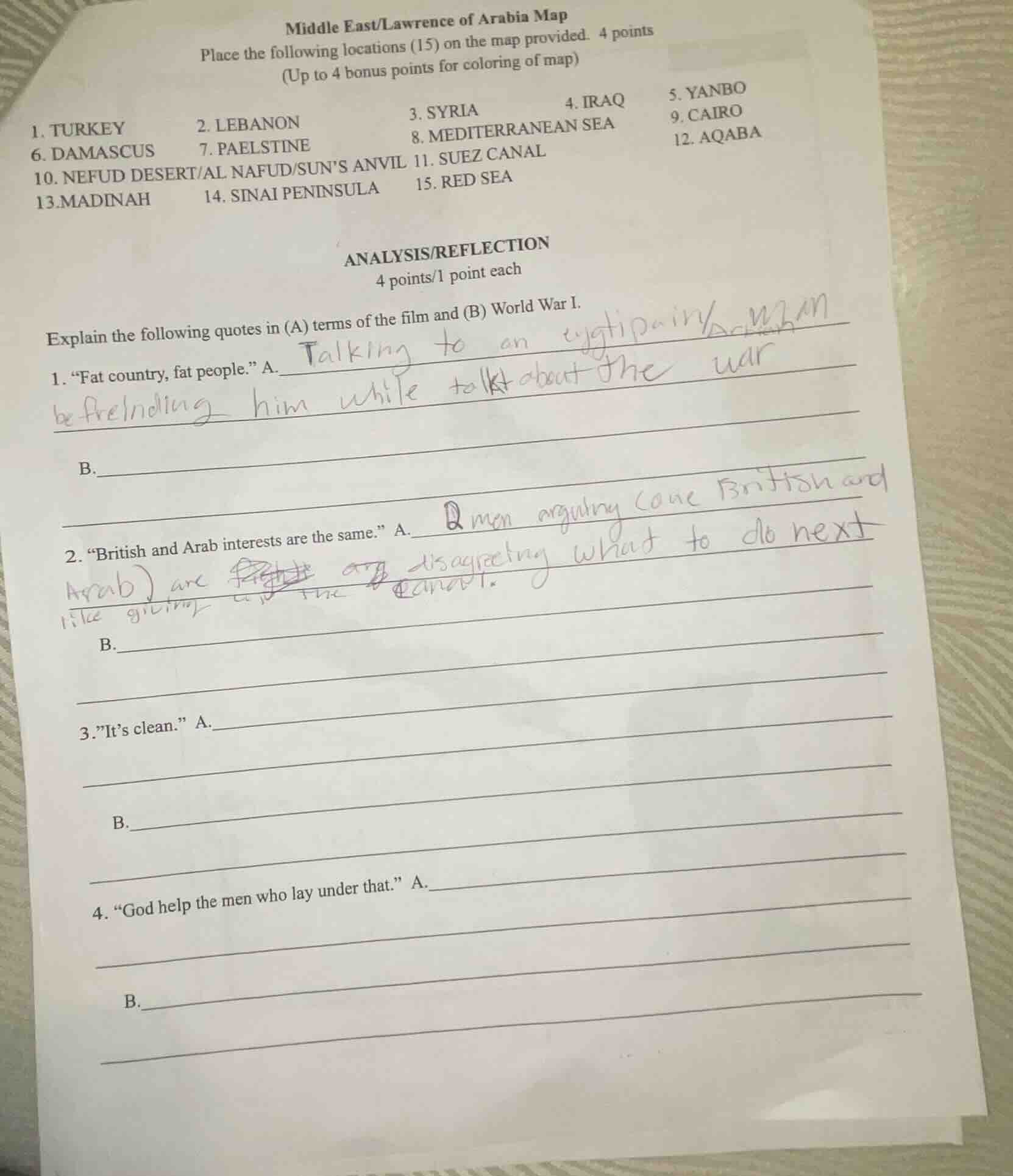
middle east/lawrence of arabia map
place the following locations (15) on the map provided. 4 points
(up to 4 bonus points for coloring of map)
- turkey 2. lebanon 3. syria 4. iraq 5. yanbo
- damascus 7. paelstine 8. mediterranean sea 9. cairo
- nefud desert/al nafud/sun’s anvil 11. suez canal 12. aqaba
13.madinah 14. sinai peninsula 15. red sea
analysis/reflection
4 points/1 point each
explain the following quotes in (a) terms of the film and (b) world war i.
- “fat country, fat people.” a.
b.
- “british and arab interests are the same.” a.
b.
- ”it’s clean.” a.
b.
- “god help the men who lay under that.” a.
b.
Quote 1: "Fat country, fat people."
A. (Film context) In Lawrence of Arabia, Lawrence utters this dismissively about Egypt, criticizing the perceived comfort and complacency of the British military establishment based in Cairo, which he sees as disconnected from the harsh desert war with the Arabs.
B. (WWI context) This reflects the British view of their Mediterranean supply base in Egypt: a resource-rich, well-provisioned territory where rear-echelon troops lived in relative comfort, in stark contrast to the brutal, resource-scarce fighting in the Arabian desert against the Ottoman Empire.
Quote 2: "British and Arab interests are the same."
A. (Film context) A British officer says this to Lawrence to argue for alliance, but the film reveals this is false: the British secretly plan to take control of Arab lands post-war, while Arabs fight for independence.
B. (WWI context) Britain publicly claimed shared goals with Arab nationalists (promising independence via the McMahon-Hussein Correspondence) to get Arab support against the Ottomans, but privately planned to divide the region with France via the Sykes-Picot Agreement, showing conflicting interests.
Quote 3: "It's clean."
A. (Film context) Lawrence says this after executing a man who killed an Arab ally, framing the act as a "clean" form of desert justice, contrasting it with the messy, hypocritical politics of the British command.
B. (WWI context) This mirrors the Allied tendency to frame violent, pragmatic acts (like targeted executions or broken promises) as morally "clean" or necessary for the larger war effort, ignoring the human and political costs.
Quote 4: "God help the men who lay under that."
A. (Film context) Lawrence says this when he sees a massive British artillery bombardment, horrified by the impersonal, destructive scale of modern warfare, which he sees as far crueler than the desert guerrilla fighting he led with Arabs.
B. (WWI context) This reflects the widespread horror at industrialized warfare in WWI: heavy artillery caused catastrophic, anonymous casualties, with soldiers trapped under barrages facing certain death, a stark break from traditional combat.

Snap & solve any problem in the app
Get step-by-step solutions on Sovi AI
Photo-based solutions with guided steps
Explore more problems and detailed explanations
- "Fat country, fat people."
A. Lawrence dismisses Cairo's complacent British establishment in the film.
B. Refers to Egypt as a well-provisioned, "comfortable" Allied rear base in WWI.
- "British and Arab interests are the same."
A. A false British claim to secure Arab alliance in the film.
B. Britain lied about shared goals; Sykes-Picot exposed conflicting interests in WWI.
- "It's clean."
A. Lawrence frames an execution as desert justice in the film.
B. Allied framing of violent pragmatic acts as "necessary" in WWI.
- "God help the men who lay under that."
A. Lawrence is horrified by British artillery's destruction in the film.
B. Reflects WWI horror at industrialized, deadly artillery barrages.