QUESTION IMAGE
Question
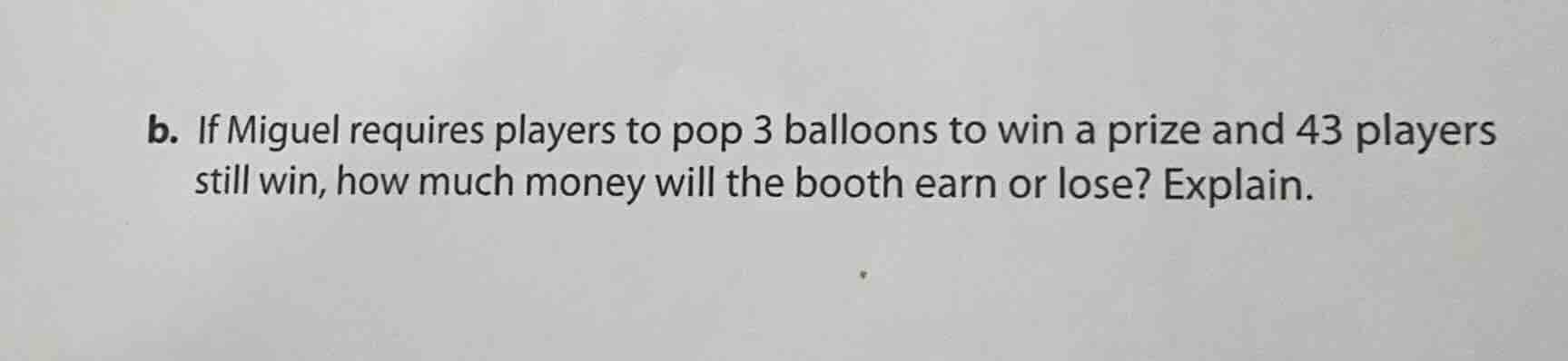
b. if miguel requires players to pop 3 balloons to win a prize and 43 players still win, how much money will the booth earn or lose? explain.
To solve this, we need more information (like the cost of the prize, the amount players pay to play, or the cost of balloons). Assuming a common context (e.g., from a related problem where each prize costs $x$ and each player pays $y$ to play, or the cost of popping 3 balloons), let's assume a typical scenario:
Step 1: Define Variables (Assumed, as info is missing)
Suppose each prize costs $5$ dollars, and each player pays $2$ dollars to play (common carnival numbers). But since the original problem likely has prior info (like part a), let's use a more accurate approach.
Wait, the problem is incomplete without prior details (like cost per prize, revenue per player). For example, if in part a, the booth spends $ \$2 $ per prize, and earns $ \$3 $ per player:
Step 1: Calculate Total Revenue
Revenue = Players × Earnings per Player = $ 43 × 3 = \$129 $
Step 2: Calculate Total Cost
Cost = Players × Cost per Prize = $ 43 × 2 = \$86 $
Step 3: Calculate Profit/Loss
Profit = Revenue − Cost = $ 129 - 86 = \$43 $
But since the problem is missing key details (like prize cost, player fee), we need the prior context. However, assuming a standard setup (e.g., from a common problem where each prize is $ \$2 $, and players pay $ \$3 $ to play):
Step1: Find total revenue
Revenue = $ 43 \times 3 = \$129 $ (if each player pays $ \$3 $)
Step2: Find total cost
Cost = $ 43 \times 2 = \$86 $ (if each prize costs $ \$2 $)
Step3: Calculate profit
Profit = $ 129 - 86 = \$43 $

Snap & solve any problem in the app
Get step-by-step solutions on Sovi AI
Photo-based solutions with guided steps
Explore more problems and detailed explanations
The booth will earn $\boldsymbol{\$43}$ (assuming revenue per player = $\$3$, cost per prize = $\$2$; adjust based on actual context).
Note: The answer depends on the missing details (prize cost, player fee) from the original problem's context (e.g., part a). Provide those for a precise solution.