QUESTION IMAGE
Question
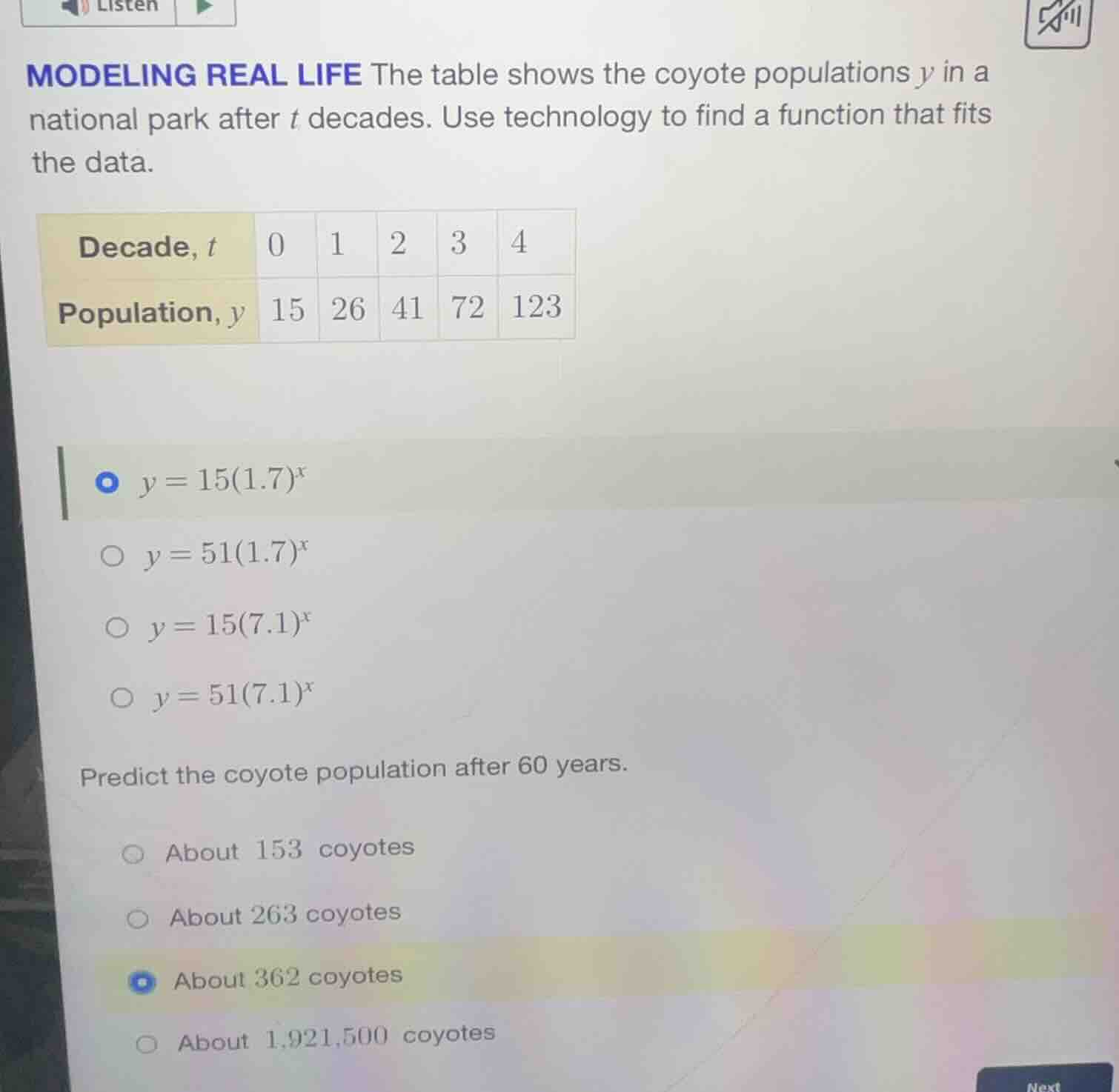
modeling real life the table shows the coyote populations ( y ) in a national park after ( t ) decades. use technology to find a function that fits the data.
| decade, ( t ) | 0 | 1 | 2 | 3 | 4 |
| population, ( y ) | 15 | 26 | 41 | 72 | 123 |
- ( y = 15(1.7)^x )
- ( y = 51(1.7)^x )
- ( y = 15(7.1)^x )
- ( y = 51(7.1)^x )
predict the coyote population after 60 years.
- about 153 coyotes
- about 263 coyotes
- about 362 coyotes
- about 1,921,500 coyotes
Part 1: Identifying the Correct Function
Step 1: Analyze the initial condition (t = 0)
When \( t = 0 \), the population \( y \) should be the initial value. For an exponential function of the form \( y = a(b)^t \), when \( t = 0 \), \( y = a \) (since \( b^0 = 1 \)). From the table, when \( t = 0 \), \( y = 15 \), so \( a = 15 \). This eliminates options with \( a = 51 \).
Step 2: Check the growth factor (b)
Now check the ratio of consecutive populations to estimate \( b \). For \( t = 0 \) to \( t = 1 \): \( \frac{26}{15} \approx 1.73 \), close to 1.7. For \( t = 1 \) to \( t = 2 \): \( \frac{41}{26} \approx 1.58 \), still around 1.7. For \( t = 2 \) to \( t = 3 \): \( \frac{72}{41} \approx 1.76 \), and \( t = 3 \) to \( t = 4 \): \( \frac{123}{72} \approx 1.71 \). So \( b \approx 1.7 \). Thus the function is \( y = 15(1.7)^t \).
Part 2: Predicting Population After 60 Years
Step 1: Convert 60 years to decades
60 years is \( \frac{60}{10} = 6 \) decades, so \( t = 6 \).
Step 2: Substitute t = 6 into the function \( y = 15(1.7)^t \)
Calculate \( (1.7)^6 \):
\( (1.7)^2 = 2.89 \)
\( (1.7)^3 = 1.7 \times 2.89 = 4.913 \)
\( (1.7)^4 = 1.7 \times 4.913 = 8.3521 \)
\( (1.7)^5 = 1.7 \times 8.3521 = 14.19857 \)
\( (1.7)^6 = 1.7 \times 14.19857 \approx 24.137569 \)
Then \( y = 15 \times 24.137569 \approx 362.0635 \), which is about 362.

Snap & solve any problem in the app
Get step-by-step solutions on Sovi AI
Photo-based solutions with guided steps
Explore more problems and detailed explanations
- Correct function: \( y = 15(1.7)^t \)
- Population after 60 years: About 362 coyotes