QUESTION IMAGE
Question
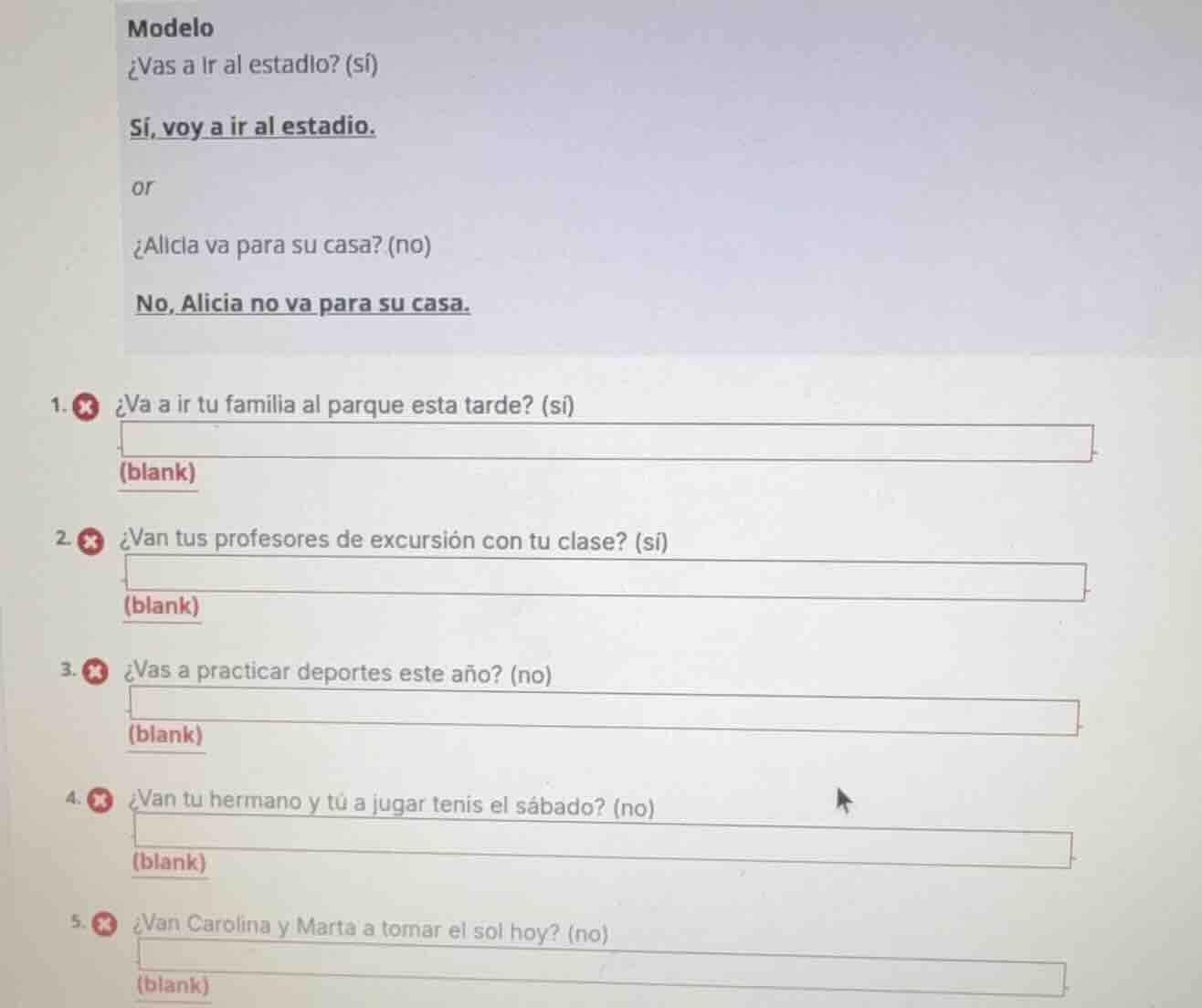
modelo
¿vas a ir al estadio? (sí)
sí, voy a ir al estadio.
or
¿alicia va para su casa? (no)
no, alicia no va para su casa.
1.
¿va a ir tu familia al parque esta tarde? (sí)
(blank)
2.
¿van tus profesores de excursión con tu clase? (sí)
(blank)
3.
¿vas a practicar deportes este año? (no)
(blank)
4.
¿van tu hermano y tú a jugar tenis el sábado? (no)
(blank)
5.
¿van carolina y marta a tomar el sol hoy? (no)
(blank)
Question 1
The model shows that for a "sí" response, we follow the structure of the affirmative answer. The subject "tu familia" (your family) is third - person plural, so the verb form should be "van". So we construct the sentence as "Sí, mi familia va a ir al parque esta tarde." (Note: "tu familia" can be referred to as "mi familia" in the answer or just keep the subject as "tu familia" as in "Sí, tu familia va a ir al parque esta tarde.").
The subject "tus profesores" (your teachers) is third - person plural. Following the affirmative response model, we use the verb "van". So the sentence is "Sí, mis profesores van de excursión con mi clase." (or "Sí, tus profesores van de excursión con tu clase.").
The subject is "tú" (you, singular). For a negative response, we use "no" followed by the subject and the negative form of the verb. The verb "vas" (you go) in negative form is "no vas". So the sentence is "No, no voy a practicar deportes este año." (Wait, correction: The original verb structure is "vas a practicar", so the negative response should be "No, no voy a practicar deportes este año."? No, wait, the subject is "tú", so the correct negative response is "No, no vas a practicar deportes este año." Wait, let's check the model. The model has "No, Alicia no va para su casa." So for "tú", the verb is "vas", so negative is "no vas". So the sentence is "No, no vas a practicar deportes este año."? Wait, no, the question is "¿Vas a practicar deportes este año? (no)". So the answer should be "No, no voy a practicar deportes este año." Wait, I made a mistake. "tú" is the subject, so when answering, if we are using "yo" (I) no, but the question is about "tú", so the correct answer is "No, no vas a practicar deportes este año."? Wait, no, the model: the question is "¿Alicia va para su casa? (no)" and the answer is "No, Alicia no va para su casa." So the subject in the answer is the same as in the question. So the question is about "tú", so the answer is "No, no vas a practicar deportes este año." Wait, no, "vas" is the second - person singular (tú) form of "ir" in the "ir a + infinitive" structure. So the negative is "no vas". So the answer is "No, no vas a practicar deportes este año."

Snap & solve any problem in the app
Get step-by-step solutions on Sovi AI
Photo-based solutions with guided steps
Explore more problems and detailed explanations
Sí, mi familia va a ir al parque esta tarde. (or Sí, tu familia va a ir al parque esta tarde.)