QUESTION IMAGE
Question
module 2 mid topic 2 assessment review
period: 1-2
date: jun/7
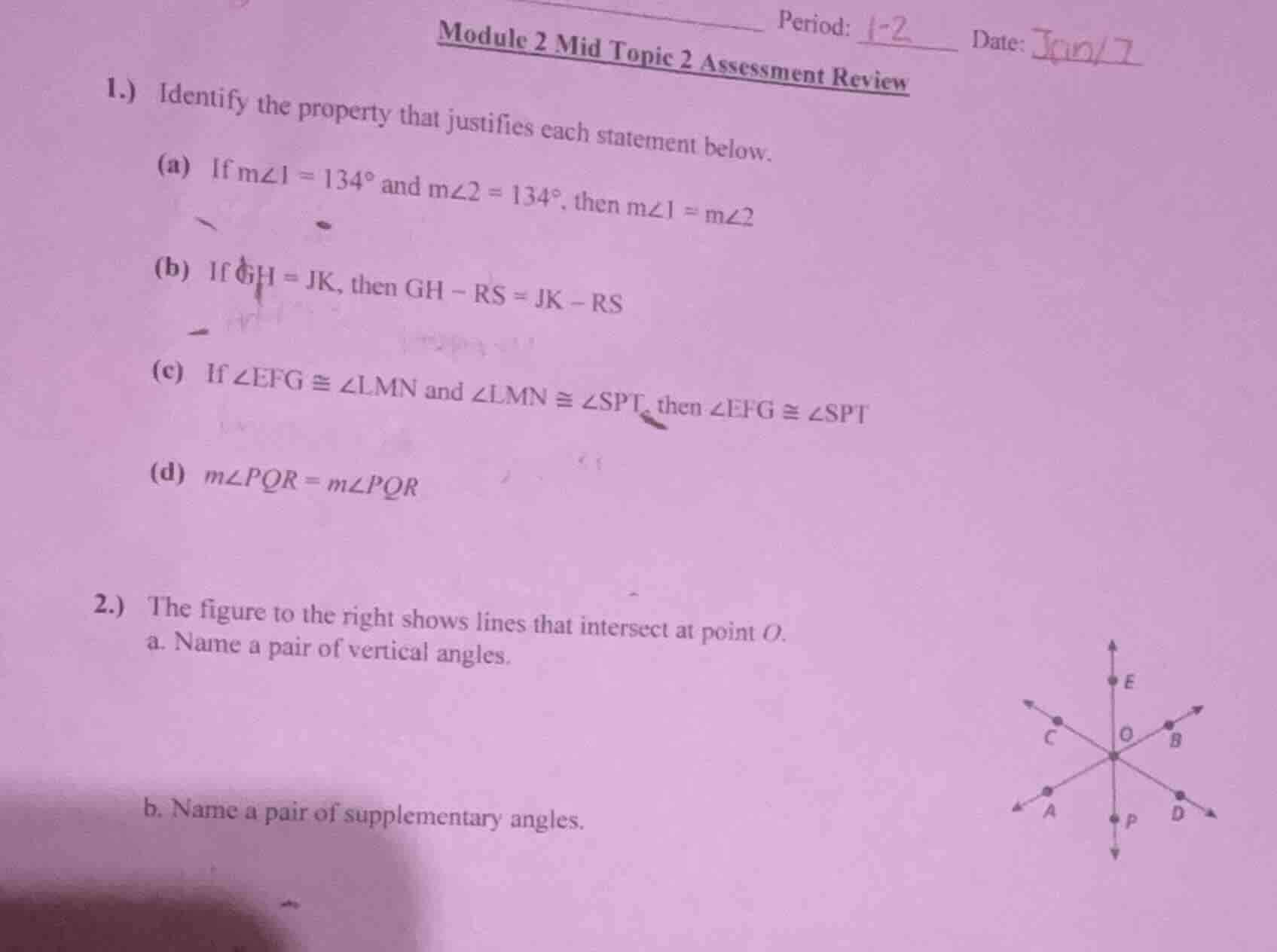
1.) identify the property that justifies each statement below.
(a) if m∠1 = 134° and m∠2 = 134°, then m∠1 = m∠2
(b) if gh = jk, then gh - rs = jk - rs
(c) if ∠efg ≅ ∠lmn and ∠lmn ≅ ∠spt, then ∠efg ≅ ∠spt
(d) m∠pqr = m∠pqr
2.) the figure to the right shows lines that intersect at point o.
a. name a pair of vertical angles.
b. name a pair of supplementary angles.
(image of intersecting lines at o with points e, p on one line, a, b, c, d on others)
Problem 1(a)
Step1: Analyze the statement
We have two angles with the same measure, \( m\angle1 = 134^\circ \) and \( m\angle2 = 134^\circ \), and we conclude \( m\angle1 = m\angle2 \). This is the Substitution Property (or more specifically, the property of equality that if two quantities are equal to the same quantity, they are equal to each other, which is a form of the Substitution or Transitive? Wait, no, here both are equal to \( 134^\circ \), so it's the Substitution Property or the Transitive Property of Equality? Wait, the Transitive Property is if \( a = b \) and \( b = c \), then \( a = c \). Here, \( m\angle1 = 134^\circ \) and \( m\angle2 = 134^\circ \), so \( m\angle1 = m\angle2 \) by the Substitution Property (replacing \( 134^\circ \) in the first equation with \( m\angle2 \) from the second). Alternatively, it's the Reflexive? No, Reflexive is \( a = a \). Wait, no, this is the Transitive Property of Equality? Wait, no, Transitive is \( a = b \), \( b = c \), so \( a = c \). Here, \( m\angle1 = 134^\circ \) and \( m\angle2 = 134^\circ \), so \( m\angle1 = m\angle2 \) because they are both equal to the same number. This is the Substitution Property or the Property of Equality (Transitive)? Wait, actually, the correct property here is the Transitive Property of Equality? No, Transitive is for three terms. Wait, the correct property is the Substitution Property or the Property that if two quantities are equal to the same quantity, they are equal to each other, which is a form of the Transitive Property? Wait, maybe I'm overcomplicating. The statement is: If \( m\angle1 = 134^\circ \) and \( m\angle2 = 134^\circ \), then \( m\angle1 = m\angle2 \). This is the Transitive Property of Equality? No, Transitive is \( a = b \), \( b = c \), so \( a = c \). Here, \( a = m\angle1 \), \( b = 134^\circ \), \( c = m\angle2 \). So \( a = b \), \( c = b \), so \( a = c \) by Transitive. Yes, that's the Transitive Property of Equality. Wait, but sometimes this is called the Substitution Property. Alternatively, it's the Property of Equality (Transitive)**.
Wait, let's recall:
- Reflexive Property: \( a = a \)
- Symmetric Property: If \( a = b \), then \( b = a \)
- Transitive Property: If \( a = b \) and \( b = c \), then \( a = c \)
- Substitution Property: If \( a = b \), then \( a \) can be replaced with \( b \) in any equation.
In this case, \( m\angle1 = 134^\circ \) and \( m\angle2 = 134^\circ \), so we can substitute \( 134^\circ \) in the first equation with \( m\angle2 \) (from the second equation), giving \( m\angle1 = m\angle2 \). So this is the Substitution Property.
Step2: Confirm the property
The statement uses the fact that both angles are equal to \( 134^\circ \), so we can substitute one for the other, leading to \( m\angle1 = m\angle2 \). This is justified by the Substitution Property of Equality (or the Transitive Property, but more accurately, Substitution here).
Step1: Analyze the statement
We have \( GH = JK \), and we conclude \( GH - RS = JK - RS \). This is the Subtraction Property of Equality, which states that if \( a = b \), then \( a - c = b - c \) for any real number \( c \).
Step2: Apply the property
Here, \( a = GH \), \( b = JK \), and \( c = RS \). Since \( GH = JK \), subtracting \( RS \) from both sides gives \( GH - RS = JK - RS \), which is the Subtraction Property of Equality.
Step1: Analyze the statement
We have \( \angle EFG \cong \angle LMN \) and \( \angle LMN \cong \angle SPT \), and we conclude \( \angle EFG \cong \angle SPT \). This is the Transitive Property of Congruence, which states that if \( \angle A \cong \angle B \) and \( \angle B \cong \angle C \), then \( \angle A \cong \angle C \).
Step2: Apply the property
Here, \( \angle EFG \cong \angle LMN \) (first congruence) and \( \angle LMN \cong \angle SPT \) (second congruence), so by the Transitive Property of Congruence, \( \angle EFG \cong \angle SPT \).

Snap & solve any problem in the app
Get step-by-step solutions on Sovi AI
Photo-based solutions with guided steps
Explore more problems and detailed explanations
Substitution Property (or Transitive Property of Equality, but more accurately, Substitution)