QUESTION IMAGE
Question
monday week 20
name
language practice
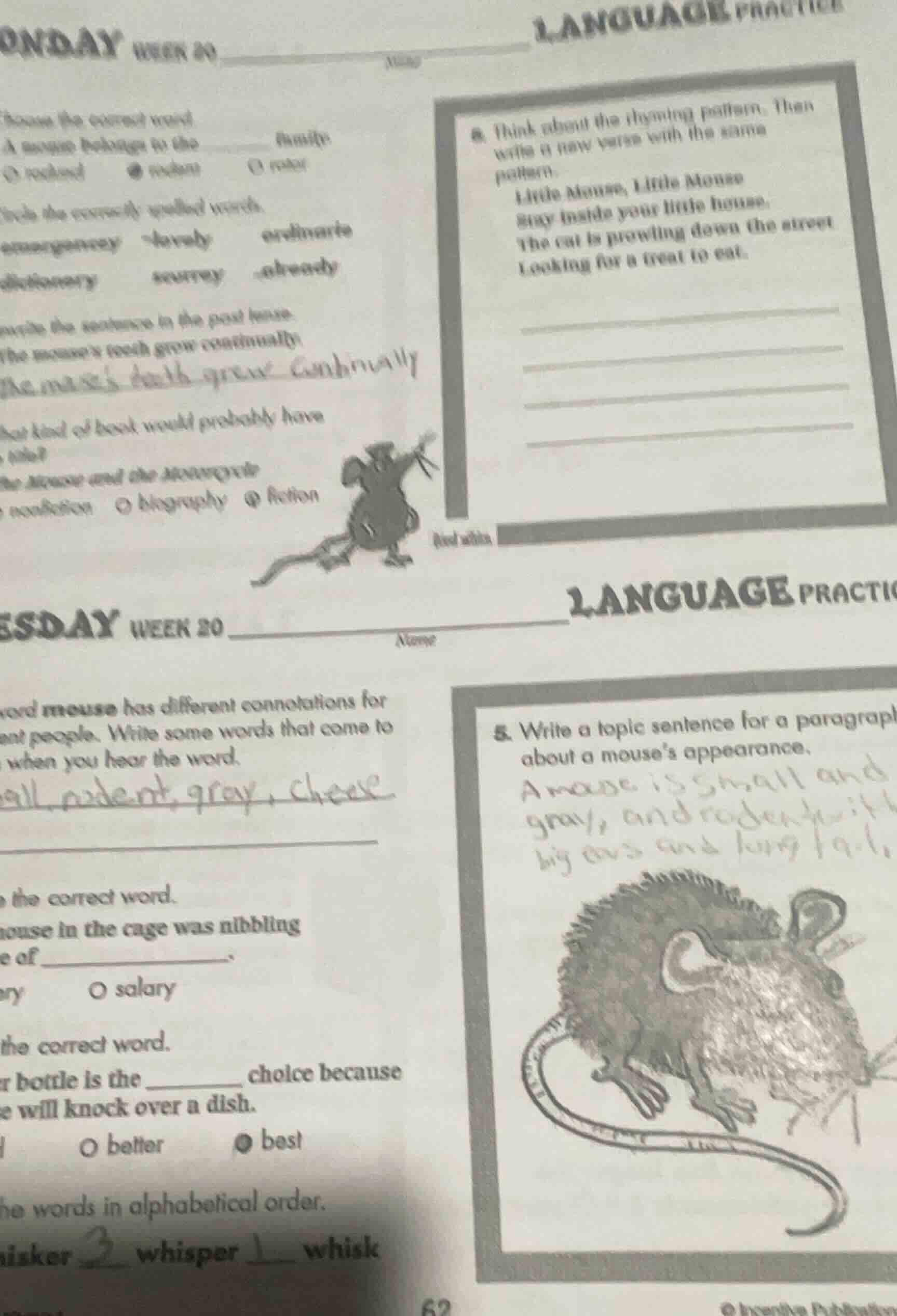
choose the correct word.
a mouse belongs to the ______ family.
○ rodentd ◉ rodent ○ roder
circle the correctly spelled word.
amergency lovely ordinarie
dictionary scurrey abready
rewrite the sentence in the past tense.
the mouse’s teeth grow continually.
the mouses teeth grew continually
what kind of book would probably have this title?
the mouse and the motorcycle
○ nonfiction ○ biography ◉ fiction
- think about the rhyming pattern. then write a new verse with the same pattern.
little mouse, little mouse
stay inside your little house.
the cat is prowling down the street
looking for a treat to eat.
____________________
____________________
____________________
____________________
tuesday week 20
name
language practice
the word mouse has different connotations for different people. write some words that come to mind when you hear the word.
tall, rodent, gray, cheese
____________________
choose the correct word.
the mouse in the cage was nibbling on a piece of ______.
○ salary
choose the correct word.
the water bottle is the ______ choice because the mouse will knock over a dish.
○ better ◉ best
arrange the words in alphabetical order.
whisker 3 whisper 1 whisk
- write a topic sentence for a paragraph about a mouse’s appearance.
a mouse is small and gray, and rodent with big ears and long tail.
(image of a mouse)
- Monday, Question 1: A mouse is a rodent, so this is the correct term for its family.
- Monday, Question 2: Identify words with standard English spelling: "emergency", "lovely", "dictionary", "scurry", "already" are correctly spelled; "erdinvarie" is misspelled (should be "extraordinary").
- Monday, Question 3: Convert the present tense verb "grow" to its past tense form "grew", and correct the misspelling of "mouse's".
- Monday, Question 4: The Mouse and the Motorcycle is a fictional story with talking animals, so it is fiction.
- Monday, Question 6: The original poem uses an AABB rhyme scheme (Mouse/House, street/eat). The new verse follows this pattern.
- Tuesday, Question 1: These are common associated words for "mouse" based on traits and stereotypes.
- Tuesday, Question 2: Mice are known to nibble cheese, which fits the context.
- Tuesday, Question 3: "Best" is the superlative form, correct for comparing the bottle as the top choice over other options.
- Tuesday, Question 4: Alphabetical order is determined by the first differing letter: whisk (W-H-I-S-K), whisper (W-H-I-S-P-E-R), whisker (W-H-I-S-K-E-R).
- Tuesday, Question 5: A topic sentence introduces the main focus, here summarizing a mouse's key physical traits.

Snap & solve any problem in the app
Get step-by-step solutions on Sovi AI
Photo-based solutions with guided steps
Explore more problems and detailed explanations
- Monday Q1: rodent
- Monday Q2: emergency, lovely, dictionary, scurry, already
- Monday Q3: The mouse's teeth grew continually.
- Monday Q4: fiction
- Monday Q6: Little Squirrel, Little Squirrel / Hide within your leafy pearl / The hawk is soaring high above / Looking for a tasty dove.
- Tuesday Q1: small, rodent, gray, cheese (additional options: tiny, whiskered, tail, nibble)
- Tuesday Q2: cheese
- Tuesday Q3: best
- Tuesday Q4: 1. whisk, 2. whisper, 3. whisker
- Tuesday Q5: A small mouse has distinct, delicate physical features including soft gray fur, large round ears, a long thin tail, and prominent whiskers.