QUESTION IMAGE
Question
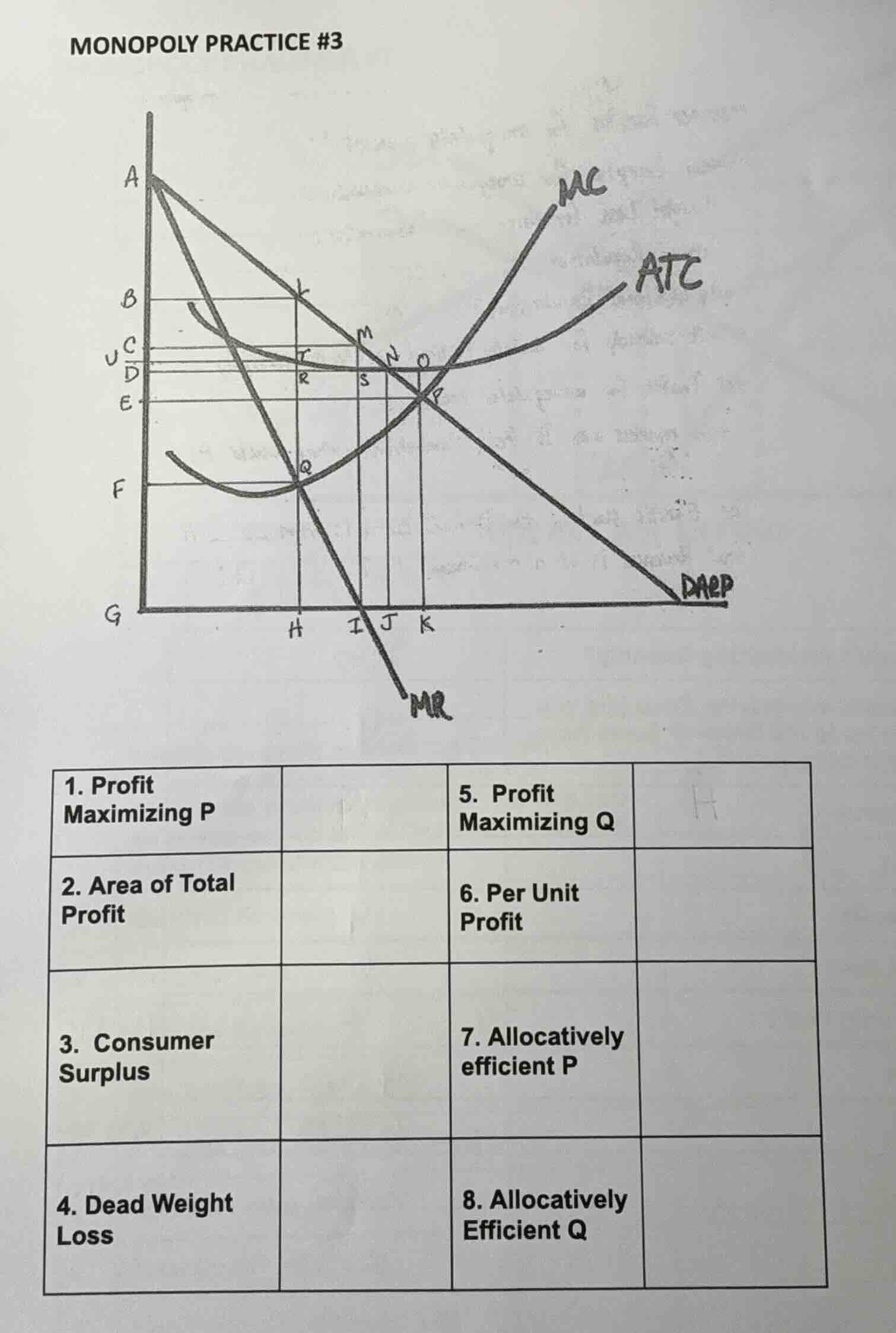
monopoly practice #3
- profit maximizing p
- profit maximizing q
- area of total profit
- per unit profit
- consumer surplus
- allocatively efficient p
- dead weight loss
- allocatively efficient q
Step1: Identify profit-maximizing P
A monopoly maximizes profit where $MR=MC$. This occurs at point $Q$, which corresponds to price $B$ on the demand curve.
Step2: Identify total profit area
Total profit = (Price - ATC) × Quantity. At profit-maximizing quantity $OH$, price is $B$, ATC is $F$. The area is rectangle $BFRH$.
Step3: Identify consumer surplus area
Consumer surplus is the area above price $B$, below demand curve, from 0 to $OH$. This is triangle $ABK$.
Step4: Identify dead weight loss area
Deadweight loss is the area of inefficiency between profit-maximizing quantity $OH$ and allocatively efficient quantity $OK$. This is triangle $QKP$.
Step5: Identify profit-maximizing Q
Profit-maximizing quantity is where $MR=MC$, corresponding to $OH$.
Step6: Identify per unit profit
Per unit profit = Price - ATC = $B - F$, or the vertical distance $BF$.
Step7: Identify allocatively efficient P
Allocative efficiency occurs where $MC=Demand$ (point $P$), corresponding to price $E$.
Step8: Identify allocatively efficient Q
Allocative efficient quantity is where $MC=Demand$, corresponding to $OK$.

Snap & solve any problem in the app
Get step-by-step solutions on Sovi AI
Photo-based solutions with guided steps
Explore more problems and detailed explanations
- Profit Maximizing P: $B$
- Area of Total Profit: Area $BFRH$
- Consumer Surplus: Area $ABK$
- Dead Weight Loss: Area $QKP$
- Profit Maximizing Q: $OH$
- Per Unit Profit: $B-F$ (vertical distance $BF$)
- Allocatively efficient P: $E$
- Allocatively Efficient Q: $OK$