QUESTION IMAGE
Question
5.3: more and less with decimals
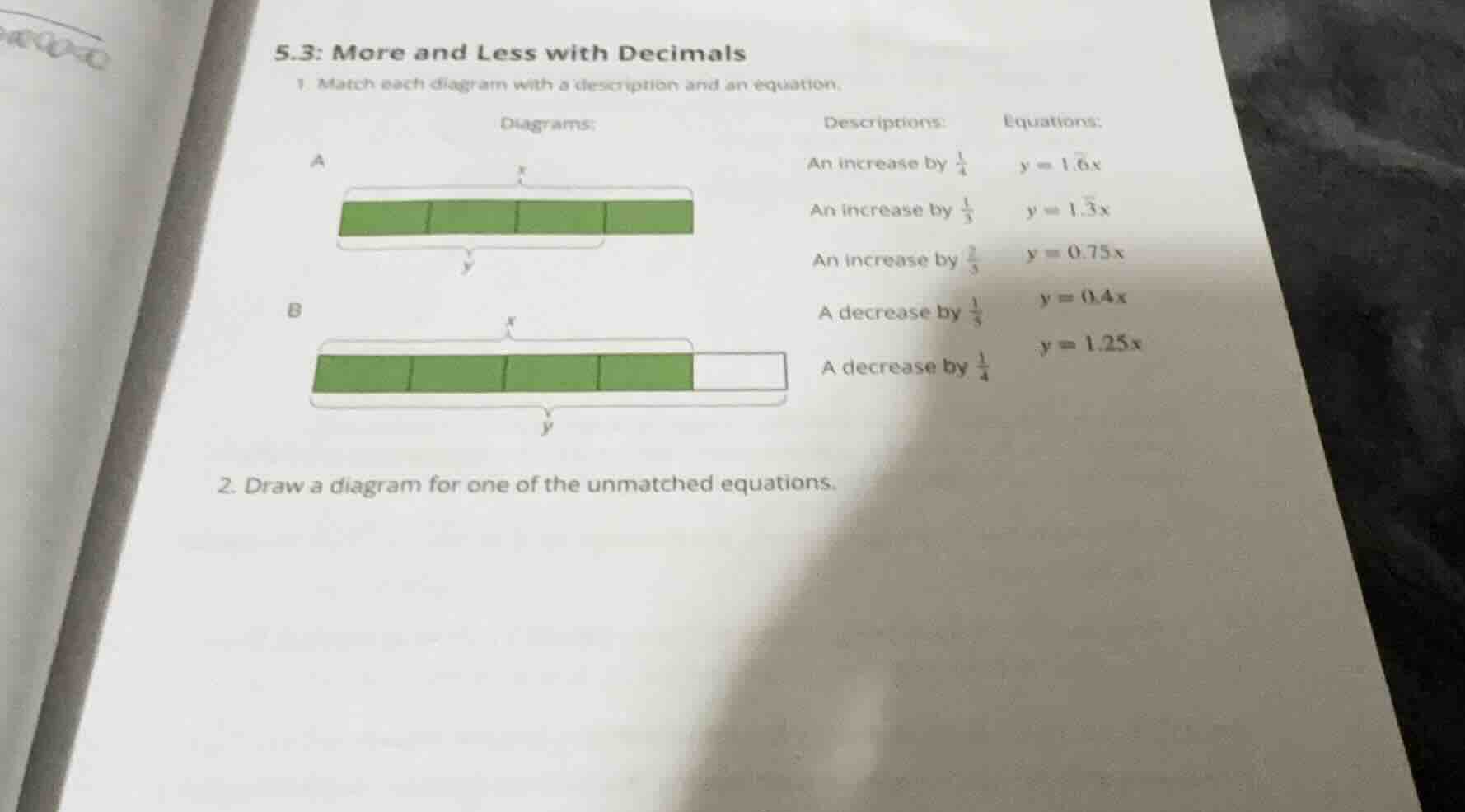
- match each diagram with a description and an equation.
diagrams:
a
diagram of a bar divided into four green segments, with x above the full bar and y below the first three segments
b
diagram of a bar with four green segments and one white segment, with x above the green part and y below the full bar
descriptions:
an increase by \\(\frac{1}{4}\\)
an increase by \\(\frac{1}{3}\\)
an increase by \\(\frac{2}{3}\\)
a decrease by \\(\frac{1}{5}\\)
a decrease by \\(\frac{1}{4}\\)
equations:
\\(y = 1.\overline{6}x\\)
\\(y = 1.\overline{3}x\\)
\\(y = 0.75x\\)
\\(y = 0.4x\\)
\\(y = 1.25x\\)
- draw a diagram for one of the unmatched equations.
Part 1: Matching Diagrams, Descriptions, and Equations
Diagram A:
- Analysis: Diagram A has \( x \) as 4 parts (the full green bar) and \( y \) as 3 parts (the shorter green segment). So \( y \) is less than \( x \), indicating a decrease. The fraction of decrease: \( \frac{4 - 3}{4} = \frac{1}{4} \), so it's a decrease by \( \frac{1}{4} \). The equation: \( y = x - \frac{1}{4}x = \frac{3}{4}x = 0.75x \).
- Match: Description - A decrease by \( \frac{1}{4} \); Equation - \( y = 0.75x \).
Diagram B:
- Analysis: Diagram B has \( x \) as 4 parts (the green bar) and \( y \) as 5 parts (green + white). So \( y \) is more than \( x \), indicating an increase. The fraction of increase: \( \frac{5 - 4}{4} = \frac{1}{4} \), so it's an increase by \( \frac{1}{4} \). The equation: \( y = x + \frac{1}{4}x = \frac{5}{4}x = 1.25x \).
- Match: Description - An increase by \( \frac{1}{4} \); Equation - \( y = 1.25x \).
Part 2: Drawing a Diagram for an Unmatched Equation (e.g., \( y = 1.\overline{6}x \) or \( y = 0.4x \))
Let’s choose \( y = 0.4x \) (a decrease by \( \frac{3}{5} \), since \( 1 - 0.4 = 0.6 = \frac{3}{5} \)):
- Step 1: Represent \( x \) as a bar divided into 5 equal parts (since \( 0.4 = \frac{2}{5} \), so \( y \) is \( \frac{2}{5} \) of \( x \)).
- Step 2: Shade 2 parts (to represent \( y \)) and leave 3 parts unshaded (to show the decrease).
Final Matches (Part 1):
- Diagram A: Description - A decrease by \( \frac{1}{4} \); Equation - \( \boldsymbol{y = 0.75x} \).
- Diagram B: Description - An increase by \( \frac{1}{4} \); Equation - \( \boldsymbol{y = 1.25x} \).
Diagram for Unmatched Equation (Example):
For \( y = 0.4x \):
- Draw a horizontal bar labeled \( x \), divided into 5 equal segments.
- Shade 2 segments (labeled \( y \)) and leave 3 unshaded. This visually shows \( y = \frac{2}{5}x = 0.4x \).

Snap & solve any problem in the app
Get step-by-step solutions on Sovi AI
Photo-based solutions with guided steps
Explore more problems and detailed explanations
Part 1: Matching Diagrams, Descriptions, and Equations
Diagram A:
- Analysis: Diagram A has \( x \) as 4 parts (the full green bar) and \( y \) as 3 parts (the shorter green segment). So \( y \) is less than \( x \), indicating a decrease. The fraction of decrease: \( \frac{4 - 3}{4} = \frac{1}{4} \), so it's a decrease by \( \frac{1}{4} \). The equation: \( y = x - \frac{1}{4}x = \frac{3}{4}x = 0.75x \).
- Match: Description - A decrease by \( \frac{1}{4} \); Equation - \( y = 0.75x \).
Diagram B:
- Analysis: Diagram B has \( x \) as 4 parts (the green bar) and \( y \) as 5 parts (green + white). So \( y \) is more than \( x \), indicating an increase. The fraction of increase: \( \frac{5 - 4}{4} = \frac{1}{4} \), so it's an increase by \( \frac{1}{4} \). The equation: \( y = x + \frac{1}{4}x = \frac{5}{4}x = 1.25x \).
- Match: Description - An increase by \( \frac{1}{4} \); Equation - \( y = 1.25x \).
Part 2: Drawing a Diagram for an Unmatched Equation (e.g., \( y = 1.\overline{6}x \) or \( y = 0.4x \))
Let’s choose \( y = 0.4x \) (a decrease by \( \frac{3}{5} \), since \( 1 - 0.4 = 0.6 = \frac{3}{5} \)):
- Step 1: Represent \( x \) as a bar divided into 5 equal parts (since \( 0.4 = \frac{2}{5} \), so \( y \) is \( \frac{2}{5} \) of \( x \)).
- Step 2: Shade 2 parts (to represent \( y \)) and leave 3 parts unshaded (to show the decrease).
Final Matches (Part 1):
- Diagram A: Description - A decrease by \( \frac{1}{4} \); Equation - \( \boldsymbol{y = 0.75x} \).
- Diagram B: Description - An increase by \( \frac{1}{4} \); Equation - \( \boldsymbol{y = 1.25x} \).
Diagram for Unmatched Equation (Example):
For \( y = 0.4x \):
- Draw a horizontal bar labeled \( x \), divided into 5 equal segments.
- Shade 2 segments (labeled \( y \)) and leave 3 unshaded. This visually shows \( y = \frac{2}{5}x = 0.4x \).