QUESTION IMAGE
Question
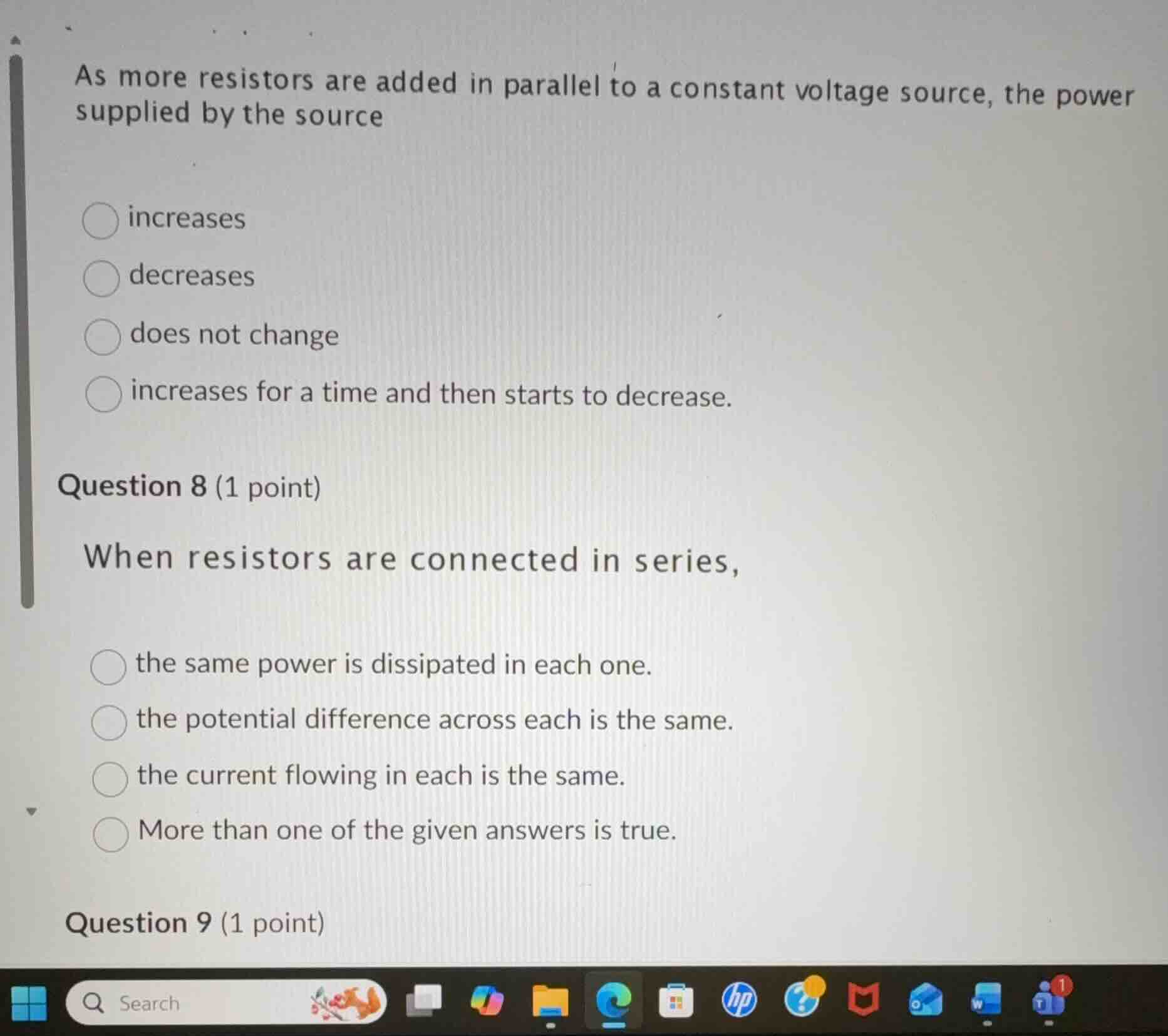
as more resistors are added in parallel to a constant voltage source, the power supplied by the source
increases
decreases
does not change
increases for a time and then starts to decrease.
question 8 (1 point)
when resistors are connected in series,
the same power is dissipated in each one.
the potential difference across each is the same.
the current flowing in each is the same.
more than one of the given answers is true.
question 9 (1 point)
Response
First Question (Resistors in Parallel and Power)
Brief Explanations
- Recall the formula for equivalent resistance in parallel: $\frac{1}{R_{eq}}=\sum_{i = 1}^{n}\frac{1}{R_{i}}$. As more resistors are added in parallel, $R_{eq}$ decreases (since adding more terms to the sum on the right - hand side makes $\frac{1}{R_{eq}}$ larger, so $R_{eq}$ smaller).
- The power supplied by a voltage source is given by $P=\frac{V^{2}}{R_{eq}}$, where $V$ is the constant voltage of the source. Since $V$ is constant and $R_{eq}$ decreases as more resistors are added in parallel, from the formula $P=\frac{V^{2}}{R_{eq}}$, when the denominator ($R_{eq}$) decreases, the power $P$ increases.
Brief Explanations
- Current in series resistors: In a series circuit, the current has only one path to flow. By the definition of a series circuit, the current flowing through each resistor in series is the same. Mathematically, if we have resistors $R_1, R_2, R_3,\cdots$ in series, the current $I$ through each resistor is the same, i.e., $I = I_1=I_2 = I_3=\cdots$.
- Power dissipation in series resistors: The power dissipated in a resistor is given by $P = I^{2}R$. Since different resistors may have different resistances ($R$ values) and $I$ is the same for all, the power dissipated ($P$) will be different for resistors with different $R$ values (because $P\propto R$ when $I$ is constant).
- Potential difference in series resistors: The potential difference (voltage) across a resistor in series is given by $V = IR$. Since $I$ is the same for all resistors but $R$ can be different, the potential difference across each resistor will be different (because $V\propto R$ when $I$ is constant).
So, only the statement "the current flowing in each is the same" is true.

Snap & solve any problem in the app
Get step-by-step solutions on Sovi AI
Photo-based solutions with guided steps
Explore more problems and detailed explanations
increases