QUESTION IMAGE
Question
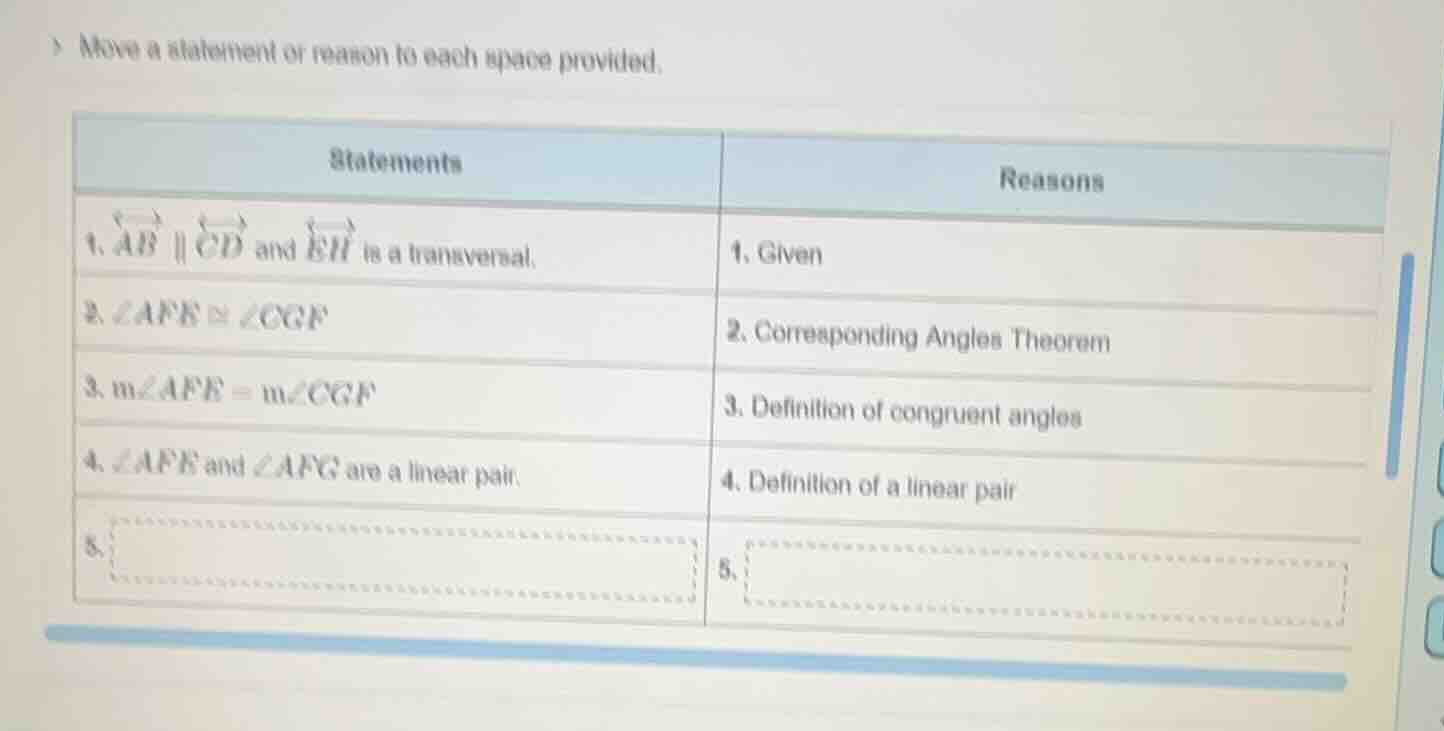
move a statement or reason to each space provided.
statements\treasons
- $overleftrightarrow{ab} \parallel \overleftrightarrow{cd}$ and $overleftrightarrow{eh}$ is a transversal.\t1. given
- $\angle afe \cong \angle cgf$\t2. corresponding angles theorem
- $m\angle afe = m\angle cgf$\t3. definition of congruent angles
- $\angle afe$ and $\angle afg$ are a linear pair.\t4. definition of a linear pair
- \t5.
To solve this, we continue the proof (assuming we're proving something like supplementary angles or a linear pair relationship with the parallel lines). Let's assume we want to show \( m\angle AFE + m\angle AFG = 180^\circ \) (since a linear pair is supplementary).
Step-by-Step Format:
Step1: Recall Linear Pair Postulate
A linear pair of angles is supplementary, so their measures sum to \( 180^\circ \).
Step2: Apply to \( \angle AFE \) and \( \angle AFG \)
Since \( \angle AFE \) and \( \angle AFG \) are a linear pair (from Step 4), by the Linear Pair Postulate:
\( m\angle AFE + m\angle AFG = 180^\circ \)

Snap & solve any problem in the app
Get step-by-step solutions on Sovi AI
Photo-based solutions with guided steps
Explore more problems and detailed explanations
Statement 5: \( m\angle AFE + m\angle AFG = 180^\circ \)
Reason 5: Linear Pair Postulate (or "If two angles form a linear pair, then they are supplementary")