QUESTION IMAGE
Question
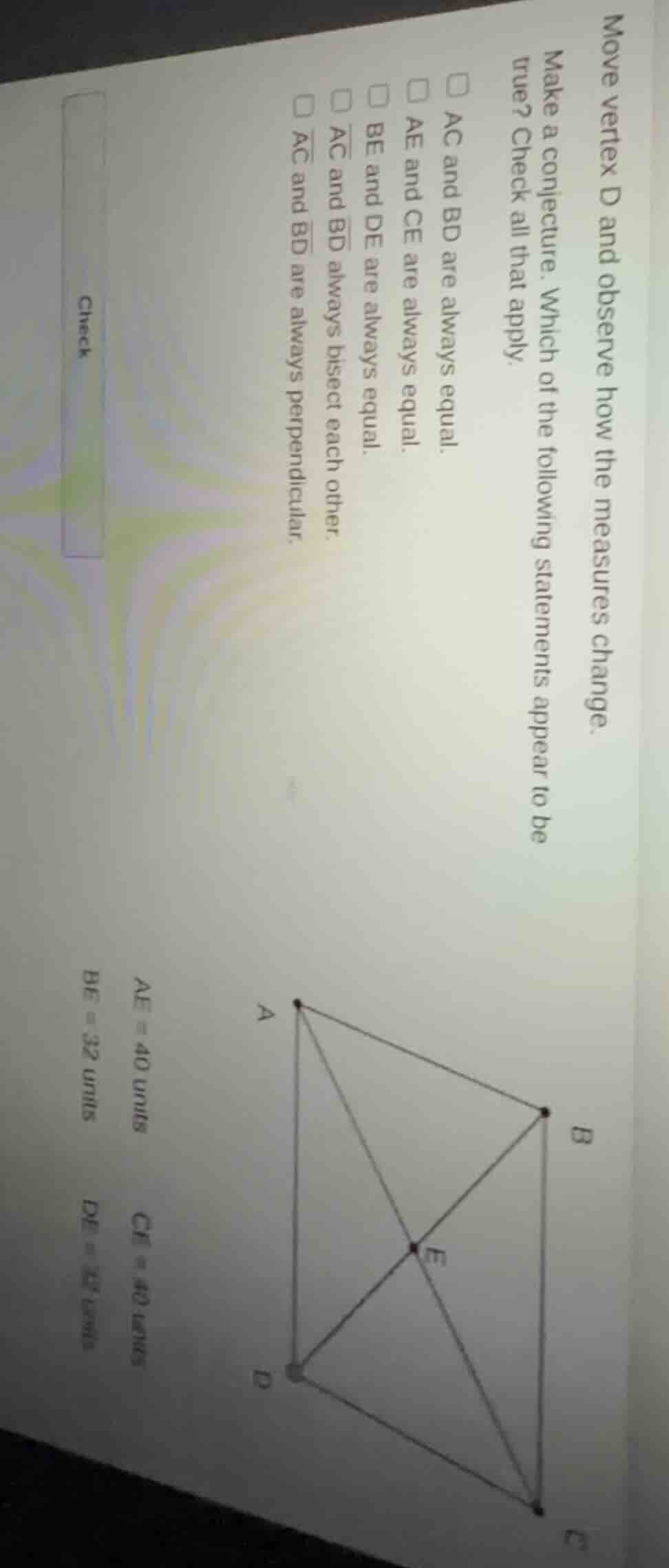
move vertex d and observe how the measures change. make a conjecture. which of the following statements appear to be true? check all that apply. □ ac and bd are always equal. □ ae and ce are always equal. □ be and de are always equal. □ ac and bd always bisect each other. □ ac and bd are always perpendicular. check ae = 40 units ce = 40 units be = 32 units de = 32 units
Brief Explanations
- For "AE and CE are always equal": From the given data, \( AE = 40 \) units and \( CE = 40 \) units. When we move vertex \( D \), in a parallelogram (assuming the figure is a parallelogram as diagonals bisect each other), the diagonals bisect each other, so \( AE=CE \) as \( E \) is the mid - point of \( AC \).
- For "AC and BD always bisect each other": In a parallelogram (the figure looks like a parallelogram with vertices \( A, B, C, D \)), the property of a parallelogram is that its diagonals bisect each other. So \( E \) (the intersection of diagonals \( AC \) and \( BD \)) is the mid - point of both \( AC \) and \( BD \), meaning \( AC \) and \( BD \) bisect each other.
- For "AC and BD are always equal": In a general parallelogram, the diagonals are not always equal (they are equal in rectangles, a special case of parallelograms). Since we can move vertex \( D \) to make it a non - rectangular parallelogram, this statement is false.
- For "BE and DE are always equal": From the given data, \( BE = 32 \) units and \( DE = 32 \) units. Since \( E \) is the mid - point of \( BD \) (because diagonals bisect each other in a parallelogram), \( BE = DE\).
- For "AC and BD are always perpendicular": In a general parallelogram, the diagonals are not always perpendicular (they are perpendicular in rhombuses, a special case of parallelograms). Since we can move vertex \( D \) to make it a non - rhombus parallelogram, this statement is false.

Snap & solve any problem in the app
Get step-by-step solutions on Sovi AI
Photo-based solutions with guided steps
Explore more problems and detailed explanations
- AE and CE are always equal.
- AC and BD always bisect each other.
- BE and DE are always equal.