QUESTION IMAGE
Question
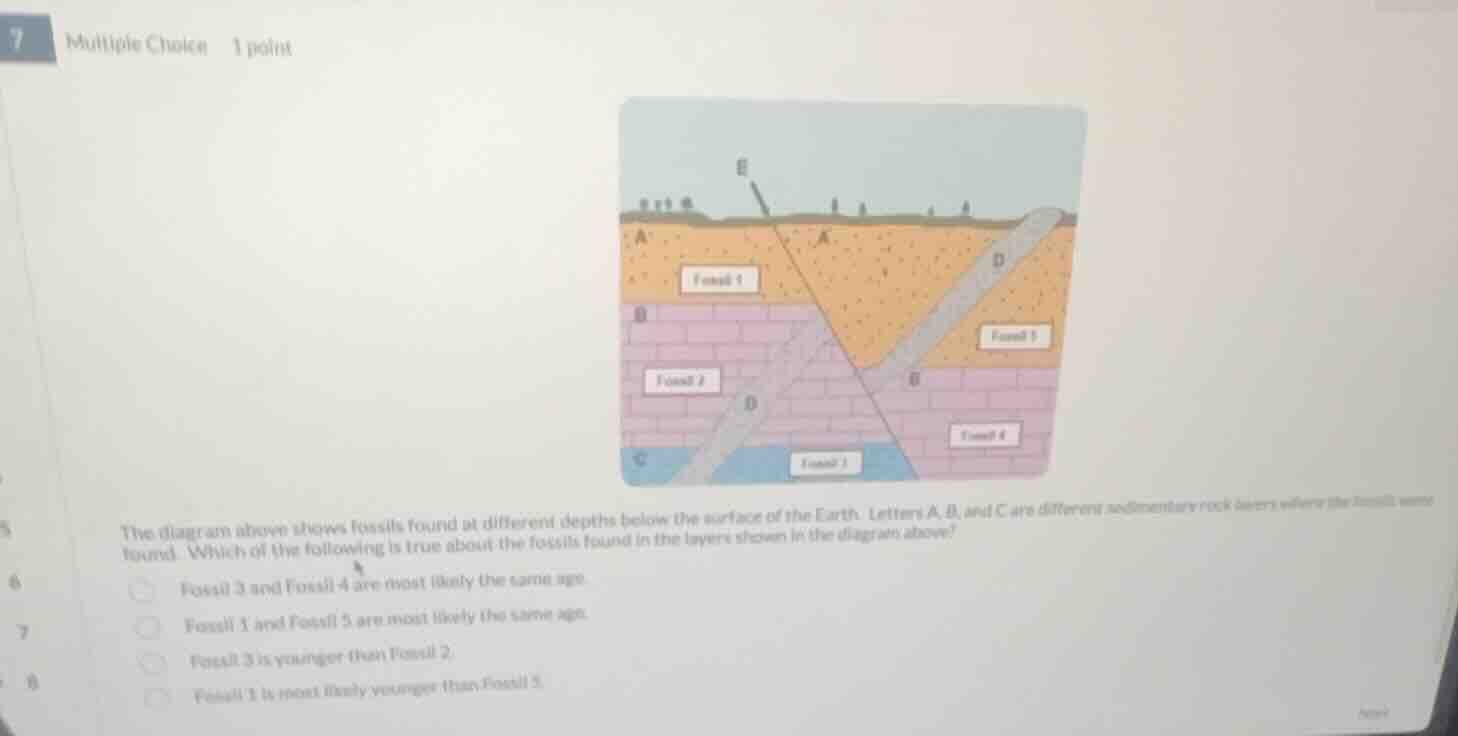
7 multiple choice 1 point the diagram above shows fossils found at different depths below the surface of the earth. letters a, b, and c are different sedimentary rock layers where the fossils were found. which of the following is true about the fossils found in the layers shown in the diagram above? fossil 3 and fossil 4 are most likely the same age. fossil 1 and fossil 5 are most likely the same age. fossil 3 is younger than fossil 2. fossil 1 is most likely younger than fossil 5.
To solve this, we use the principle of superposition (in geology: older rock layers are generally deeper, younger are shallower) and cross - cutting relationships (a fault or intrusion that cuts through layers is younger than the layers it cuts).
Step 1: Analyze each option
- Option 1: Fossil 3 and Fossil 4 are most likely the same age
Fossil 3 is in layer C and Fossil 4 is in layer B. Layer C is deeper (older) than layer B. So they are not the same age.
- Option 2: Fossil 1 and Fossil 5 are most likely the same age
Fossil 1 is in layer A' and Fossil 5 is in layer A. Layer A' and layer A are part of the same general sedimentary sequence (the horizontal layers), and they are at a similar stratigraphic level (before the faulting). So they are likely the same age.
- Option 3: Fossil 3 is younger than Fossil 2
Fossil 3 is in layer C (deeper, older) and Fossil 2 is in layer B (shallower, younger than C but older than A). So Fossil 3 is older than Fossil 2, not younger.
- Option 4: Fossil 1 is most likely younger than Fossil 5
Fossil 1 is in layer A' and Fossil 5 is in layer A. These are similar - aged layers (before faulting), and there's no indication Fossil 1 is younger. Also, layer A' and A are part of the upper, younger sedimentary layers compared to lower layers, but relative to each other, they are likely same - aged or very close. And based on the fault (E) which cuts through, the layers A' and A were deposited before the fault, so Fossil 1 (A') and Fossil 5 (A) are same - aged, and Fossil 1 is not younger than Fossil 5.

Snap & solve any problem in the app
Get step-by-step solutions on Sovi AI
Photo-based solutions with guided steps
Explore more problems and detailed explanations
B. Fossil 1 and Fossil 5 are most likely the same age (assuming the option labels were mis - numbered in the original and this is the correct one based on analysis)