QUESTION IMAGE
Question
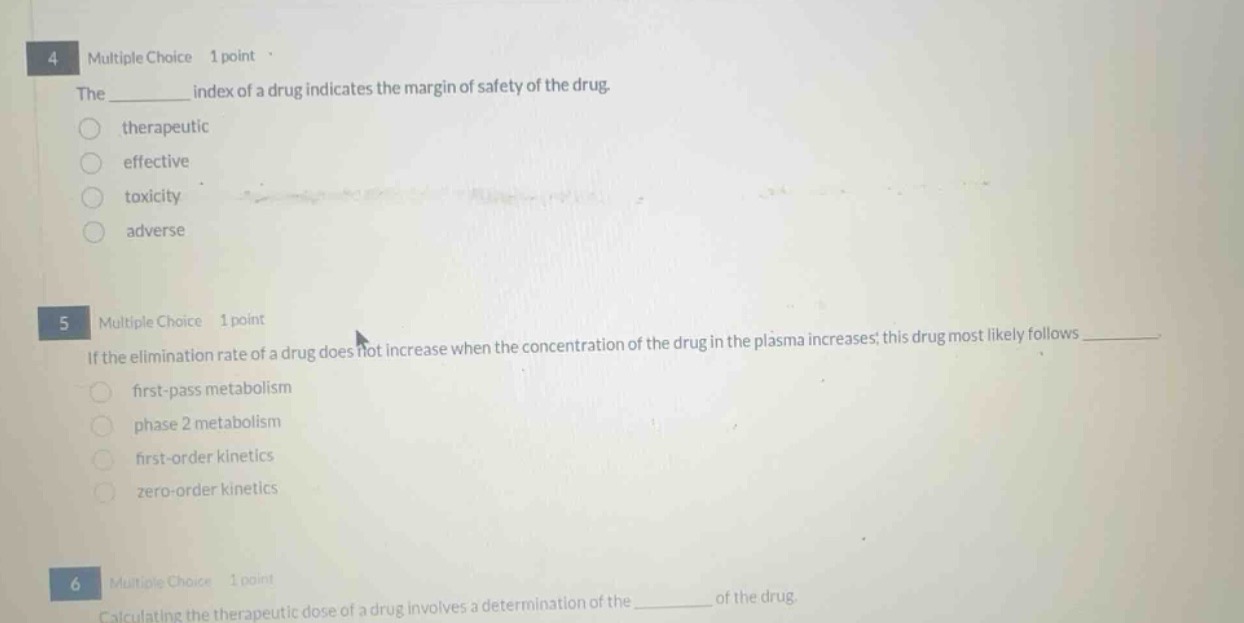
4 multiple choice 1 point the ____ index of a drug indicates the margin of safety of the drug. therapeutic effective toxicity adverse 5 multiple choice 1 point if the elimination rate of a drug does not increase when the concentration of the drug in the plasma increases, this drug most likely follows __. first - pass metabolism phase 2 metabolism first - order kinetics zero - order kinetics 6 multiple choice 1 point calculating the therapeutic dose of a drug involves a determination of the ____ of the drug.
Question 4
The therapeutic index (TI) of a drug is defined as the ratio of the dose that produces a toxic effect to the dose that produces a therapeutic effect, and it is used to indicate the margin of safety of a drug. The "effective" index is not a standard term for drug safety margin. "Toxicity" refers to the degree to which a drug is toxic, not a measure of safety margin. "Adverse" is related to adverse effects, not a specific index for safety margin.
In first - order kinetics, the elimination rate of a drug is proportional to the drug concentration in the plasma. So, if the elimination rate does not increase with an increase in plasma drug concentration, it is not first - order. First - pass metabolism is about the metabolism of a drug before it reaches systemic circulation, not about elimination rate - concentration relationship. Phase 2 metabolism is a type of drug metabolism, not related to elimination rate kinetics. In zero - order kinetics, the elimination rate is constant and does not depend on the drug concentration (when the concentration is above the saturation level of the eliminating enzyme or process). So a drug with an elimination rate that does not increase with plasma concentration increase most likely follows zero - order kinetics.

Snap & solve any problem in the app
Get step-by-step solutions on Sovi AI
Photo-based solutions with guided steps
Explore more problems and detailed explanations
A. therapeutic