QUESTION IMAGE
Question
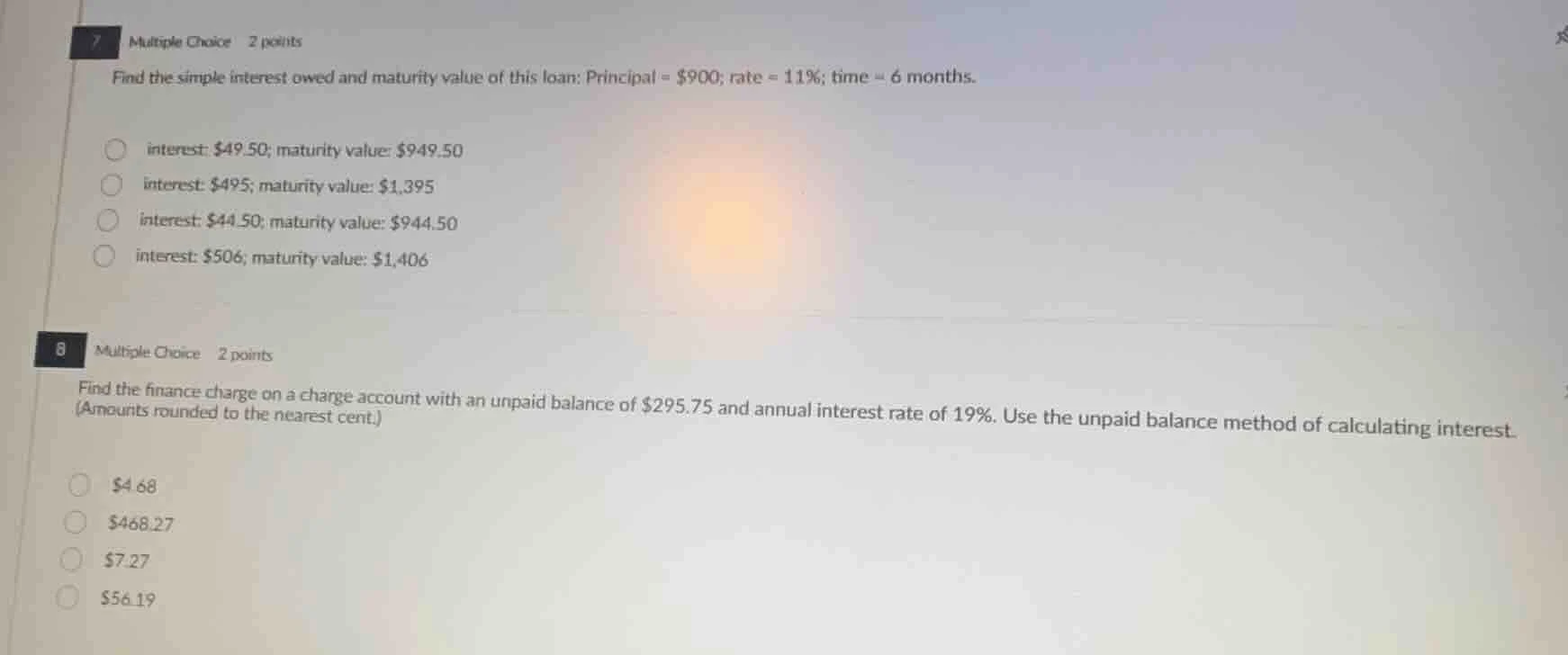
7 multiple choice 2 points find the simple interest owed and maturity value of this loan: principal = $900; rate = 11%; time = 6 months. interest: $49.50; maturity value: $949.50 interest: $495; maturity value: $1,395 interest: $44.50; maturity value: $944.50 interest: $506; maturity value: $1,406 8 multiple choice 2 points find the finance charge on a charge account with an unpaid balance of $295.75 and annual interest rate of 19%. use the unpaid balance method of calculating interest. (amounts rounded to the nearest cent.) $4.68 $468.27 $7.27 $56.19
Question 7
Step1: Recall simple interest formula
The formula for simple interest is \( I = P \times r \times t \), where \( P \) is principal, \( r \) is annual rate (in decimal), and \( t \) is time in years.
Step2: Convert time to years
Time is 6 months, so \( t=\frac{6}{12}=0.5 \) years.
Step3: Convert rate to decimal
Rate \( r = 11\% = 0.11 \).
Step4: Calculate interest
Substitute \( P = 900 \), \( r = 0.11 \), \( t = 0.5 \) into the formula:
\( I = 900 \times 0.11 \times 0.5 = 900 \times 0.055 = 49.5 \) dollars.
Step5: Calculate maturity value
Maturity value \( = P + I = 900 + 49.5 = 949.5 \) dollars.
Step1: Recall unpaid balance interest formula
The finance charge (interest) using the unpaid balance method is \( I = B \times r \times t \), where \( B \) is unpaid balance, \( r \) is annual rate (decimal), and \( t \) is time (in years, here \( t = \frac{1}{12} \) for monthly, but since it's annual rate and we assume the period is 1 month? Wait, no—actually, for the unpaid balance method, if it's annual rate, and we are calculating the finance charge for one month (since charge accounts typically bill monthly), \( t=\frac{1}{12} \). Wait, but actually, the problem says "annual interest rate" and "finance charge"—usually, for a charge account, the finance charge is calculated monthly, so \( t = \frac{1}{12} \) year.
Step2: Convert rate to decimal
Rate \( r = 19\% = 0.19 \).
Step3: Substitute values
Unpaid balance \( B = 295.75 \), \( r = 0.19 \), \( t=\frac{1}{12} \).
\( I = 295.75 \times 0.19 \times \frac{1}{12} \).
First, calculate \( 295.75 \times 0.19 = 56.1925 \).
Then, \( 56.1925 \div 12 \approx 4.6827 \), rounded to nearest cent is $4.68? Wait, no—wait, maybe I made a mistake. Wait, no—wait, maybe the time is 1 year? No, that can't be. Wait, no, the unpaid balance method: the finance charge is calculated on the unpaid balance for the period (usually monthly), so \( t = \frac{1}{12} \). Wait, but let's recalculate:
\( 295.75 \times 0.19 = 56.1925 \) (annual interest if it were for 1 year). But since it's a monthly finance charge, divide by 12: \( 56.1925 \div 12 \approx 4.68 \). Wait, but wait, maybe the problem is assuming the period is 1 year? No, that would be too high. Wait, no—wait, the options include $4.68, $468.27, etc. Wait, $295.75 * 0.19 = 56.1925, which is about $56.19 if t=1, but that's not matching. Wait, no—wait, maybe I misread the problem. Wait, the problem says "finance charge on a charge account"—maybe the time is 1 month, so \( t = \frac{1}{12} \). Wait, but let's check the options. Let's recalculate:
\( I = 295.75 \times 0.19 \times \frac{1}{12} \).
\( 295.75 \times 0.19 = 56.1925 \).
\( 56.1925 \div 12 \approx 4.68 \) (rounded to nearest cent). Wait, but option A is $4.68, option C is $7.27, D is $56.19. Wait, maybe the time is 2 months? No, the problem says "finance charge"—usually, for a charge account, if you have an unpaid balance, the finance charge is calculated monthly. Wait, maybe I made a mistake in the formula. Wait, actually, the unpaid balance method: the finance charge is \( B \times r \times (number of months / 12) \). If it's one month, then \( t = 1/12 \). So:
\( 295.75 0.19 (1/12) ≈ 295.75 * 0.015833 ≈ 4.68 \). So that's $4.68.

Snap & solve any problem in the app
Get step-by-step solutions on Sovi AI
Photo-based solutions with guided steps
Explore more problems and detailed explanations
interest: $49.50; maturity value: $949.50