QUESTION IMAGE
Question
multiple choice (2 pts. each)
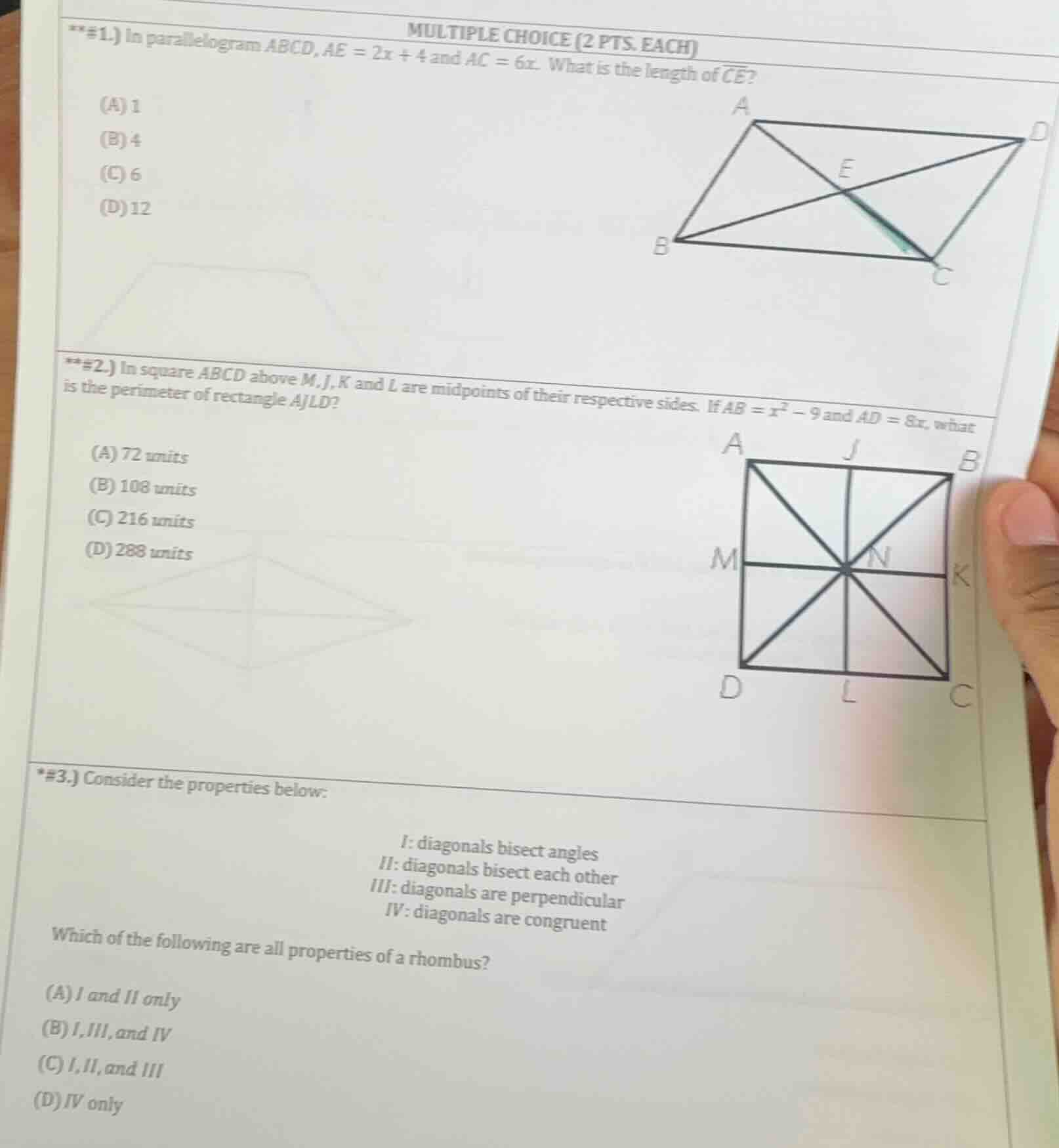
**#1.) in parallelogram abcd, ae = 2x + 4 and ac = 6x. what is the length of \\(\overline{ce}\\)?
(a) 1
(b) 4
(c) 6
(d) 12
**#2.) in square abcd above m, j, k and l are midpoints of their respective sides. if ab = \\(x^2 - 9\\) and ad = 8x, what is the perimeter of rectangle ajld?
(a) 72 units
(b) 108 units
(c) 216 units
(d) 288 units
*#3.) consider the properties below:
i: diagonals bisect angles
ii: diagonals bisect each other
iii: diagonals are perpendicular
iv: diagonals are congruent
which of the following are all properties of a rhombus?
(a) i and ii only
(b) i, iii, and iv
(c) i, ii, and iii
(d) iv only
Question 1
Step1: Recall parallelogram diagonal property
In a parallelogram, diagonals bisect each other. So \( AE = CE \) and \( AC = AE + CE = 2AE \).
Given \( AE = 2x + 4 \) and \( AC = 6x \), we have \( 6x = 2(2x + 4) \).
Step2: Solve for \( x \)
Expand the right side: \( 6x = 4x + 8 \).
Subtract \( 4x \) from both sides: \( 6x - 4x = 8 \) → \( 2x = 8 \) → \( x = 4 \).
Step3: Find \( AE \) then \( CE \)
Substitute \( x = 4 \) into \( AE \): \( AE = 2(4) + 4 = 12 \).
Since \( AE = CE \), \( CE = 12 \)? Wait, no, wait. Wait, \( AC = 6x = 24 \), and \( AE = 12 \), so \( CE = AC - AE = 24 - 12 = 12 \)? Wait, no, the options have 12 as D. Wait, let's check again. Wait, \( AC = 6x \), \( AE = 2x + 4 \), and \( AE = \frac{AC}{2} \) (since diagonals bisect). So \( 2x + 4 = \frac{6x}{2} = 3x \). Then \( 3x - 2x = 4 \) → \( x = 4 \). Then \( AE = 2(4) + 4 = 12 \), so \( CE = AE = 12 \). So answer is D.
Step1: Recall square side property
In a square, all sides are equal, so \( AB = AD \). Thus, \( x^2 - 9 = 8x \).
Step2: Solve quadratic equation
Rearrange: \( x^2 - 8x - 9 = 0 \).
Factor: \( (x - 9)(x + 1) = 0 \). So \( x = 9 \) (since side length can't be negative, \( x = -1 \) is invalid).
Step3: Find side lengths
\( AB = 9^2 - 9 = 81 - 9 = 72 \), \( AD = 8(9) = 72 \) (consistent with square).
Step4: Analyze rectangle \( AJLD \)
\( J \) is midpoint of \( AB \), so \( AJ = \frac{AB}{2} = \frac{72}{2} = 36 \).
\( AD = 72 \) (length of rectangle).
Step5: Calculate perimeter of rectangle
Perimeter of rectangle \( = 2(AJ + AD) = 2(36 + 72) = 2(108) = 216 \).
Step1: Recall rhombus diagonal properties
- I: Diagonals of a rhombus bisect the angles (true, since rhombus sides are equal, diagonals are angle bisectors).
- II: Diagonals of a parallelogram (rhombus is a parallelogram) bisect each other (true).
- III: Diagonals of a rhombus are perpendicular (true).
- IV: Diagonals of a rhombus are not necessarily congruent (that's a rectangle property). So rhombus has I, II, III.

Snap & solve any problem in the app
Get step-by-step solutions on Sovi AI
Photo-based solutions with guided steps
Explore more problems and detailed explanations
D. 12