QUESTION IMAGE
Question
multiple choice question
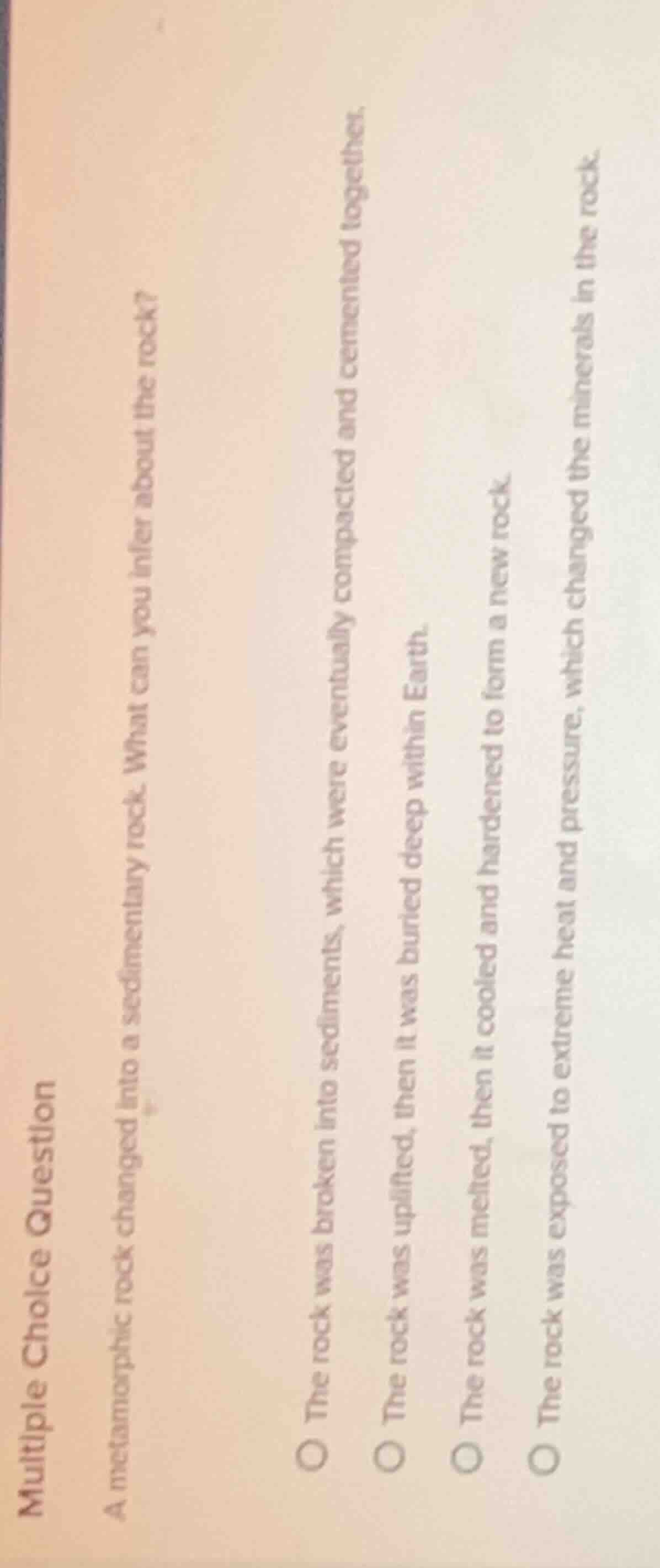
a metamorphic rock changed into a sedimentary rock. what can you infer about the rock?
- the rock was broken into sediments, which were eventually compacted and cemented together.
- the rock was uplifted, then it was buried deep within earth.
- the rock was melted, then it cooled and hardened to form a new rock.
- the rock was exposed to extreme heat and pressure, which changed the minerals in the rock.
To solve this, we analyze each option based on rock cycle processes:
- Option 1: Describes sedimentary rock formation (compaction/cementation of sediments), but the question is about a metamorphic rock changing to sedimentary, so this is the reverse of what's asked. Eliminate.
- Option 2: Uplifting and burial don't directly relate to metamorphic to sedimentary change. Eliminate.
- Option 3: Melting and cooling form igneous rocks, not sedimentary. Eliminate.
- Option 4: Metamorphic rocks form under extreme heat/pressure (changing minerals). If a metamorphic rock becomes sedimentary, it must first be exposed (through processes like uplift/erosion) to be broken into sediments, which then compact/cement. Wait, no—wait, the question is a metamorphic rock changed into sedimentary. Wait, no, let's re - read. Wait, the question is "A metamorphic rock changed into a sedimentary rock. What can you infer about the rock?" Wait, no, maybe I misread. Wait, no—wait, metamorphic to sedimentary: first, the metamorphic rock must be weathered/eroded (broken into sediments), then those sediments compact/cement. But the options: Wait, option 4 says "The rock was exposed to extreme heat and pressure, which changed the minerals in the rock." Wait, no—metamorphic rocks form from extreme heat/pressure. Wait, maybe the question is a rock (originally, maybe) changed into sedimentary, but it was a metamorphic rock before. Wait, no, let's re - evaluate:
Wait, the key is: Sedimentary rock forms from sediments (broken - down rocks) compacted/cemented. Metamorphic rock forms from existing rocks (sedimentary, igneous, or other metamorphic) under heat/pressure. If a metamorphic rock is changed into sedimentary, it must first be broken into sediments (weathering/erosion), then compacted/cemented. But the options: Wait, option 4: "The rock was exposed to extreme heat and pressure, which changed the minerals in the rock." That's how metamorphic rocks form. Wait, maybe the question is a rock (that was metamorphic) changed into sedimentary. So before it became sedimentary, it was metamorphic, meaning it had been exposed to heat/pressure (to be metamorphic in the first place). Wait, maybe I messed up. Let's re - check each option:
Wait, the correct process for a metamorphic rock to become sedimentary: The metamorphic rock is exposed (through uplift, erosion, etc.), then weathered into sediments, then those sediments are compacted/cemented into sedimentary rock. But the options:
Wait, option 4: "The rock was exposed to extreme heat and pressure, which changed the minerals in the rock." That's the process of a rock becoming metamorphic (metamorphism). So if a rock is now sedimentary but was metamorphic, we can infer that at some point (before becoming sedimentary), it was exposed to heat/pressure (to be metamorphic). The other options don't fit:
- Option 1: Describes sedimentary formation, but the rock was metamorphic first, so it had to go through metamorphism (heat/pressure) before being broken into sediments.
- Option 2: Uplifting and burial don't explain the metamorphic origin.
- Option 3: Igneous formation process.
So the only option that relates to the rock having been a metamorphic rock (formed under heat/pressure) is option 4. Wait, maybe I had it backwards. Let's clarify:
Metamorphic rock → (weathering/erosion) → sediments → (compaction/cementation) → sedimentary rock.
So the metamorphic rock, before being broken into sediments, was formed by heat/pressure (option 4 describes the metamorphic formation process). So we can infer that the rock (before becoming s…

Snap & solve any problem in the app
Get step-by-step solutions on Sovi AI
Photo-based solutions with guided steps
Explore more problems and detailed explanations
D. The rock was exposed to extreme heat and pressure, which changed the minerals in the rock. (Assuming option 4 is labeled D; since the original options are in circles, we'll present it as the fourth option: "The rock was exposed to extreme heat and pressure, which changed the minerals in the rock.")