QUESTION IMAGE
Question
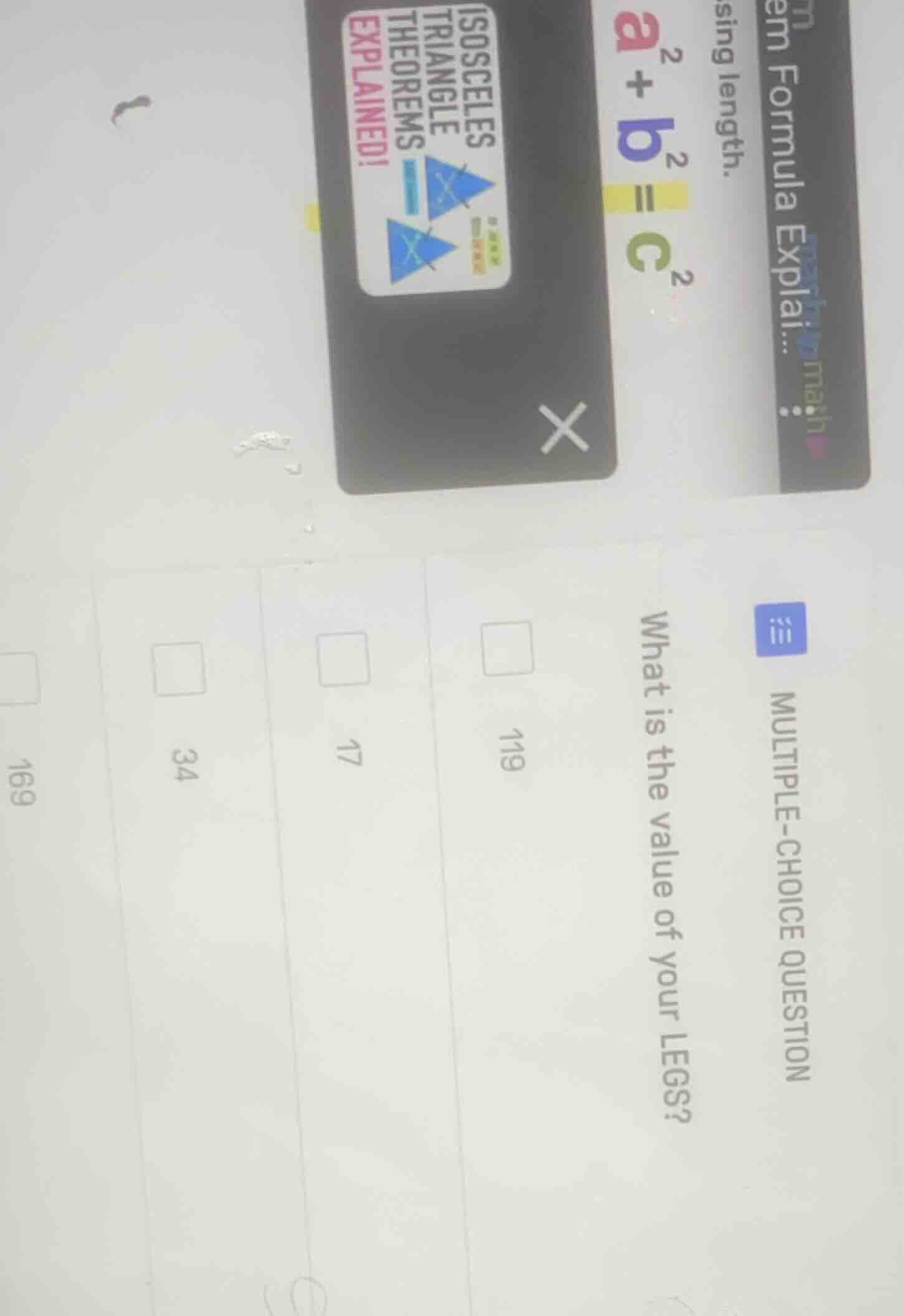
multiple-choice question what is the value of your legs? 119 17 34 169
isosceles triangle theorems explained!
a² + b² = c²
sing length.
em formula explai...math
The formula \(a^2 + b^2 = c^2\) is the Pythagorean theorem, typically used for right - angled triangles. If we assume that the triangle is an isosceles right - angled triangle (since there is a reference to isosceles triangle theorems), then \(a = b\). Let's assume \(c^2=169\) (from the option 169, which is likely the hypotenuse squared). Then \(a^2 + a^2=c^2\), so \(2a^2 = 169\) is not an integer solution. Wait, maybe we made a wrong assumption. Let's check the options. If we consider a right - angled triangle where maybe the legs are such that \(a^2 + b^2\) gives one of the options. Wait, maybe the question is about the square of a leg or hypotenuse. Wait, the options are 119, 17, 34, 169. Let's check the Pythagorean triples. We know that \(13^2 = 169\), and if we consider a right - angled triangle with legs, maybe we made a mistake. Wait, maybe the question is asking for the length of a leg or hypotenuse. Wait, if we consider that maybe the triangle is a right - angled triangle and we are to find the square of a leg or hypotenuse. Wait, let's check the numbers. If we assume that the hypotenuse \(c\) has \(c^2 = 169\) (so \(c = 13\)), and if it's an isosceles right - angled triangle, then \(a^2+a^2 = 169\), \(2a^2=169\), \(a^2=\frac{169}{2}=84.5\) which is not an option. Wait, maybe it's a right - angled triangle with legs such that \(a = 8\) and \(b = 15\), then \(c^2=64 + 225 = 289\), not an option. Wait, maybe the question is about the sum of squares or something else. Wait, the option 169 is \(13^2\), which is a perfect square. Maybe the question is asking for the square of the hypotenuse or a leg. If we consider a right - angled triangle with legs 8 and 15, no. Wait, maybe the triangle has legs such that \(a^2 + b^2\) is one of the options. Wait, 17 squared is 289, 34 squared is 1156, 119 is not a perfect square, 169 is 13 squared. Wait, maybe the question is about the value of \(a^2 + b^2\) or \(c^2\). If we assume that the triangle is a right - angled triangle and we are to find the square of the hypotenuse, and the legs are such that \(a^2 + b^2=169\), so the answer is 169.
Step 1: Identify the formula
The formula \(a^2 + b^2=c^2\) is the Pythagorean theorem for right - angled triangles.
Step 2: Analyze the options
We check the perfect squares among the options. \(13^2 = 169\), and since the Pythagorean theorem involves squares of side lengths (either legs or hypotenuse), 169 is a perfect square which is consistent with the Pythagorean theorem (as \(c^2\) for a right - angled triangle with integer side lengths could be 169, for example, if the hypotenuse is 13). The other options: 119 is not a perfect square, 17 squared is 289, 34 squared is 1156. So the most probable answer related to the Pythagorean theorem (considering the isosceles triangle reference might be a red herring or maybe a right - angled isosceles triangle with non - integer sides, but the perfect square option is 169) is 169.

Snap & solve any problem in the app
Get step-by-step solutions on Sovi AI
Photo-based solutions with guided steps
Explore more problems and detailed explanations
169