QUESTION IMAGE
Question
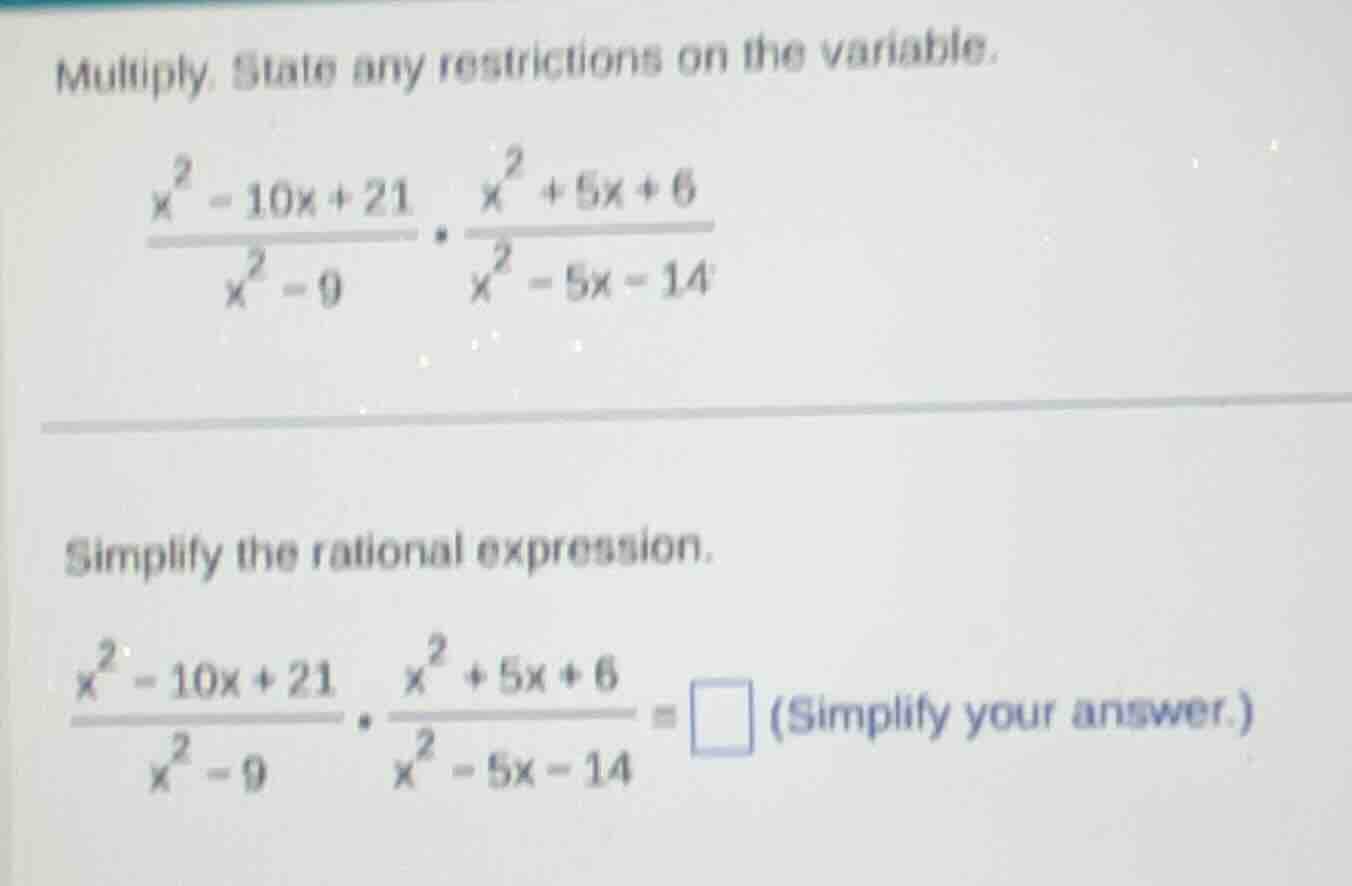
multiply. state any restrictions on the variable.\\(\frac{x^{2}-10x + 21}{x^{2}-9}cdot\frac{x^{2}+5x + 6}{x^{2}-5x - 14}\\)\
simplify the rational expression.\\(\frac{x^{2}-10x + 21}{x^{2}-9}cdot\frac{x^{2}+5x + 6}{x^{2}-5x - 14}=square\\) (simplify your answer.)
Step1: Factor each quadratic
Factor \(x^2 - 10x + 21\): Find two numbers that multiply to 21 and add to -10. They are -7 and -3. So \(x^2 - 10x + 21=(x - 7)(x - 3)\).
Factor \(x^2 + 5x + 6\): Find two numbers that multiply to 6 and add to 5. They are 2 and 3. So \(x^2 + 5x + 6=(x + 2)(x + 3)\).
Factor \(x^2 - 9\): This is a difference of squares, \(x^2 - 9=(x - 3)(x + 3)\).
Factor \(x^2 - 5x - 14\): Find two numbers that multiply to -14 and add to -5. They are -7 and 2. So \(x^2 - 5x - 14=(x - 7)(x + 2)\).
Substitute the factored forms into the expression:
\(\frac{(x - 7)(x - 3)}{(x - 3)(x + 3)} \cdot \frac{(x + 2)(x + 3)}{(x - 7)(x + 2)}\)
Step2: Cancel common factors
Cancel \((x - 7)\) from numerator and denominator, \((x - 3)\) from numerator and denominator, \((x + 2)\) from numerator and denominator, and \((x + 3)\) from numerator and denominator.
After canceling, we are left with \(1\)? Wait, no, wait. Wait, let's check again. Wait, no, let's do the cancellation step by step.
First fraction numerator: \((x - 7)(x - 3)\), denominator: \((x - 3)(x + 3)\)
Second fraction numerator: \((x + 2)(x + 3)\), denominator: \((x - 7)(x + 2)\)
So cancel \((x - 7)\) (first numerator and second denominator), \((x - 3)\) (first numerator and first denominator), \((x + 2)\) (second numerator and second denominator), \((x + 3)\) (first denominator and second numerator). Wait, that leaves 1? Wait, no, let's multiply the numerators and denominators before canceling.
Numerators: \((x - 7)(x - 3)(x + 2)(x + 3)\)
Denominators: \((x - 3)(x + 3)(x - 7)(x + 2)\)
Now, cancel \((x - 7)\), \((x - 3)\), \((x + 2)\), \((x + 3)\) from numerator and denominator. So all factors cancel, leaving \(\frac{1}{1}\)? Wait, no, that can't be. Wait, maybe I factored wrong. Wait, let's re - factor \(x^2 - 5x - 14\). Wait, \(x^2 - 5x - 14\): looking for two numbers that multiply to -14 and add to -5. Let's see, -7 and 2: \(-7\times2=-14\) and \(-7 + 2=-5\). So that's correct, \((x - 7)(x + 2)\).
Wait, \(x^2 - 10x + 21=(x - 7)(x - 3)\) (correct, \(-7\times - 3 = 21\), \(-7-3=-10\)). \(x^2 + 5x + 6=(x + 2)(x + 3)\) (correct, \(2\times3 = 6\), \(2 + 3 = 5\)). \(x^2 - 9=(x - 3)(x + 3)\) (correct, difference of squares).
So numerator: \((x - 7)(x - 3)(x + 2)(x + 3)\)
Denominator: \((x - 3)(x + 3)(x - 7)(x + 2)\)
So when we divide numerator and denominator, all factors cancel, so the result is 1? Wait, that seems odd, but let's check with a value. Let's pick \(x = 0\) (not a restricted value, since restricted values are \(x
eq3,-3,7,-2\)).
Original expression: \(\frac{0 - 0 + 21}{0 - 9}\cdot\frac{0 + 0 + 6}{0 - 0 - 14}=\frac{21}{-9}\cdot\frac{6}{-14}=\frac{21\times6}{(-9)\times(-14)}=\frac{126}{126}=1\). So yes, it simplifies to 1. But wait, maybe I made a mistake in factoring? Wait, no, the factoring is correct. So the simplified form is 1, with restrictions \(x
eq3,-3,7,-2\) (since those values make the original denominators zero). But the question here is just to simplify the rational expression.
Wait, let's go through the steps again:
- Factor each quadratic:
\(x^2 - 10x + 21=(x - 7)(x - 3)\)
\(x^2 + 5x + 6=(x + 2)(x + 3)\)
\(x^2 - 9=(x - 3)(x + 3)\)
\(x^2 - 5x - 14=(x - 7)(x + 2)\)
- Substitute into the expression:
\(\frac{(x - 7)(x - 3)}{(x - 3)(x + 3)}\cdot\frac{(x + 2)(x + 3)}{(x - 7)(x + 2)}\)
- Cancel common factors:
- Cancel \((x - 7)\) from numerator and denominator.
- Cancel \((x - 3)\) from numerator and denominator.
- Cancel \((x + 2)\) from numerator and denominator.
- Cancel \((x + 3)\) from numerator and denominator.
After canceling,…

Snap & solve any problem in the app
Get step-by-step solutions on Sovi AI
Photo-based solutions with guided steps
Explore more problems and detailed explanations
\(1\) (with restrictions \(x
eq - 3,3,-2,7\))