QUESTION IMAGE
Question
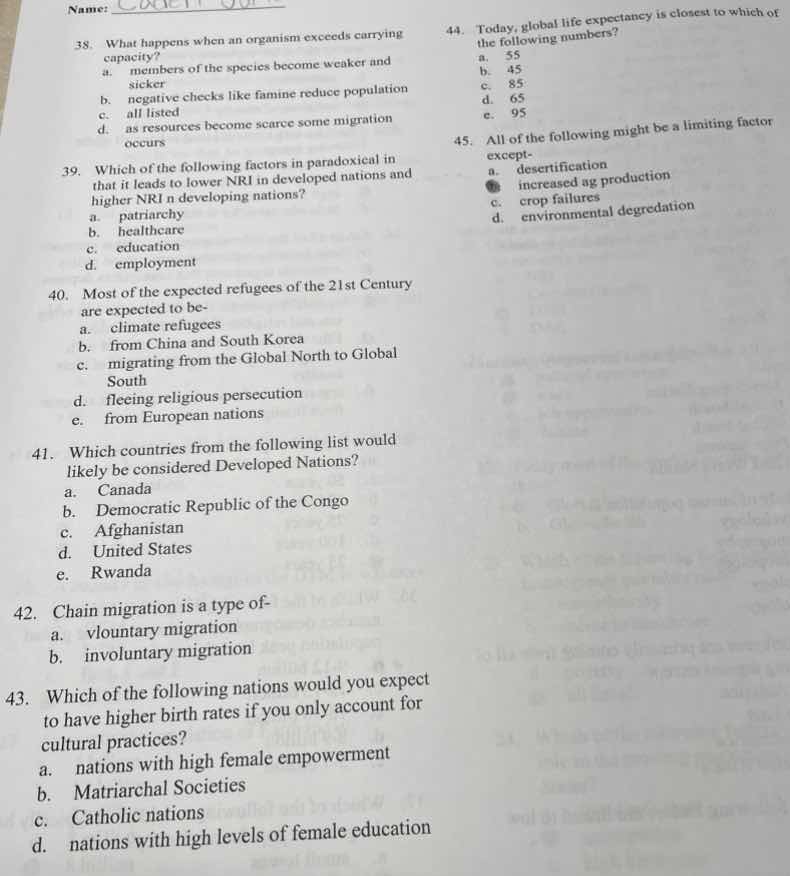
name:38. what happens when an organism exceeds carrying capacity?a. members of the species become weaker and sickerb. negative checks like famine reduce populationc. all listedd. as resources become scarce some migration occurs39. which of the following factors in paradoxical in that it leads to lower nri in developed nations and higher nri n developing nations?a. patriarchyb. healthcarec. educationd. employment40. most of the expected refugees of the 21st century are expected to be-a. climate refugeesb. from china and south koreac. migrating from the global north to global southd. fleeing religious persecutione. from european nations41. which countries from the following list would likely be considered developed nations?a. canadab. democratic republic of the congoc. afghanistand. united statese. rwanda42. chain migration is a type of-a. voluntary migrationb. involuntary migration43. which of the following nations would you expect to have higher birth rates if you only account for cultural practices?a. nations with high female empowermentb. matriarchal societiesc. catholic nationsd. nations with high levels of female education44. today, global life expectancy is closest to which of the following numbers?a. 55b. 45c. 85d. 65e. 9545. all of the following might be a limiting factor except-a. desertificationb. increased ag productionc. crop failuresd. environmental degradation
- When an organism exceeds carrying capacity, negative feedback mechanisms like famine, disease, or resource scarcity act to reduce the population, and migration can also occur as resources run out.
- In developed nations, higher education leads to delayed childbearing and lower fertility (lower NRI), while in developing nations, education can improve access to healthcare and economic stability that supports slightly higher fertility (higher NRI), creating a paradoxical effect.
- Climate change-driven events like extreme weather, droughts, and sea-level rise are projected to displace more people in the 21st century than other causes.
- Developed nations have high-income economies, advanced infrastructure, and high human development indices; Canada and the United States fit this classification.
- Chain migration is when migrants follow others from their home community to a new location, which is a voluntary choice based on existing social networks.
- Catholic doctrine traditionally encourages larger families, which correlates with higher birth rates compared to groups with lower fertility norms.
- Global average life expectancy is currently around 70 years, with the closest option being 65, accounting for regional disparities.
- Limiting factors reduce population growth; increased ag production increases food availability, which supports population growth rather than limiting it.

Snap & solve any problem in the app
Get step-by-step solutions on Sovi AI
Photo-based solutions with guided steps
Explore more problems and detailed explanations
- c. negative checks like famine reduce population
- c. education
- a. climate refugees
- a. Canada, d. United States
- a. voluntary migration
- c. Catholic nations
- d. 65
- b. increased ag production