QUESTION IMAGE
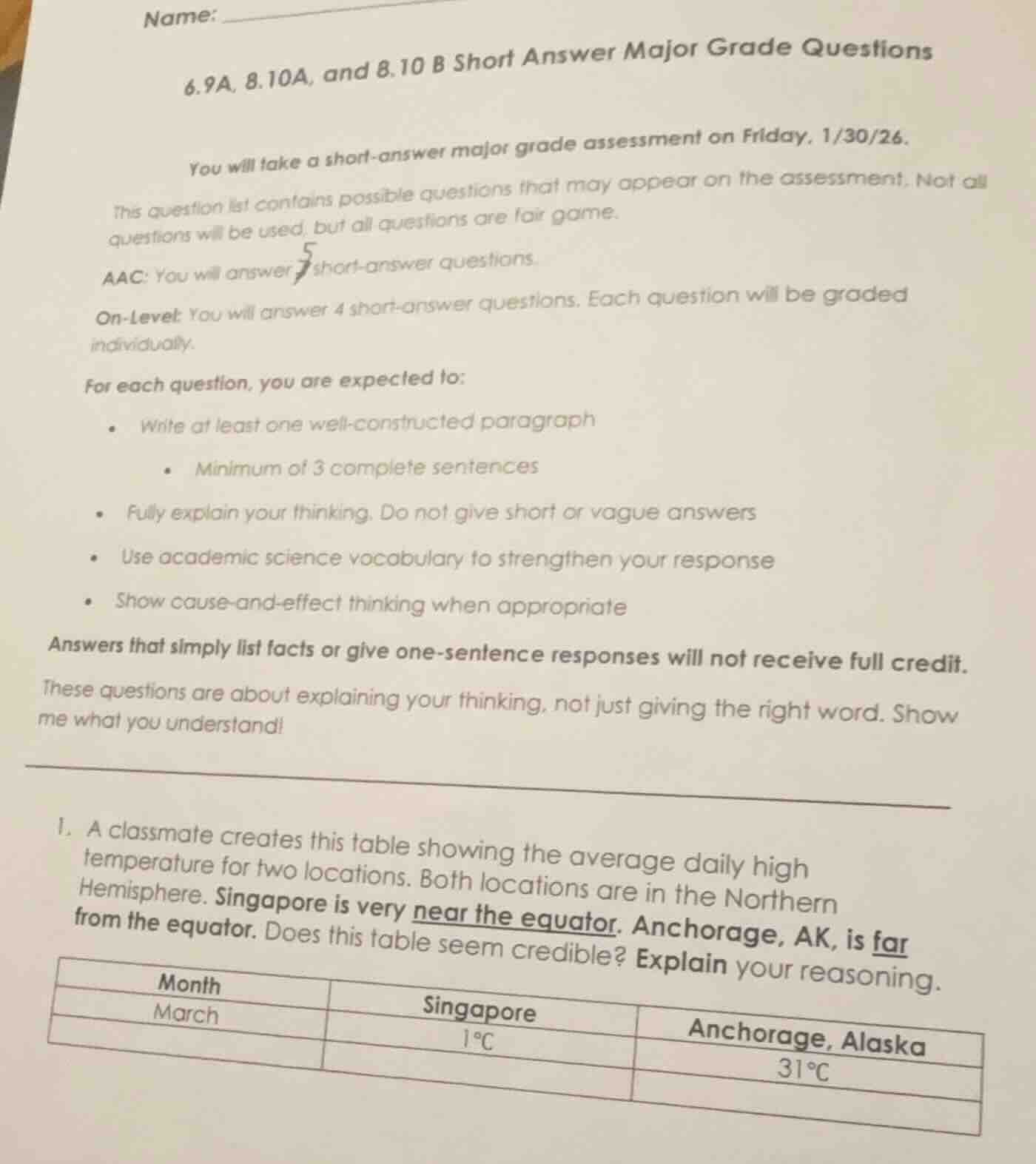
Question
name:
6.9a, 8.10a, and 8.10 b short answer major grade questions
you will take a short-answer major grade assessment on friday, 1/30/26.
this question list contains possible questions that may appear on the assessment. not all questions will be used, but all questions are fair game.
aac: you will answer 5 short-answer questions.
on-level: you will answer 4 short-answer questions. each question will be graded individually.
for each question, you are expected to:
- write at least one well-constructed paragraph
- minimum of 3 complete sentences
- fully explain your thinking. do not give short or vague answers
- use academic science vocabulary to strengthen your response
- show cause-and-effect thinking when appropriate
answers that simply list facts or give one-sentence responses will not receive full credit.
these questions are about explaining your thinking, not just giving the right word. show me what you understand!
- a classmate creates this table showing the average daily high temperature for two locations. both locations are in the northern hemisphere. singapore is very near the equator. anchorage, ak, is far from the equator. does this table seem credible? explain your reasoning.
| month | singapore | anchorage, alaska |
|---|
To determine if the table is credible, we analyze the climate patterns based on latitude. Locations near the equator (like Singapore) have relatively consistent, warm temperatures year - round because the sun's rays hit the equatorial region more directly and evenly. In March, a temperature of \(1^\circ C\) for Singapore is extremely unusual and goes against our understanding of equatorial climate. On the other hand, Anchorage, Alaska is far from the equator. In March, it is still in the cold season (late winter/early spring), and a temperature of \(31^\circ C\) is highly abnormal for this location and time of year, as high - latitude areas like Anchorage have much cooler temperatures during this period due to the low angle of the sun's rays and the presence of ice and snow. So, the temperature values in the table do not match the expected climate patterns based on the latitude of the two locations, making the table not credible.

Snap & solve any problem in the app
Get step-by-step solutions on Sovi AI
Photo-based solutions with guided steps
Explore more problems and detailed explanations
The table is not credible. Locations near the equator (like Singapore) have warm, consistent temperatures year - round. A \(1^\circ C\) temperature in March for Singapore is abnormal. Anchorage, Alaska is far from the equator and in March (late winter/early spring) should have cool temperatures, so \(31^\circ C\) is also abnormal. These values do not match the expected climate patterns based on latitude.