QUESTION IMAGE
Question
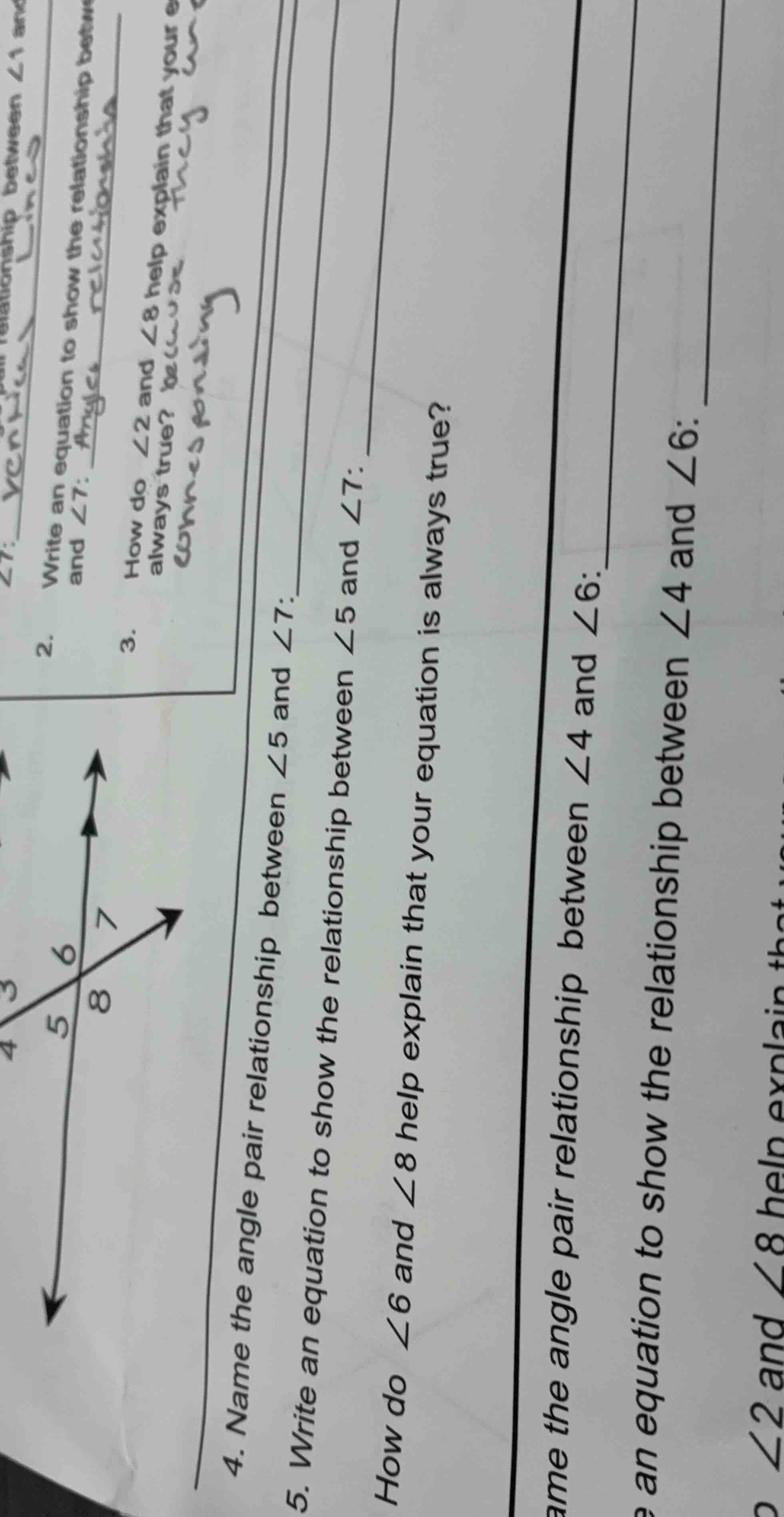
- name the angle pair relationship between $\angle 1$ and $\angle 7$:2. write an equation to show the relationship between and $\angle 7$:3. how do $\angle 2$ and $\angle 8$ help explain that your equation is always true?4. name the angle pair relationship between $\angle 5$ and $\angle 7$:5. write an equation to show the relationship between $\angle 5$ and $\angle 7$:6. how do $\angle 6$ and $\angle 8$ help explain that your equation is always true?7. name the angle pair relationship between $\angle 4$ and $\angle 6$:8. write an equation to show the relationship between $\angle 4$ and $\angle 6$:9. how do $\angle 2$ and $\angle 8$ help explain that your equation is always true?
Brief Explanations
For ∠5 and ∠7:
- They are vertical angles, formed by intersecting lines and opposite each other.
- Vertical angles are always congruent (equal in measure).
- ∠6 and ∠8 are also vertical angles, so $m\angle6 = m\angle8$. Also, ∠5 and ∠6 are supplementary, as are ∠7 and ∠8. Substituting the equal measures shows ∠5 must equal ∠7.
For ∠4 and ∠6:
- They are alternate interior angles, lying between the two parallel lines and on opposite sides of the transversal.
- Alternate interior angles for parallel lines are congruent.
- ∠2 and ∠8 are alternate exterior angles, so $m\angle2 = m\angle8$. ∠8 and ∠6 are supplementary, and ∠4 and ∠2 are supplementary. Substituting the equal measure of ∠2 and ∠8 proves ∠4 equals ∠6.

Snap & solve any problem in the app
Get step-by-step solutions on Sovi AI
Photo-based solutions with guided steps
Explore more problems and detailed explanations
- ∠5 and ∠7: Vertical Angles
- $m\angle5 = m\angle7$
- ∠6 and ∠8 are vertical angles, so $m\angle6 = m\angle8$. Since $m\angle5 + m\angle6 = 180^\circ$ and $m\angle7 + m\angle8 = 180^\circ$, substitute $m\angle8$ with $m\angle6$: $m\angle7 + m\angle6 = 180^\circ$. By transitivity, $m\angle5 = m\angle7$.
- ∠4 and ∠6: Alternate Interior Angles
- $m\angle4 = m\angle6$
- ∠2 and ∠8 are alternate exterior angles, so $m\angle2 = m\angle8$. $m\angle4 + m\angle2 = 180^\circ$ and $m\angle6 + m\angle8 = 180^\circ$. Substitute $m\angle8$ with $m\angle2$: $m\angle6 + m\angle2 = 180^\circ$. By transitivity, $m\angle4 = m\angle6$.